
PeerHood: Reclaiming Spontaneity in Mobile Social Networks
Social networking on mobile environment
This paper introduces a decentralized social networking framework designed for mobile environments, utilizing the PeerHood middleware. It enables dynamic group creation and peer-to-peer (P2P) communication without relying on centralized servers, achieving proximity-based social interaction through heterogeneous networking technologies like Bluetooth and WLAN.
TL;DR
Long before the era of ubiquitous 5G and cloud-everything, this research proposed a vision for social networking that doesn't need a central server. By using the PeerHood middleware, the authors created a system where your phone automatically finds and groups you with nearby people based on shared interests—turning physical proximity into a dynamic, private social graph.
Background: Beyond the Mobile Browser
In 2008, social networking was synonymous with MySpace and Facebook—platforms built for the desktop and accessed clumsily via mobile browsers. The authors argues that a "Mobile Environment" is unique. It isn't just about accessing centralized data on the go; it’s about proximity, mobility, and ad-hoc connections. The goal was to move away from the "Client-Server" bottleneck and toward a true Peer-to-Peer (P2P) social fabric.
The Problem: The Centralization Trap
Traditional SNSs fail in mobile contexts for two reasons:
- Connectivity Reliance: They require constant internet access to a central hub.
- Lack of Context: They ignore the immediate physical environment of the user.
If you are at a conference or a café, your most relevant "social network" might be the people in the same room, yet traditional apps require you to find them manually through a global database.
Methodology: PeerHood and Dynamic Discovery
The research utilizes the PeerHood middleware as the foundational layer. PeerHood acts as a buffer that hides the complexity of Bluetooth, WLAN, and GPRS, presenting a unified "Personal Area Network" to the application.
Core Mechanism: Interest-Based Proximity
The system doesn't just look for "any" device; it looks for compatible devices.
- Proactive Monitoring: PeerHood constantly scans the vicinity.
- Semantic Matching: When a new device is detected, the system compares "Interest Profiles."
- Dynamic Grouping: If interests align, the device is automatically added to a social group. If the device moves out of range, the monitoring function detects the signal loss and gracefully removes it from the active session.
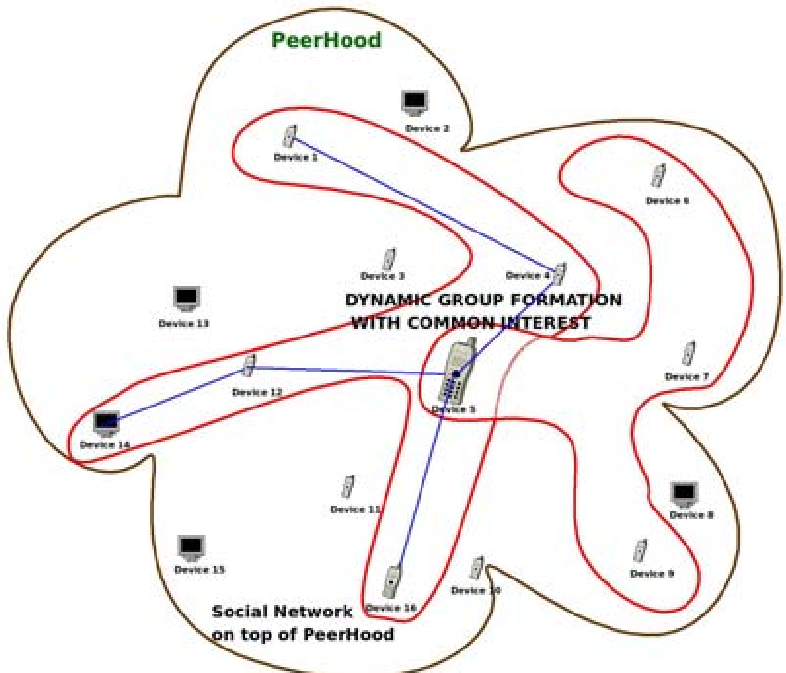 Figure 1: The conceptual model of PeerHood social networking, showing nodes forming clusters based on proximity and shared interests.
Experiments & Reference Implementation
To validate the theory, the authors built a prototype application. This wasn't just a chat tool; it included features that we now associate with modern social apps, but performed entirely over P2P:
- Dynamic Discovery: Automatic joining/leaving based on location.
- Trusted Friends: A secondary layer of security for file sharing.
- Multi-hop Socializing: Users could see "friends of friends" through intermediate nodes, effectively extending the network range without a central tower.
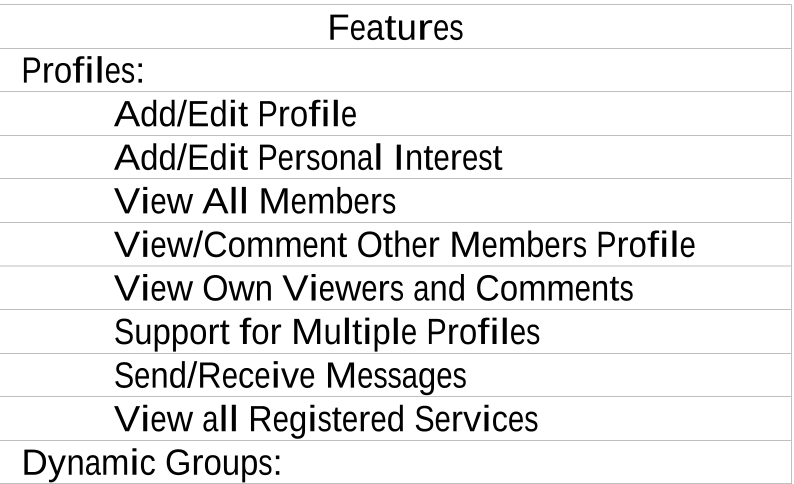 Table 1: The feature set of the reference implementation, highlighting the balance between dynamic discovery and profile management.
Critical Insight: The Value of Localized Interaction
The genius of this approach lies in its Inductive Bias toward locality. In a world where we are digitally connected to everyone, we are often disconnected from those standing three feet away. PeerHood’s middleware approach offered a way to bridge that gap technically and socially.
Limitations & Future Work
While groundbreaking for its time, the system faced challenges with power consumption (constant scanning) and trust. How do you ensure a peer is who they say they are in a world without central identity verification? These questions paved the way for modern research into Decentralized Identifiers (DIDs) and Edge Computing.
Conclusion
This paper serves as a vital reminder that "social" doesn't have to mean "centralized." By focusing on the middleware and the physical environment, the authors proved that mobile devices can be more than just windows into a database—they can be active, intelligent nodes in a living, breathing social ecosystem.