
Social Networking on Smartphones: The Gateway to Digital Addiction
Social networking on smartphones: When mobile phones become addictive
This study investigates the psychological triggers of mobile phone addiction, identifying the use of Social Networking Service (SNS) mobile applications as a primary predictor. Utilizing Partial Least Squares (PLS) path modeling, the research demonstrates how SNS network size and usage intensity drive the adoption of mobile apps, ultimately fostering addictive behaviors.
TL;DR
Is your smartphone an essential tool or a digital leash? This seminal study reveals that the primary driver of mobile phone addiction isn't the device itself, but our compulsive need to stay connected via Social Networking Service (SNS) applications. By exploring the "optimal flow" of digital interactions, the research proves that as our online networks grow and our posting intensity increases, our vulnerability to addiction skyrockets.
Problem & Motivation: Beyond the "Checking Habit"
In the early 2010s, as smartphones transitioned from luxury items to ubiquitous necessities, a new social phenomenon emerged: mobile addiction. While researchers previously viewed frequent phone use as a mere "checking habit" or an annoyance, Salehan and Negahban hypothesized a deeper psychological mechanism.
They noticed that the explosive growth of Facebook and Twitter coincided with rising levels of "technostress." The authors' central insight was that the smartphone serves as a vehicle for a very specific type of addiction: one fueled by the "optimal flow" of social gratification. This isn't just about utility; it's about the short-term satisfaction of a "like" or a "comment" overshadowing long-term mental health.
Methodology: Mapping the Path to Dependency
The researchers developed a structural model to test how our digital social lives translate into behavioral addiction. They focused on three key antecedents:
- Network Size: The sheer number of connections (friends/followers).
- SNS Intensity: How much of a user's identity and daily routine is wrapped up in social media.
- Mobile SNS App Usage: The frequency of accessing these networks specifically via mobile devices.
Theoretical Framework
Drawing on Csikszentmihalyi’s Theory of Optimal Flow, the study suggests that the mobile interface makes social interaction so seamless and enjoyable that users enter a state of "flow" where they lose track of time and consequences—the hallmark of addictive behavior.
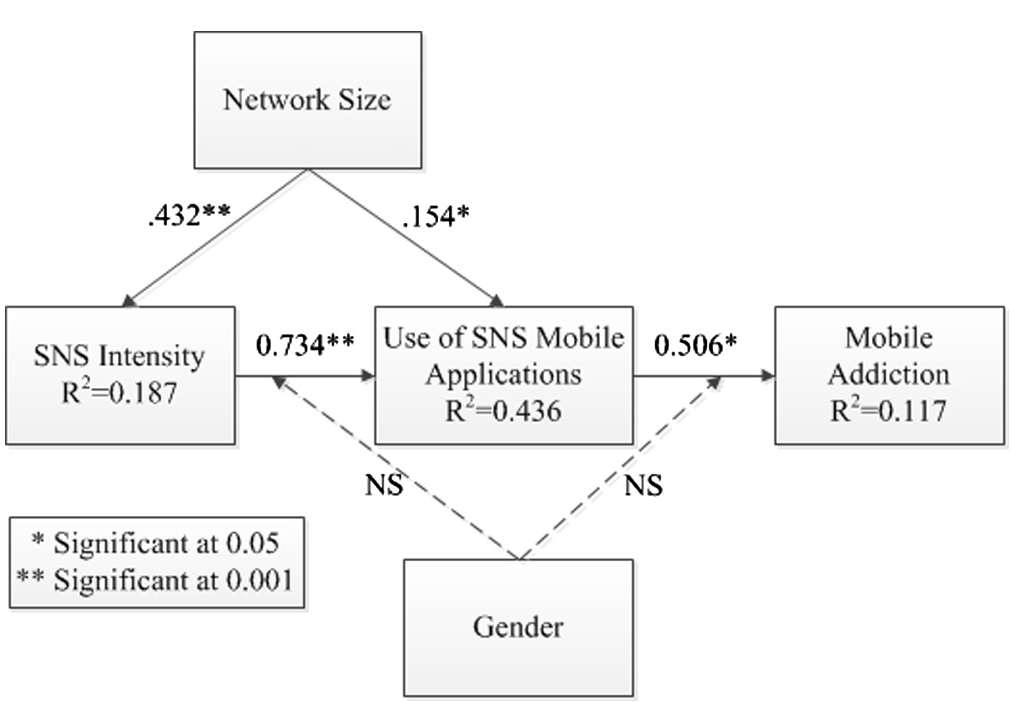 Figure 1: The research model illustrating the path from social network characteristics to mobile addiction.
Experiments & Results: The Social Multiplier Effect
The study analyzed data from smartphone users using Partial Least Squares (PLS), and the results were striking:
- The Addiction Link: Use of SNS mobile apps was a massive predictor of addiction (β = 0.50). This suggests that the more we use specifically social apps, the more we feel "lost" or "uneasy" without our phones.
- The Intensity Driver: SNS Intensity was the strongest predictor of app usage (β = 0.73). If social media is part of your "everyday activity," you are far more likely to check it compulsively on your phone.
- The Gender Paradox: Interestingly, while previous literature suggested women were more prone to mobile addiction, this study found that gender did not significantly moderate the relationship. In the modern smartphone era, the addiction risk is becoming universal.
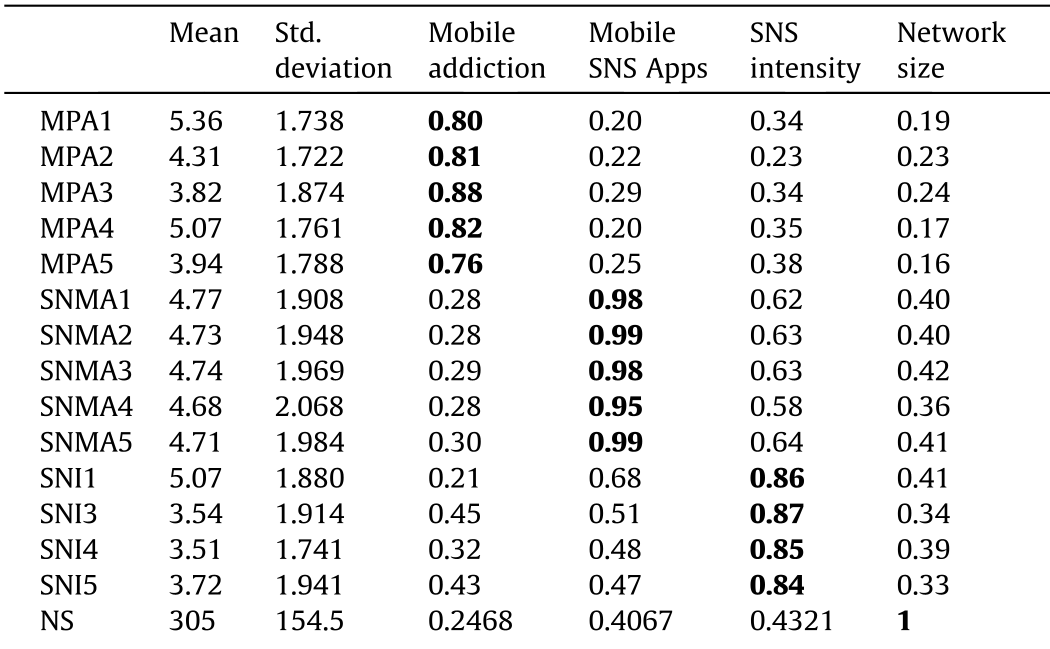 Table 1: Statistical validation showing the high reliability of the "Mobile Addiction" and "SNS Intensity" constructs.
Critical Analysis & Conclusion
This paper offers a sobering look at how the design of social networks feeds into the hardware of our lives.
Key Takeaways:
- Network Effects: More friends lead to more notifications, which lead to higher app usage, creating a feedback loop that cements addiction.
- The Weak Tie Trap: A significant portion of these large networks consists of "weak ties" (acquaintances). We are becoming addicted to devices just to maintain superficial connections.
Limitations & Future Outlook: The study was conducted in 2013. Today, with the rise of algorithmic feeds (TikTok/Reels) and push-notification engineering, the "optimal flow" described by the authors has likely become even more potent. While the authors suggest that designers should include "warning features" for excessive use (similar to today’s "Screen Time" settings), the commercial reality remains that "engagement" is often synonymous with "addiction."
Ultimately, Salehan and Negahban remind us that the smartphone is a window. But when that window only looks out onto an endless, high-intensity social landscape, we risk forgetting how to close it.