
Mapping the Social Graph: A Decade of Online Community Evolution
Social Networking and On-Line Communities: Classification and Research Trends
This paper provides a comprehensive bibliometric and thematic analysis of the evolution of online social network (OSN) research within the WWW conference series from 2000 to 2010. It categorizes the field into four primary sub-topics—Security & Privacy, Structure & Evolution, User Interaction, and Marketing—while visualizing the citation network to identify research trends and structural efficiencies.
TL;DR
This paper serves as an academic "time capsule" and structural map, documenting how Online Social Networks (OSNs) transformed from a niche interest into a massive, multi-disciplinary research track at the World Wide Web (WWW) conferences between 2000 and 2010. By analyzing citation graphs and thematic clusters, the authors reveal that the field transitioned into a "Small World" network of knowledge, primarily driven by concerns over privacy, structural evolution, and user behavior.
Back to the Roots: The Motivation
In the early 2000s, "social networking" was a nascent term. However, the explosive growth of platforms like Facebook and MySpace created a vacuum in scientific understanding. The authors recognized that the WWW conference series acted as the "ground zero" for this research. Their goal was to move beyond simple statistics and understand the topology of knowledge: How do these papers talk to each other? Which sub-fields are emerging as the most critical for the Web's future?
The Taxonomy of Social Research
The authors categorize the research landscape into four essential quadrants:
- Security & Privacy: Moving beyond simple anonymization to complex issues like "Collective Privacy Management" (where your friends' settings affect your data).
- Structure & Evolution: Analyzing the "Network Community Profile," discovering that as communities grow larger, they often blend into the global "background noise" of the network.
- User Interaction: Proving the "Similarity" hypothesis—users who communicate frequently on platforms like MSN Messenger show higher correlations in their search behavior and personal attributes.
- Marketing: Utilizing user-generated tags to discover "Social Interest" clusters, effectively bridging the gap between human language and machine-readable data.
Methodology: The Geometry of Citations
The core of this paper lies in its graph-theoretic analysis. The researchers treated papers as nodes and citations as directed edges.
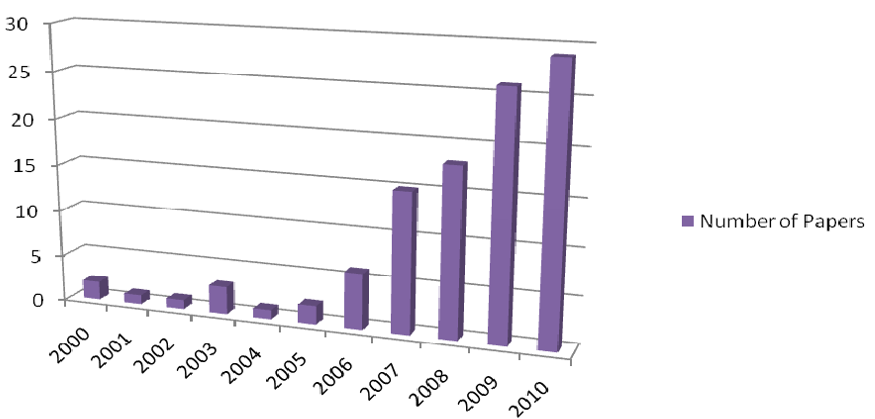 Figure 1: The exponential growth of OSN research interest at WWW conferences (2000-2010).
They identified a "seed set" of 20 representative papers to observe how they influenced the broader network. By calculating Global Efficiency (0.55), they discovered that the research field itself mimics a high-performance neural network. Information doesn't just sit in silos; it propagates across tracks (e.g., from Social Networks to Semantic Web or Data Mining) with remarkable speed.
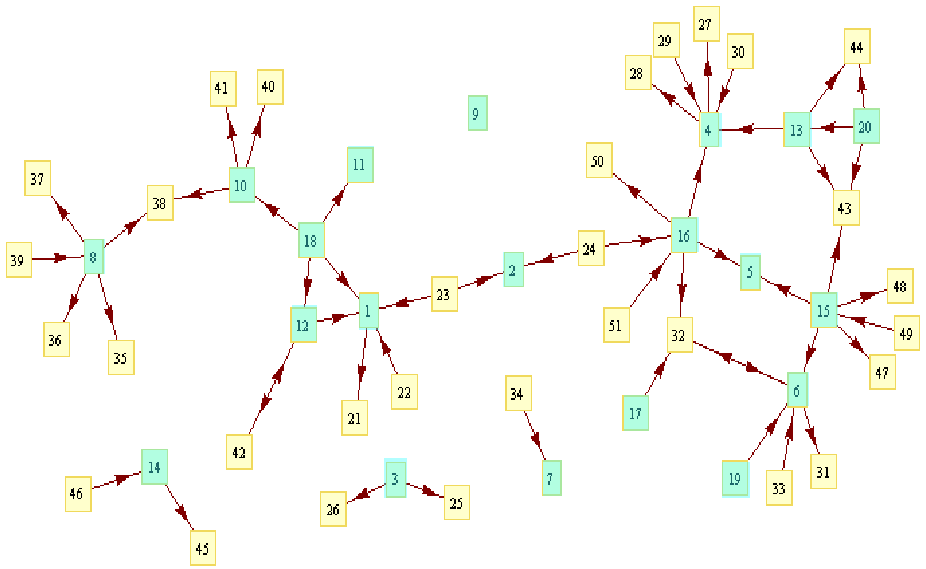 Figure 2: The intra-connection graph of OSN papers. Blue nodes represent the core "seed" set, showing clear clustering around specific sub-topics like Privacy (left) and Interaction (right).
Key Insights & Findings
- The Illusion of Anonymity: Early research in the seed set (like Backstrom et al.) proved that simple de-identification is insufficient; structural patterns alone can de-anonymize users.
- Information Delay: Contrary to popular belief that "viral" content spreads instantly, studies in the Flickr network showed that information dissemination through word-of-mouth often involves substantial delays and is limited to local clusters.
- Correlation of Habits: The "Messenger study" (Singla & Richardson) provided quantitative proof that a communication link between two people significantly increases the likelihood of shared search interests.
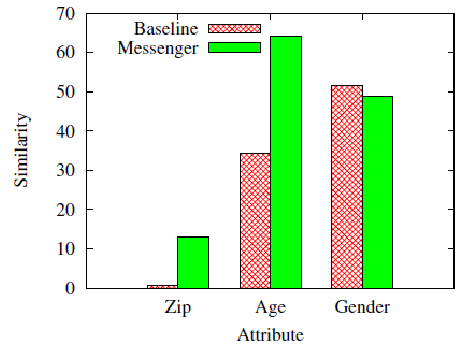 Figure 3: Evidence showing that users who interact via Messenger share significantly more common query attributes than random pairs.
Critical Analysis & Future Outlook
While the paper successfully maps the growth of the field, it also exposes its growing pains. The "low clustering coefficient" in certain areas suggests that while papers are citing each other, they are still somewhat scattered in their methodologies.
Takeaway for Today: This study was a precursor to the modern "Social Graph" era. It correctly predicted that Privacy would move from a technical niche to a "social-scientific phenomenon." For modern researchers, this paper serves as a reminder that the challenges we face today in AI-driven social moderation and data privacy have deep roots in the structural observations made over a decade ago.
Limitations: The study is confined to the WWW conference series. While influential, it may miss broader sociological or psychological breakthroughs published in journals outside the core computer science circuit.