
Is Your Privacy a Choice or an Interface Flaw? Deep Dive into Social Media Intuitiveness
Is Your Social Networking Privacy Reliant on Intuitive Interfaces?
This study investigates user awareness and intuitiveness of Facebook's privacy settings through a comprehensive questionnaire involving 392 participants. The research identifies significant gaps between perceived privacy and actual setting configurations, highlighting that a substantial portion of users rely on risky default "Everyone" settings.
TL;DR
In this research, Deborah S. Carstens and Veronica Giguere examine whether the lack of privacy on Facebook is a choice or a result of poor interface design. Surveying 366 active users, they found a startling reliance on "Everyone" (public) settings for sensitive data. The study reveals that the complexity of settings acts as a usability barrier, effectively "tricking" users into public exposure.
Background: The Illusion of Control
Social Networking Sites (SNSs) are built on the tension between sharing and safety. While Facebook allows itemized control over everything from political views to contact info, the research highlights a "Default Bias." Most users enter the platform with settings set to public and never navigate the labyrinthine menus to change them. This study positions itself at the intersection of Human-Computer Interaction (HCI) and Cybersecurity, questioning if current UIs are "intuitive" enough for the average user to actually protect themselves.
Problem & Motivation: The Usability Barrier
The authors argue that privacy isn't just a policy issue; it's a usability problem.
- The Paradox: Users claim to care about privacy, yet they post identifying photos (94.5%) and email addresses (59.6%).
- The Intuition Gap: If a user cannot find the setting, the setting effectively doesn't exist.
- The Security Risk: A major insight is the "Security Question Loophole"—users share pet names or hometowns publicly, which are the exact same details used to recover (or hack) passwords.
Methodology: Mapping the User Experience
The researchers broke down Facebook’s privacy architecture into distinct categories to test user awareness:
- Personal Information Breadth: What are you sharing? (Photos, addresses, etc.)
- Audience Granularity: Who can see it? (Everyone, Friends, Friends of Friends, or Custom).
- Directory Visibility: Can people find you via search or see your friend list?
User Configuration Trends
The study captured how users interact with specific visibility permissions.
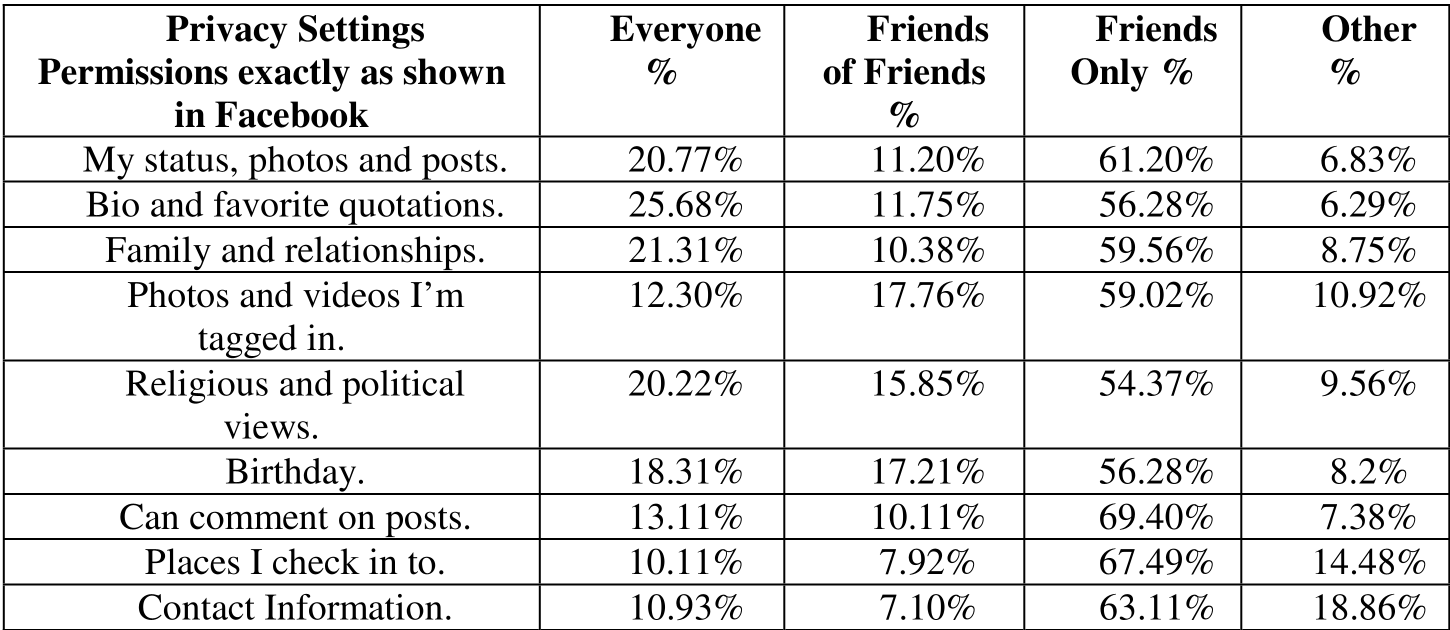 Figure 1: Percentage of users utilizing different audience settings for personal profile attributes.
Key Results: Defaulting to Danger
The findings suggest that a significant minority (10-25%) are trapped by default settings:
- Status & Photos: 20.7% allow "Everyone" to see their daily posts.
- Social Engineering: 12.57% of users have profile info that compromises their security questions (e.g., mother’s maiden name or hometown).
- The "Searchability" Trap: Over 66% allow anyone to search for them, and 69% allow friend requests from anyone, often without realizing the implications for their broader network's privacy.
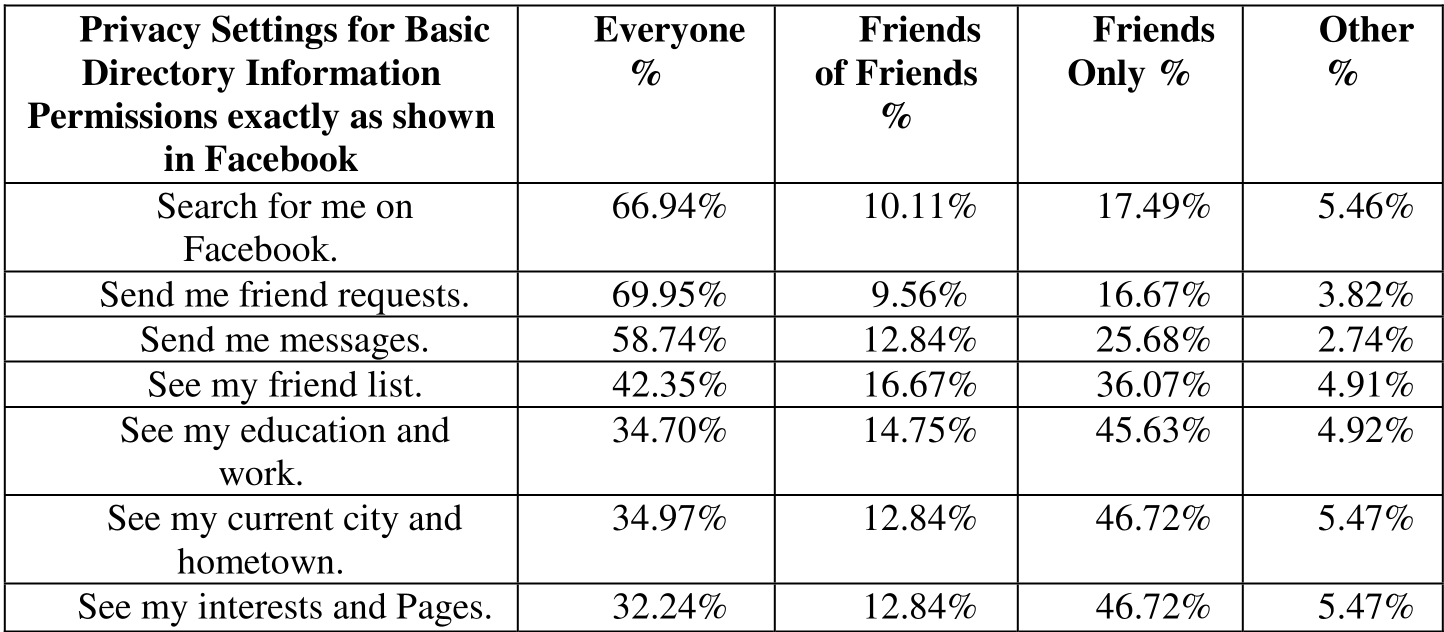 Figure 2: User settings for basic directory information, showing a heavy lean toward 'Everyone' for search and messaging.
Critical Analysis: Is Awareness Enough?
The most telling result is that 24.86% of users planned to change their settings immediately after taking the survey. This suggests that user "apathy" is actually "unawareness." The interface fails to communicate the current state of a user's privacy effectively.
Recommendations for the Industry
To solve this, the authors suggest:
- Privacy Wizards: Guided, step-by-step setup flows rather than static menus.
- Educational Tutorials: Short video clips during onboarding to explain the impact of "Friends of Friends" vs. "Friends."
- Contextual Alerts: Warning users if they set a security question whose answer is already public on their profile.
Conclusion
This paper serves as a wake-up call for SNS architects. Privacy is not a static feature but a dynamic interaction between the user and the interface. Until interfaces become more intuitive—moving away from complex grids to proactive guidance—users will continue to inadvertently leak their digital lives to the public domain.
Future Work: The researchers intend to conduct usability testing on different interface designs to see which specific UI elements (toggle vs. dropdown, wizard vs. menu) lead to the most accurate privacy configurations.