
Social Networking by Proxy: When Pets Reveal the Humans Behind the Screen
Social Networking by Proxy: Analysis of Dogster, Catster and Hamsterster
This paper explores "Social Networking by Proxy" using datasets from pet-centric platforms Dogster, Catster, and Hamsterster. It investigates the structural relationship between pet-level friendships and human-level household ties, achieving a near-perfect (AUC > 99%) accuracy in predicting whether multiple pet profiles belong to the same owner.
TL;DR
In the world of online pet social networks—Catster, Dogster, and Hamsterster—the "user" isn't a human, but a pet proxy. This paper delves into the dual-layered structure of these networks to distinguish between genuine social friendships and "family ties" (multiple profiles managed by one owner). By analyzing metadata and network topology, the researchers can predict if two pets live in the same house with over 99% accuracy.
Background: The Proxy Phenomenon
In typical social networks (Facebook, LinkedIn), one account equals one person. Online pet social networks break this mold. On these platforms, one user manages multiple accounts—one for each cat, dog, or hamster they own. This creates a fascinating research environment: a multi-profile social network. The core challenge is understanding how human owner behavior manifests through these pet "proxies" and whether we can mathematically separate social links from household clusters.
Problem & Motivation: The Hidden Household Layer
Existing social network analysis often overlooks the "Account-to-Profile" hierarchy. The authors identify a key gap: how do we quantify homophily (the tendency to connect with similar others) across different layers? Is a pet more like its "friends" or its "siblings" in the same household?
Furthermore, from a privacy and security perspective, if a user tries to hide that they own multiple accounts, can the network structure and metadata betray them?
Methodology: Assortativity and Prediction
The researchers proposed a dual-metric approach to examine homophily:
- Friendship Assortativity (): Measuring similarity between pets connected by social links.
- Account Assortativity (): Measuring similarity between pets owned by the same user.
By calculating the ratio , they could determine if "family" traits are more consistent than "friendship" traits. To link profiles, they used features ranging from network metrics (Jaccard index, degree difference) to temporal metadata (join date).
 Table 1: The scale of the pet social networks studied, showing hundreds of thousands of pets and millions of friendship links.
Experimental Insights: Decoding the Owner's Fingerprint
The results from the logistic regression experiments were startlingly precise.
Key Predictive Features:
- Same Location: This was the strongest indicator. Since household pets live together, city-level geolocation (even if coarse) is a massive giveaway.
- Join Date Difference: Humans tend to register all their pets in one sitting or during a short window. A near-identical "Join Date" is a smoking gun for a shared owner.
- Network Topology (Jaccard Index): Pets in the same household often share a high percentage of mutual "friends" because the owner promotes their pets as a group.
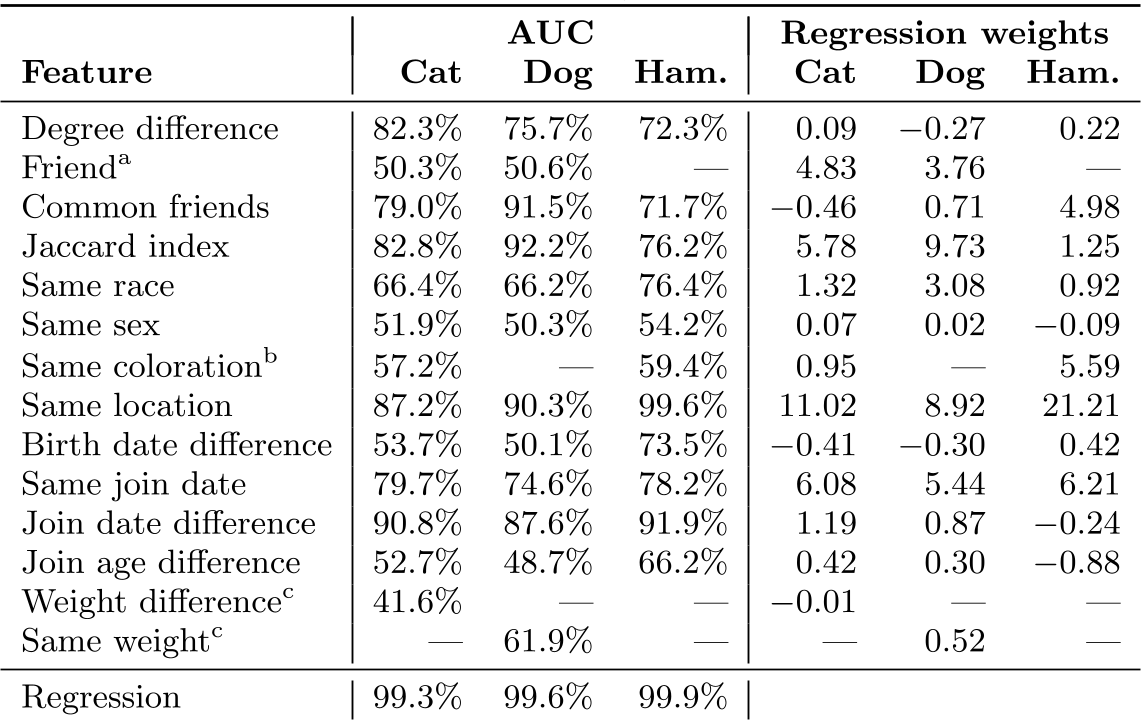 Table 2: Performance of different features in predicting family ties. Note the Regression AUC reaching nearly 100%.
Critical Analysis & Conclusion
This work demonstrates that "proxy" networking doesn't obscure human behavior; it amplifies it. The extremely high AUC (Area Under the Curve) values suggest that linking multiple profiles to a single entity is trivial if the profiles share even basic metadata or common connections.
Takeaways for the Future:
- Privacy Implication: Even if you don't explicitly link your accounts, the temporal and spatial "traces" of your registration and networking habits are enough for algorithms to de-anonymize your household.
- Structural Insight: In multi-profile systems, homophily is significantly stronger within the "household" than across "friendships."
While the platforms studied (like Hamsterster) may now be defunct, the logic applies perfectly to modern "finstas," business-managed brand accounts, or even botnets where a single entity controls a fleet of digital proxies.