
From CPU to Disk: Deciphering the Infrastructure Bottlenecks of Social Media
Impact of Social Networking Services on the Performance and Scalability of Web Server Infrastructures
This paper investigates the performance and scalability of Web server infrastructures supporting social networking services (SNS), specifically Blogging, Photo sharing, and Video sharing. By employing discrete event simulation, the authors identify shifting hardware bottlenecks—from CPU to Disk—resulting from high user interactivity and multimedia-heavy workloads.
TL;DR
Social Networking Services (SNS) have fundamentally altered the Web's DNA, transitioning from a "Read-centric" model to a "Read-Write" paradigm. This paper reveals that as services move from text-based blogging to video sharing, the primary system bottleneck shifts from the CPU to the Disk. Furthermore, even in photo sharing, increasing user interactivity (uploads) can trigger a dramatic migration of the performance ceiling from compute to storage.
Background Positioning
While early 2000s Web research focused on optimizing e-commerce throughput, this work serves as a critical bridge into the Web 2.0 era. It identifies that the "Social" aspect of the Web isn't just a marketing term—it's a hardware-stressing reality where user uploads and multimedia payloads redefine capacity planning.
The "Read-Write" Friction
The authors identify two primary stressors for modern infrastructures:
- User Interactivity: Unlike traditional sites, SNS users are creators. Every "Write" operation is significantly more expensive for storage units than a "Read" operation.
- Multimedia Density: The shift from 30KB blog posts to 8MB+ video clips increases the strain on secondary storage and network links, making traditional CPU-bound optimizations less relevant.
Methodology: Simulating the Social Workload
To analyze these effects, the researchers modeled three distinct services using specific statistical distributions for file sizes:
- Blogging: Mostly textual (Pareto distribution).
- Photo Sharing: Medium-sized assets (Aggregate of Normal and Lognormal distributions).
- Video Sharing: Large assets (Aggregate of four Normal distributions).
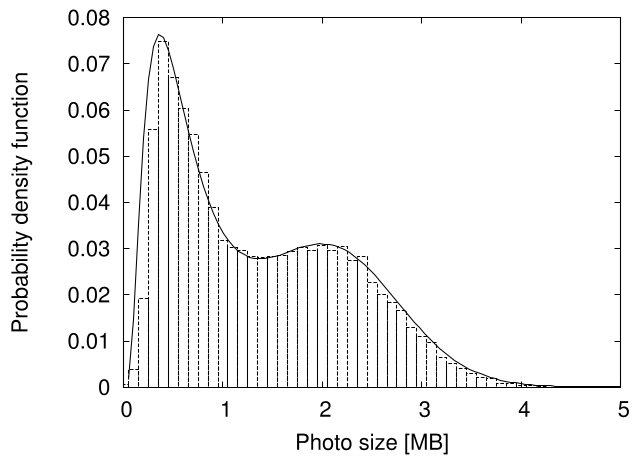 Figure 1: The complex photo size distribution used for Flickr-like workload simulation.
They specifically tested varying "Write" ratios (5%, 10%, 20%) to simulate different levels of user engagement.
Critical Insight: The Bottleneck Shift
The most profound finding of the study is the Bottleneck Shift seen in Photo Sharing.
- The CPU Era (Low Interactivity): When only 5% of users upload content, the CPU manages request parsing and session handling until it saturates.
- The Disk Era (High Interactivity): When uploads hit 10% or more, the expensive write-back policies and disk queue lengths explode. The Disk becomes the bottleneck before the CPU is fully utilized.
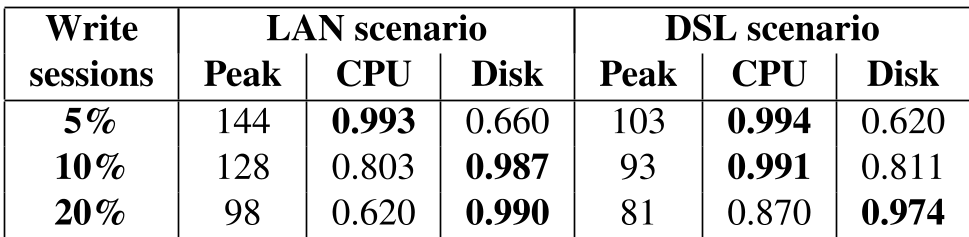 Table 4: Peak Throughput comparison—notice how Disk utilization hits ~0.99 in high-write scenarios while CPU utilization drops.
In Video Sharing, the transition is even more extreme. The Disk is the bottleneck almost immediately, regardless of the write ratio, because the sheer volume of data movement overwhelms the I/O subsystem.
The Network Factor: The DSL Paradox
The paper also explores how client-side connections affect the server. Surprisingly, slower connections (DSL) can actually increase CPU utilization on the server. Because requests take longer to complete over slow links, the server must maintain more concurrent threads, leading to higher context-switching overhead and memory pressure, shifting the bottleneck back toward the CPU in specific scenarios.
Critical Analysis & Conclusion
Takeaway
The study proves that SNS infrastructure cannot be "one-size-fits-all." A blogging platform needs compute density, while a video platform needs I/O throughput. As interactivity grows, even a "photo" app will eventually hit a wall that no amount of CPU power can fix.
Limitations
The study assumes a 90% disk cache hit rate, which might be optimistic in the "long-tail" distribution of social media where old content is rarely accessed but still occupies storage.
Future Outlook
This work lays the groundwork for the adoption of SSD arrays and Tiered Storage in data centers. For modern developers, it highlights that the "latency" a user feels may not be due to slow code (CPU), but rather the physical limitations of moving multimedia blocks from spinning rust to the network interface.