
SocS: Breaking the Ice with Digital Identities in Public Spaces
Leveraging social networking services to encourage interaction in public spaces
This paper introduces Social Surroundings (SocS), a ubiquitous computing system that bridges virtual digital identities with physical public spaces. By leveraging public profile data from Social Networking Services (SNS) like Facebook and MySpace, the system displays user-generated content on large public screens to facilitate ice-breaking and natural interaction among strangers in places like cafes.
TL;DR
In an era where we are more connected online than ever, we remain "isolated together" in physical spaces like cafes and airports. Social Surroundings (SocS) is a prototype system designed to lower the social barrier of meeting strangers by projecting their public digital lives (from sites like MySpace or Facebook) onto large public screens, providing the necessary "social context" to start a real-life conversation.
Background: The Paradox of Digital Connectivity
By 2008, Social Networking Services (SNS) had already taken the world by storm. However, the authors observed a troubling trend: while we curate rich digital identities, our physical interactions in public spaces remain stagant and awkward. The "social barrier"—the fear of approaching a stranger without a common topic—points to a loss of genuine human experience. SocS seeks to repurpose the content we already create online to serve as a bridge to natural, face-to-face communication.
Methodology: Bridging the Virtual and the Physical
The SocS system is built on a tripartite architecture:
- The Mobile Client: A J2ME application where users log in and identify their location by touching an RFID tag or scanning a QR code at their table.
- The Core Server & Crawler: A system that utilizes APIs (like OpenSocial or Flickr) to pull public media—photos, text snippets, and status updates—without requiring the user to "re-upload" content.
- UI Visualization: Two distinct public screens.
- Layout View: Shows a map of the venue (e.g., a café) with nicknames at specific tables.
- Content Show: A rotating gallery of images and snippets from the people currently in the room.
System Architecture Overview
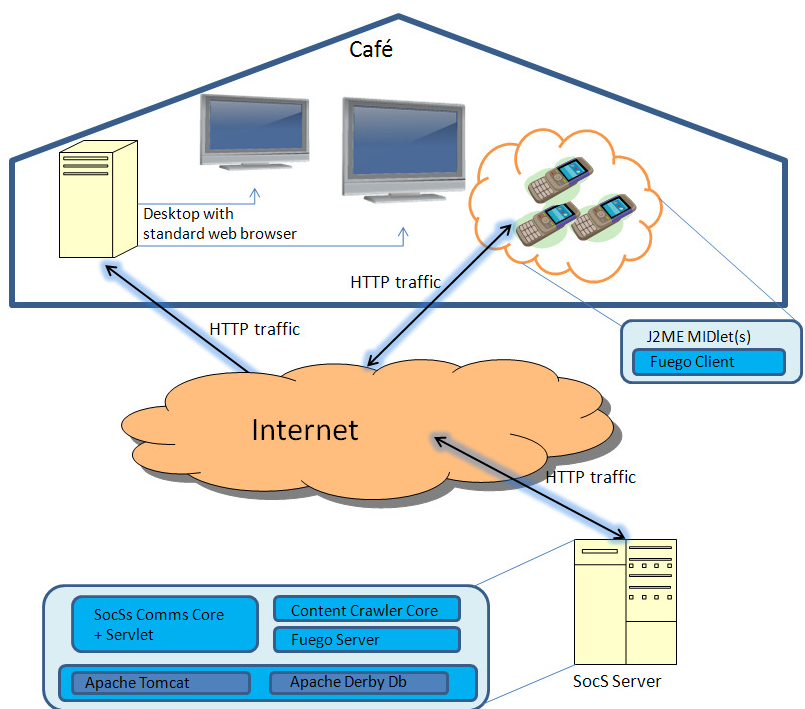 The architecture leverages the Fuego pub/sub framework to handle real-time updates between mobile devices and the public displays.
Design Principles for Social Ubiquity
The authors emphasized several "User-Centric" principles to ensure the system wouldn't be perceived as creepy or obtrusive:
- Unobtrusiveness: The content show is ambient; it does not force interaction or send intrusive push notifications.
- Data Portability: Users don't need to create a new profile. They simply grant access to their existing digital selves.
- Reactive, Not Proactive: The system only acts when a user deliberately "checks in" via RFID/QR, ensuring they remain in control of their exposure.
Visualizing the Social Space
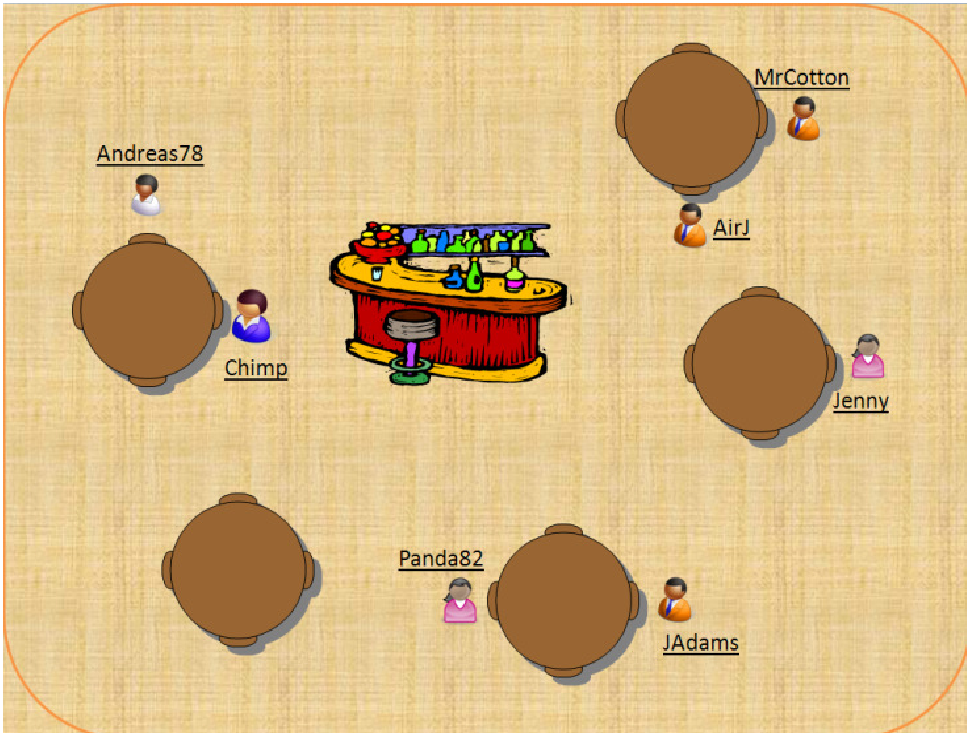 In practice, a user might see that "MsJessie" at the next table likes guacamole (from her digital profile), providing the perfect "starting point" for a real-world chat.
Critical Insights & Results
The paper posits that context is the key to interaction. Prior work on public displays often failed because the content was too generic. By making the content hyper-local and hyper-personal (but still public), SocS transforms a cold public screen into a warm social hearth.
While the paper focuses on the technical design and social motivation, it raises a critical question for the future: Is our digital self a true reflection of our physical self? The authors acknowledge the existence of "fabricated profiles" but argue that in a physical setting, the presence of the actual person serves as a natural verification mechanism.
Summary & Future Outlook
SocS represents an early, visionary attempt to solve the "stranger danger" or social awkwardness of the physical world using the wealth of data we leave online.
- Contribution: It moves SNS data from the browser to the "smart environment."
- Limitation: The success of the system relies heavily on a "critical mass" of users in a single location being willing to be visible.
- Future Work: The authors aim to study the persuasive nature of these displays—can a public screen actually nudge someone to be more social?
In the landscape of 2026, where we contemplate the role of AR glasses and AI agents, SocS reminds us that the goal of technology should not be to replace human interaction, but to provide the tools to make it easier.