
The Multitasking Illusion: How SNS Use and Task-Switching Affect Global Academic Performance
An exploration of social networking site use, multitasking, and academic performance among United States and European university students
This study investigates the cross-cultural relationship between Social Networking Site (SNS) use, multitasking, and academic performance (GPA) among university students in the US and Europe. Utilizing Moderated Multiple Regression, the authors identify that multitasking significantly moderates the negative impact of SNS use on GPA in the American cohort, whereas European students exhibit different behavioral patterns.
TL;DR
A cross-continental study of 857 students reveals that while almost everyone uses Social Networking Sites (SNSs) while studying, US students are more prone to "disruptive" multitasking than their European counterparts. This behavior acts as a critical moderator that deepens the negative relationship between SNS time and GPA, proving that feeling "good at multitasking" is often a cognitive trap.
Background Positioning
This research by Karpinski et al. moves beyond localized studies to provide an international comparative analysis. It bridges the gap between cognitive psychology (the "bottleneck" theory of information processing) and educational sociology, situating itself as a cautionary critique of the "digital native" myth.
The Cognitive Bottleneck: Why We Can't Actually Multitask
The authors ground their motivation in a harsh biological reality: humans are incapable of true concurrent multitasking for complex cognitive tasks. What we perceive as multitasking is actually task-switching.
- The Decision Cost: Every time a student moves their eyes from a textbook to a Facebook notification, the brain must "switch off" one set of rules and "switch on" another.
- The Problem State: Each task requires maintaining a "problem state" in short-term memory. Overloading this leads to the "information bottleneck," resulting in medical errors for doctors and GPA drops for students.
Methodology & Architecture
The study utilized a refined survey to capture demographic data, SNS usage minutes, study time, and multitasking perceptions.
 Figure 1: Conceptualizing the flow of social media integration in student life.
The researchers used Moderated Multiple Regression to see if the impact of SNS use on GPA changed based on whether the student was a multitasker. They also used Qualitative Data Analysis (QDA) to categorize student "themes," such as "No multitasking" vs. "Being good at multitasking."
The Comparative Divide: US vs. Europe
The findings reveal a fascinating cultural and behavioral split:
- The US Context: Multitasking is a significant moderator. For American students, the heavy use of SNS combined with the habit of constant task-switching significantly predicts a lower GPA.
- The European Context: The interaction was non-significant. European students reported being less "involved" in their notifications, suggesting a higher level of self-regulation. They might have the site open, but they don't necessarily "attend" to messages immediately.
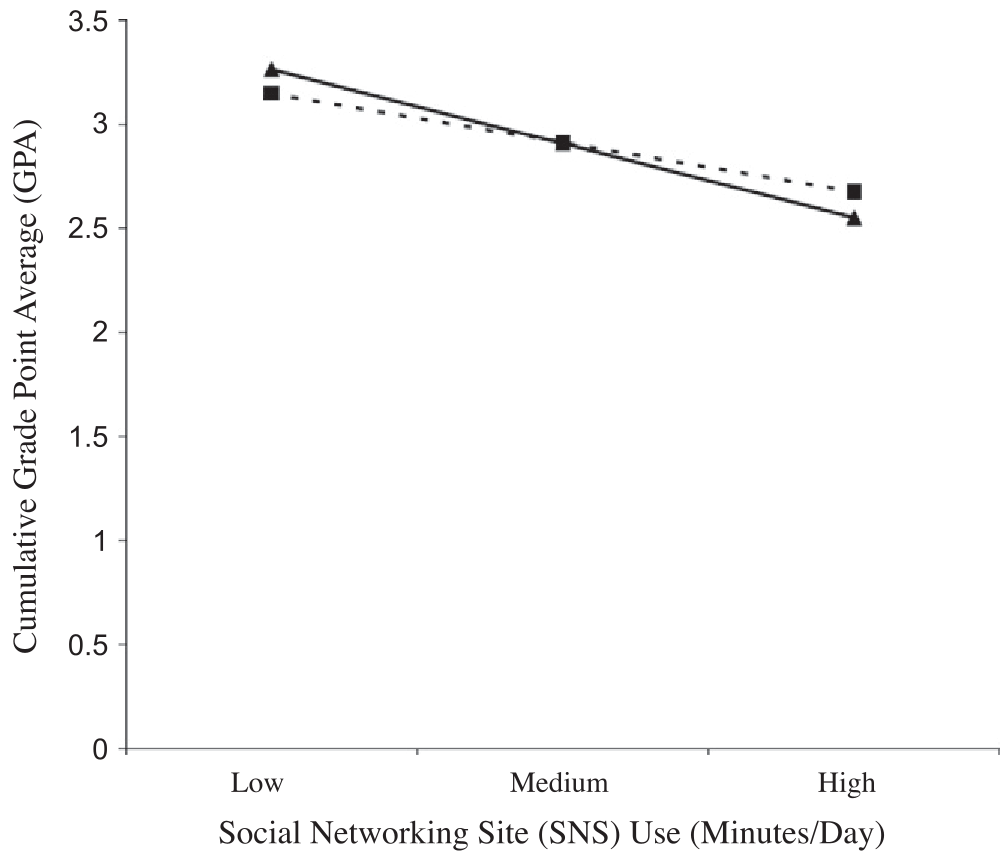 Figure 2: The interaction between SNS use and multitasking in the US sample. Note how the slope of GPA decline is steeper for those engaged in multitasking.
Perceived vs. Actual Efficacy
One of the most striking findings was that US students had significantly higher scores in feeling capable of multitasking (M=2.85 vs Europe's 2.53). However, as the authors note, quoting Clifford Nass: "Multitaskers are lousy at multitasking." The very students who think they are the most effective at it are often the ones suffering the highest cognitive interference.
Critical Analysis & Takeaways
The "Quality of Use" Argument
The study suggests that it isn't just how long you spend on SNS, but the quality and distractibility of that time. US students demonstrated "higher cognitive absorption," meaning they are more emotionally and mentally "pulled" into the SNS, making the task-switch back to studying much more expensive.
Limitations
- Self-Reporting: GPAs and minutes spent online were self-reported, which can be prone to memory bias or social desirability bias.
- Correlation vs. Causation: As a correlational study, we cannot definitively say SNS caused the lower GPA, only that they are strongly linked.
Future Outlook
As universities push for "Mobile Learning" and "Social Classrooms," this research serves as a vital warning. Integrating social media into education without teaching self-regulation strategies may inadvertently harm student performance by encouraging the very disruptive multitasking habits this study exposes.
Conclusion: The next frontier of academic success in a digital age isn't about having the best tools, but about having the cognitive discipline to close the tabs that don't matter.