
Beyond Privacy: Why Cyber-Attacks Outweigh Data Leaks in the Psychology of SNS Use
A study of social networking site use from a three-pronged security and privacy threat assessment perspective
This study investigates the duality of security threats—cyber-attacks and privacy breaches—on Social Networking Sites (SNS) and their impact on user behavior. Using a survey of 822 Facebook users and structural equation modeling (PLS), the researchers establish that perceived SNS risk significantly reduces site use, primarily through the mediation of member attitude.
TL;DR
While digital privacy often dominates headlines, its actual influence on whether we keep scrolling is surprisingly weak. This study reveals that cyber-attack exposure is the primary driver of perceived risk on platforms like Facebook. Furthermore, this risk doesn't just stop us from logging in; it fundamentally alters our attitude, which then dictates our long-term engagement levels.
Contextual Status: This work is a critical theoretical extension of the Three-Pronged Perspective Framework (TPF), shifting the academic focus from "Privacy Calculus" to a more holistic "Security-Privacy Duality."
The Problem: The "Privacy Paradox" and Missing Links
For years, researchers have been puzzled by the "Privacy Paradox"—the phenomenon where users express high concern for privacy but continue to share personal data. This paper argues that the academic gaze has been too narrow. By focusing only on privacy, we've missed the cyber-attack component (malware, hacking, identity theft).
Moreover, previous studies often failed to find a direct link between "Risk" and "Usage." The authors suggest this is because there is a missing link in the chain: Attitude. Risk doesn't just act as a barrier; it poisons the user's evaluatve state.
Methodology: The Extended Three-Pronged Perspective
The authors break down the "threat assessment" process into three logical stages:
- Threat Sources: Internet Risk (hackers), Trust in the Platform (SNS provider), and Trust in the Community (other members).
- Harm-Exposing Events: Cyber-attack exposure and Privacy breach concerns.
- Harm Assessment: The overall "Perceived SNS Risk."
The Structural Model
The authors utilized a Partial Least Squares (PLS) approach to map these interactions:
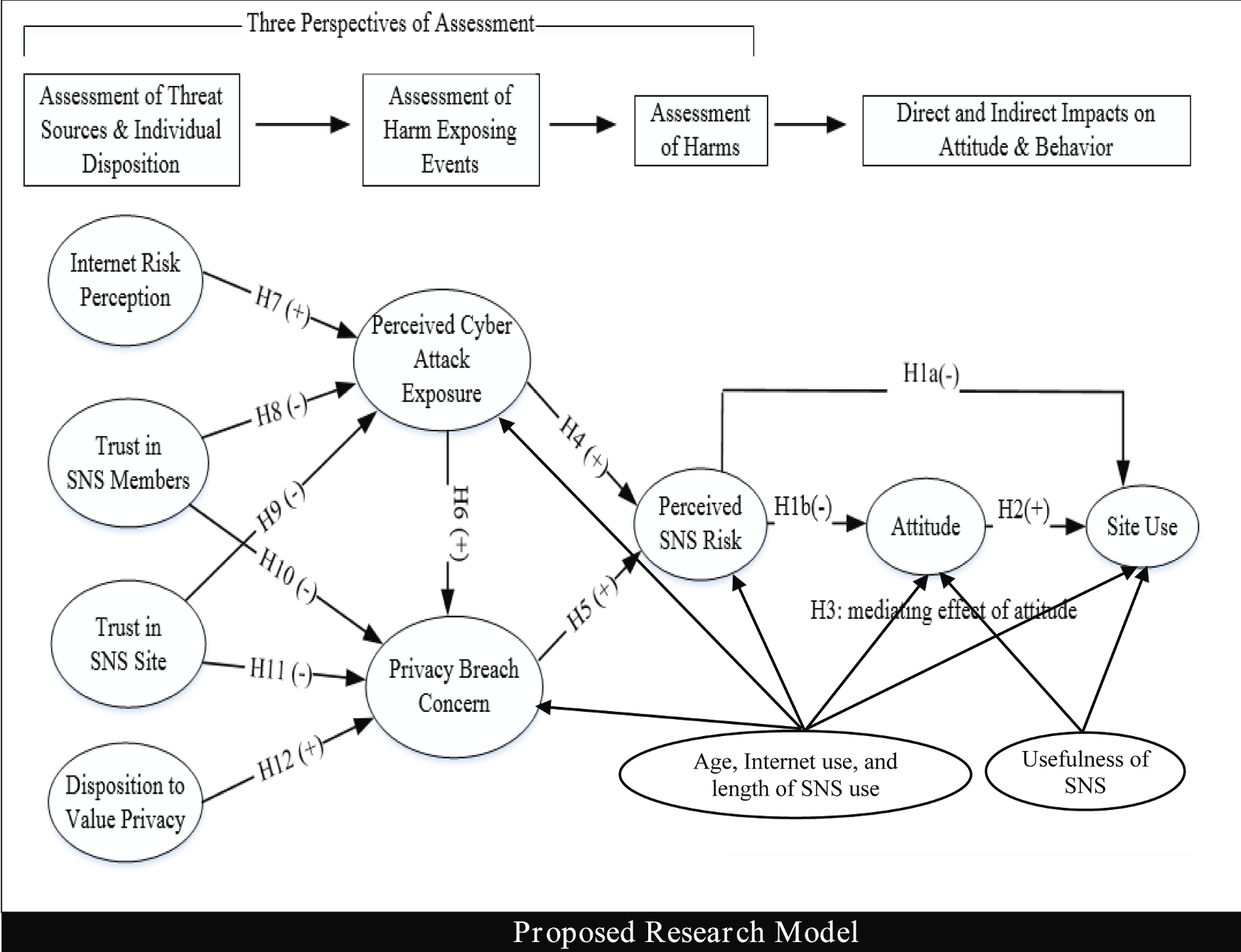
Physical Intuition: The model treats trust as a "rational risk-taking" mechanism. If you trust the vendor (SNS), your perceived exposure to external attacks drops, even if the vendor isn't directly responsible for the attackers.
Key Insights and Results
1. The Dominance of Cyber-Attacks
The most striking finding is that Cyber-attack exposure casts a significantly greater impact than privacy concerns in shaping the overall perceived risk.
- Why? The authors point to "Privacy Breach Fatigue." When users hear about data leaks every week but suffer no personal financial loss, they habituate. However, a cyber-attack (like losing control of an account) feels immediate and visceral.
2. The Mediation of Attitude
The study proved that Risk -> Attitude -> Site Use. For the general population, risk makes the user "dislike" the site experience, which leads to lower usage.
3. A Surprising Gender Split
A post hoc analysis revealed a fascinating nuance:
- Males: Outcome-oriented. Risk directly reduces their usage (Agentic behavior).
- Females: Relationship-oriented. Risk affects their attitude, but they often continue to use the site anyway to maintain social bonds (Communal behavior).
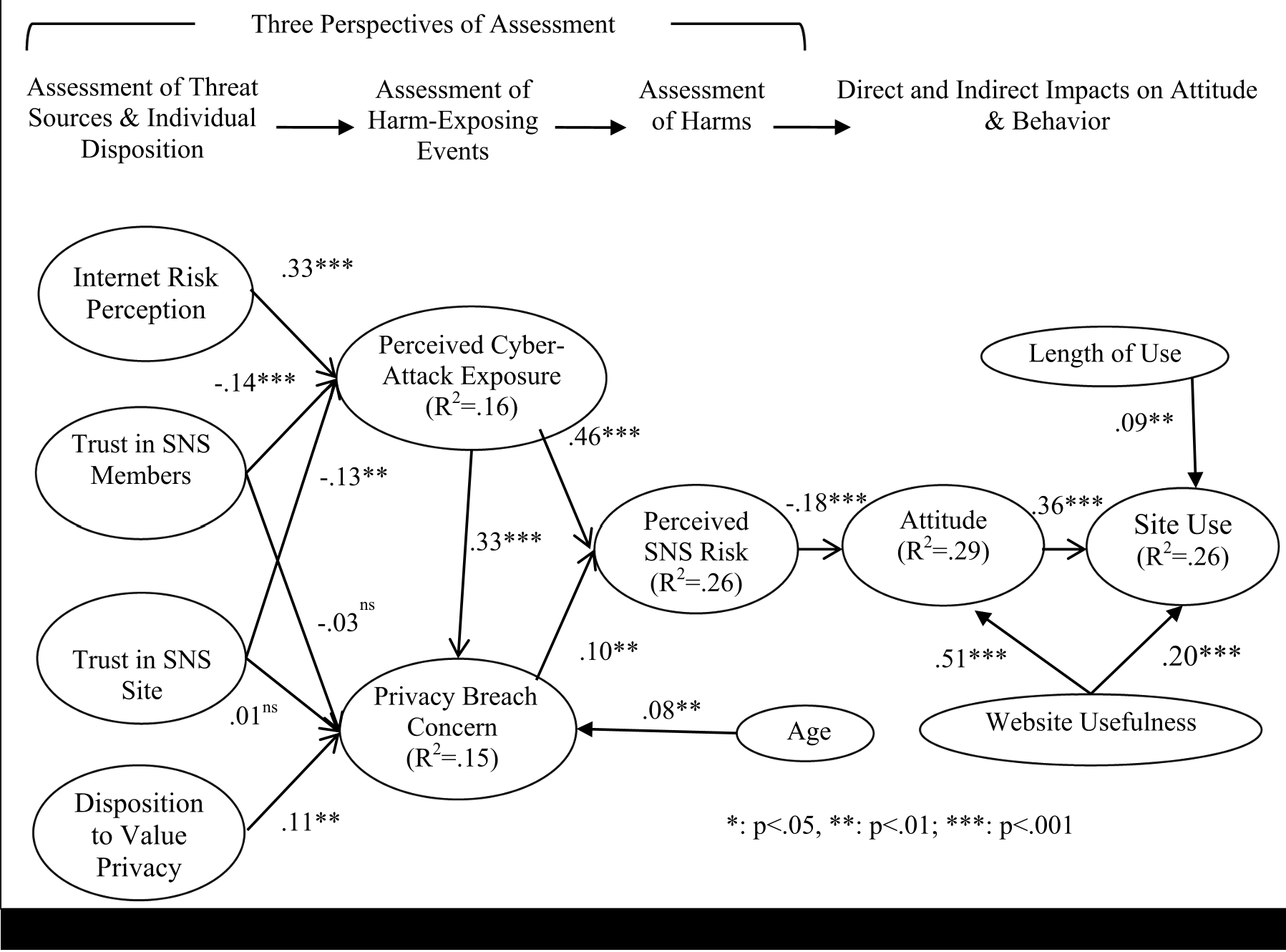 Note: The path from Risk to Attitude is strong (-.18), proving that security isn't just a technical hurdle—it's a brand sentiment issue.
Critical Analysis & Conclusion
The Takeaway: For product managers and security architects, the message is clear: Branding your platform as "Secure" (protective against hackers) is more valuable for retention than simply being "Private" (protective against data sharing).
Limitations: The study focuses on Facebook, a platform with a specific demographic "collapse." Newer platforms like TikTok or decentralized SNS (where peer trust is handled via code/smart contracts) might yield different results regarding the "Trust in SNS" variable.
Future Outlook: As AI-driven social engineering (deepfakes) becomes a primary cyber-attack vector, we can expect the "Cyber-attack Exposure" variable to become even more dominant over traditional privacy concerns in the next decade of SNS research.