
Digital Reformers: How Social Networks Shape the Future of Young Society
11634_The Role of Social Networking in the Social Reform on Young Society.
This study investigates the influence of Social Networking Sites (SNSs) on social reform among young adults, proposing a theoretical model with five key predictors. Through an empirical analysis of 302 university students, it identifies how platforms like Facebook and Twitter drive civic engagement, social trust, and life satisfaction.
TL;DR
Is social media a tool for isolation or a vehicle for social change? This study analyzes 302 university students to prove that Social Networking Sites (SNSs) like Facebook and Twitter are vital for "Social Reform." By enhancing social trust and participation, these platforms serve as crucial infrastructure for the development of young adults, contradicting the common myth that they increase social isolation.
The "Emerging Adulthood" Dilemma
The period between ages 18 and 25 is a "liminal" phase—a bridge between adolescence and full adulthood where individuals cultivate long-term social skills and identity. Historically, critics argued that digital immersion leads to social decay. The authors of this paper challenge this stance, seeking to understand if the virtual world can act as a catalyst for real-world social improvement.
Methodology: Mapping Social Reform
To quantify "Social Reform," the researchers broke it down into five measurable dimensions. They utilized a survey-based approach, applying Ordinary Least Squares (OLS) regression to isolate the impact of social media use on a student's social standing.
The Conceptual Framework
The study focused on how usage patterns (time spent, number of friends) correlate with intrinsic social values.
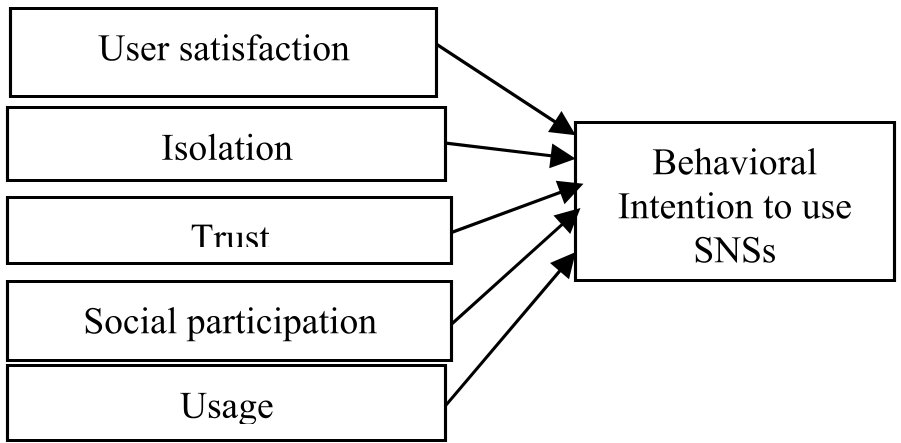
The five pillars investigated were:
- Social Trust: Faith in community and peers.
- Social Participation: Involvement in civic or community activities.
- Life Satisfaction: General well-being.
- Positive Emotion: The affective state during SNS usage.
- Isolation: The perceived lack of social connection.
Key Insights & Results
The findings provide a robust rebuttal to the "digital isolation" narrative:
- The Isolation Reversal: Contrary to Hypothesis 1, the data indicated that SNS use is inversely associated with isolation. In short, more social media use among this demographic generally led to feeling more connected, not less.
- The Power of Positive Affect: The "Positive Sense" during usage was the strongest predictor of whether a student would use SNSs for social reform. If the experience is rewarding, the social output is higher.
- Statistical Strength: The model explained 28% of the variance in the intention to use SNSs, identifying 24 significant factors that influence how Jordan's youth interact with digital platforms.
Critical Analysis & Conclusion
This work highlights that for the "Young Society," digital and physical social spheres are no longer distinct. SNSs provide a low-friction environment for building "social capital"—the trust and networks required for a functioning society.
Limitations
As an empirical study from 2014, the specific platforms (Facebook/Twitter) have evolved. Furthermore, the reliance on Likert-type questions for OLS regression requires careful interpretation regarding the interval-level assumptions of the data.
The Takeaway
Social reform in the 21st century is digital-first. For policymakers and educators, the goal should not be to limit SNS usage, but to foster "positive emotion" and "social trust" within these ecosystems to maximize their potential for community service and civic participation.