
SONTUS: Toward a Standardized Taxonomy for Measuring Social Media Time
Social networking time use scale (SONTUS): A new instrument for measuring the time spent on the social networking sites
This paper introduces the Social Networking Time Use Scale (SONTUS), a psychometrically validated instrument designed to provide a standardized measure of time spent on social networking sites (SNSs). Developed through exploratory (n=2049) and confirmatory (n=1808) studies, SONTUS identifies five distinct dimensions of SNS use and demonstrates high reliability (Cronbach’s alpha = 0.92) and strong construct validity.
TL;DR
Quantifying "time spent" on social media has long been the "Wild West" of behavioral science, plagued by subjective recall and inconsistent metrics. This paper introduces SONTUS (Social Networking Time Use Scale), a 29-item instrument that decomposes SNS usage into five psychological and situational dimensions. Moving beyond simple minute-counting, SONTUS provides a high-fidelity lens through which we can finally compare study results globally.
The "Minute" Mirage: Why Previous Metrics Failed
For years, researchers asked participants: "How many minutes did you spend on Facebook yesterday?" The author argues this is fundamentally flawed for three reasons:
- Categorical Bias: Forcing users into buckets (e.g., "1-2 hours") leads to "average seeking" behavior where users pick what feels "normal" rather than what is true.
- Platform Myopia: People don't just use one site. Focusing only on Facebook ignores the fragmented ecosystems of WhatsApp, Instagram, and niche platforms.
- The Recall Gap: Human memory is notoriously bad at aggregating micro-interactions (checking a feed for 2 minutes, 30 times a day).
Methodology: Mapping the Situational Landscape
The author moves from the What to the Where and Why. By synthesizing Uses and Gratifications Theory (UGT) and Connectivism, the research identifies that SNS use isn't a monolith; it is a response to environmental cues and internal needs.
The Five Pillars of SONTUS
Following an Exploratory Factor Analysis on over 2,000 participants, the scale settled into five distinct factors:
- Relaxation & Free Periods: The "idle" time (e.g., sitting at home, watching TV).
- Academic-related Periods: Use during seminars or while doing homework (often reflecting multitasking).
- Public-places Use: Waiting for a bus or repair services.
- Stress-related Periods: Using SNS as a tool to mitigate mental or financial pressure.
- Motives for Use: The proactive drive to find people or maintain existing ties.
 Note: The study utilized sophisticated factor analysis to ensure each item only loaded onto one distinct behavioral dimension.
Proving the Tool: Reliability and Validity
In a second study of 1,808 individuals, the author applied Confirmatory Factor Analysis (CFA). The results were striking: a second-order model (where SONTUS is a "master" factor of the five sub-factors) showed near-perfect fit indices.
Performance vs. External Benchmarks
SONTUS wasn't just validated against itself; it was tested against the "Big Five" personality traits and clinical measures like the Hospital Anxiety and Depression Scale.
- Loneliness: SONTUS explained a massive 72% of the variance in loneliness scores.
- Incremental Value: The scale predicted psychological outcomes significantly better than just knowing a person's age, gender, or how many accounts they owned.
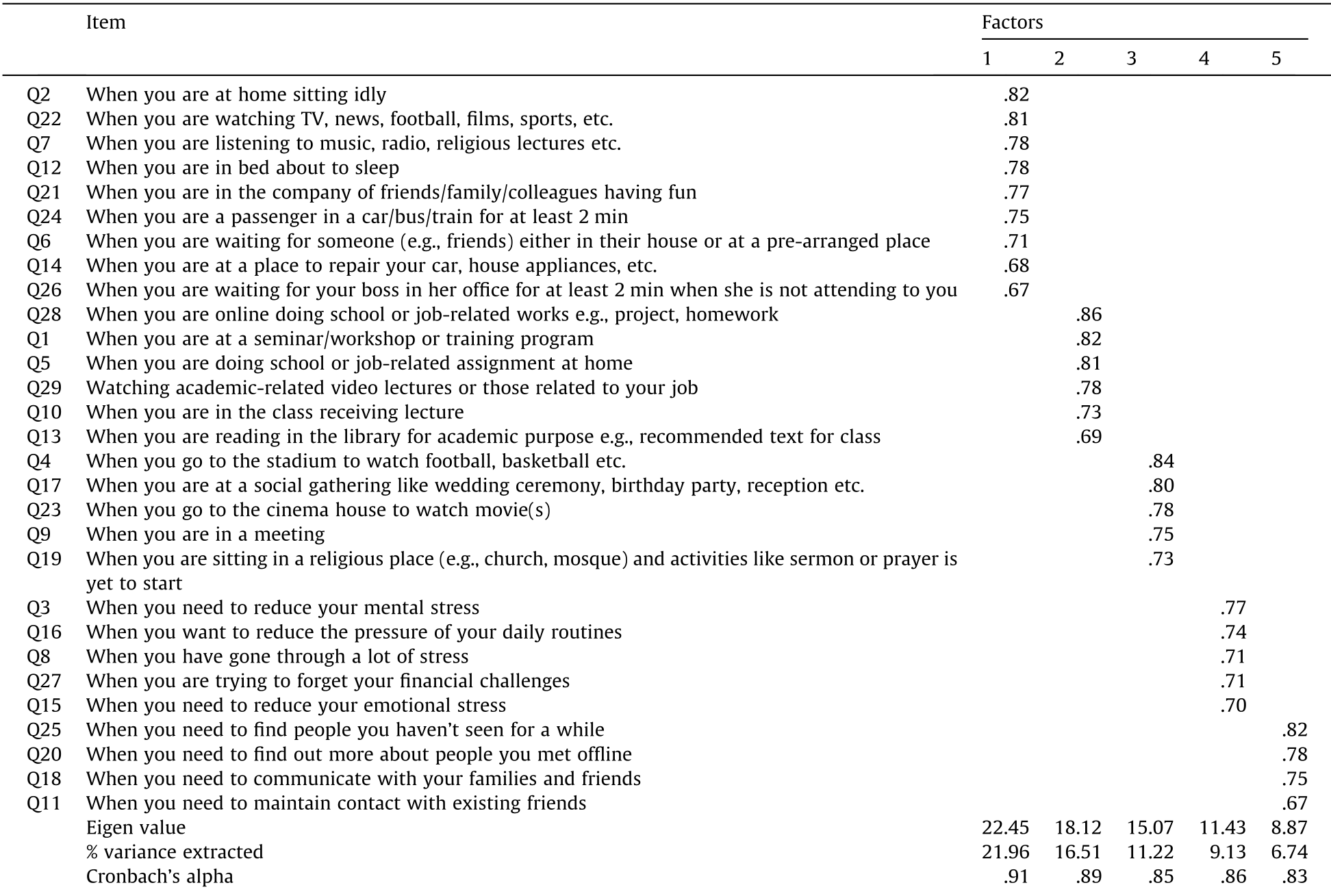 The high factor loadings (mostly >0.70) indicate that the 29 items are highly representative of their underlying situational constructs.
Critical Insight: Quality vs. Quantity
The author hits on a profound academic debate: Is it how much we use SNS or how we use it? While SONTUS measures "time," it does so by looking at the context of that time. High scores in the "Relaxation" dimension might be benign, whereas high scores in "Stress-related" usage could be a precursor to clinical addiction or depression.
Conclusion and Future Outlook
SONTUS represents a shift from quantitative "crude time" to qualitative "contextual time."
Takeaways for the Industry:
- Standardization: Researchers now have a "meter stick" to compare SNS behavior in Nigeria to that in the US or China.
- Nuance: Future apps and mental health interventions can use the SONTUS framework to identify when usage becomes problematic (e.g., "Stress-related" vs. "Academic-related").
Limitations: Like all self-reported scales, SONTUS still relies on the user's perception of their own behavior. The next step for this field will be integrating the SONTUS situational framework with passive "screen time" tracking data to see if our perceived situational use matches our actual digital footprint.