
Search in Social Networks: Balancing Privacy with High-Performance Retrieval
Search in social networks with access control
The paper presents a framework for keyword search in social networks that enforces privacy through access control. It introduces a symmetric design space categorized by "Index Axis" and "Access Axis" to balance search speed, update efficiency, and storage.
TL;DR
As social platforms like Facebook and Twitter (X) grew, the challenge of "searching private content" became a technical bottleneck. This paper explores how to build search engines where results are restricted by social graphs. The authors find that while indexing everything for everyone is fast, it breaks the bank on storage; the sweet spot lies in combining a global index with specialized "Author Lists" for efficient filtering.
Background & Motivation
Most search engines are designed for public data (web search) or localized private data (desktop search). Social networks represent a middle ground: data is private, but shared with a dynamic set of "friends."
The core struggle is Access Control Enforcement. If Alice searches for "Sushi," the engine must only return posts from her friends. Conventional wisdom suggests two extremes:
- The Global Index: Easy to manage, but you have to check permissions for every single search result (Slow query time).
- The Per-User Index: Alice gets her own index of everything she can see. (Massive redundancy; if a celebrity has 1 million followers, their post is stored 1 million times).
Methodology: The Symmetric Design Space
The authors propose a dual-axis framework to navigate this problem, characterized by Cardinality (how many lists/indices) and Redundancy (how many times a document is recorded).
1. The Index Axis (Data Organization)
- Global Index (1,1): One index for all. Low storage, but requires heavy filtering.
- User Indexes (|V|,1): Each user has an index of only their own posts. To search, Alice queries the indices of all her 200 friends.
- Friends Indexes (|V|,a): Each user has an index of everything they are allowed to see. Hyper-fast search, but storage explodes.
2. The Access Axis (Permission Filtering)
This axis mirrors the index axis but focuses on "Author Lists." It stores who authored what, allowing the system to intersect "documents containing the keyword" with "documents written by friends."
 Figure: The fundamental challenge of mapping users to content through social edges.
Experimental Insights
The researchers tested these strategies using a real Twitter crawl (approx. 417k users).
- The Storage Trap: The "Friends-Index" strategy, while providing SOTA-level search latency, quickly led to system crashes due to memory swapping. Redundancy grows linearly with the average number of followers.
- The Search Bottleneck: As the number of friends grows, "User-Indexes" slow down because the system has to merge results from hundreds of different small indices.
- The Winner: A Global Index paired with User-Lists or Friends-Lists (Access Axis) proved most resilient. By decoupling the content index from the permission list, the system minimizes the "Redundancy Tax."
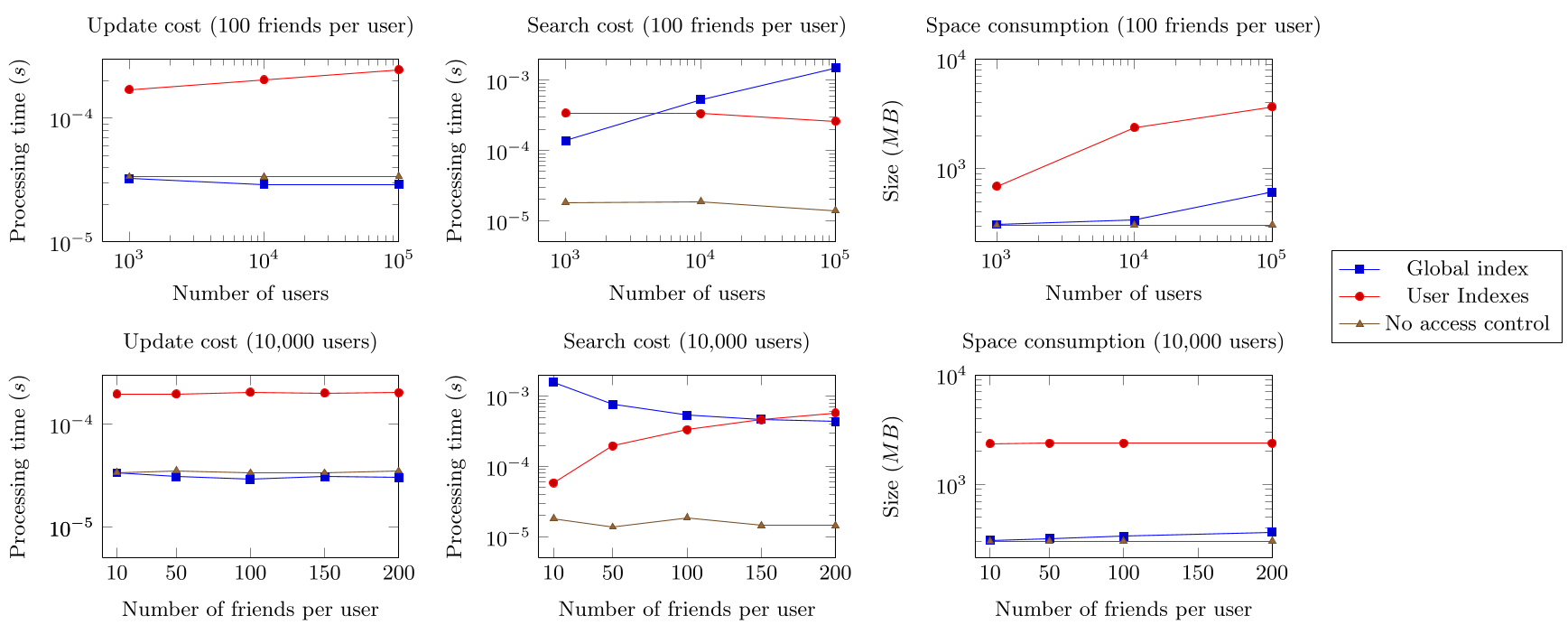 Figure: Trade-offs between user-indexed and global-indexed strategies as network connectivity changes.
Critical Analysis & Conclusion
While this 2010 work laid the foundation, it assumes a static network. In modern contexts, friendships change by the second.
Takeaway: The "beautiful symmetry" between indexing content and indexing permissions is the key insight here. For engineers building modern social apps, the lesson is clear: Don't duplicate data for the sake of access control. Instead, optimize the "Filtering Iterator" that sits on top of your global content index.
Future Outlook: Modern implementations likely replace these discrete lists with Bitmaps or Bloom Filters to speed up the "is this author a friend?" check, and use Personalized PageRank to rank results not just by recency, but by social proximity.