
Social Networks and Asset Price Dynamics: Beyond Naive Imitation
5941_Social Networks and Asset Price Dynamics.
This paper investigates the impact of social network topologies and mimetic learning strategies on asset price dynamics using an agent-based artificial stock market. By employing Genetic Programming (GP) for strategy evolution, the authors analyze how different network structures—from regular lattices to scale-free networks—interact with varying degrees of imitation (strong, semi-strong, weak) to influence price volatility, distortion, and trading volume.
TL;DR
Why do financial markets crash or bubble? This paper argues it’s not just whom you follow (the social network), but how you follow them. By using Genetic Programming to simulate boundedly rational traders across various network topologies, the authors demonstrate that "intelligent" imitation—where traders modify or test strategies rather than blindly copying them—is a crucial stabilizer for market volatility and price distortion.
Background: The Learning Gap in HAMs
Heterogeneous-Agent Models (HAMs) have long been the tool of choice for explaining "stylized facts" like fat tails and volatility clustering. However, they often suffer from a binary view of learning: you either learn alone (individual) or follow the herd (social). This paper bridges the gap by placing GP-powered traders in a social network, forcing them to communicate via "word-of-mouth" building blocks rather than just mind-reading perfect strategies.
Methodology: The Architecture of Mimetic Strategy
The core innovation lies in the hierarchy of imitation. Instead of assuming all imitation is equal, the researchers categorize it by "innovation aggressiveness":
- Strong Imitation: Direct duplication. Usually leads to high synchronization and market imbalance.
- Semi-Strong Imitation: A trader copies a neighbor's rule but parks it in a strategy pool for evaluation before using it.
- Weak Imitation: Knowledge exchange. Traders take "fragments" of successful neighbor strategies and combine them with their own via crossover and mutation.
Model Architecture and Interaction
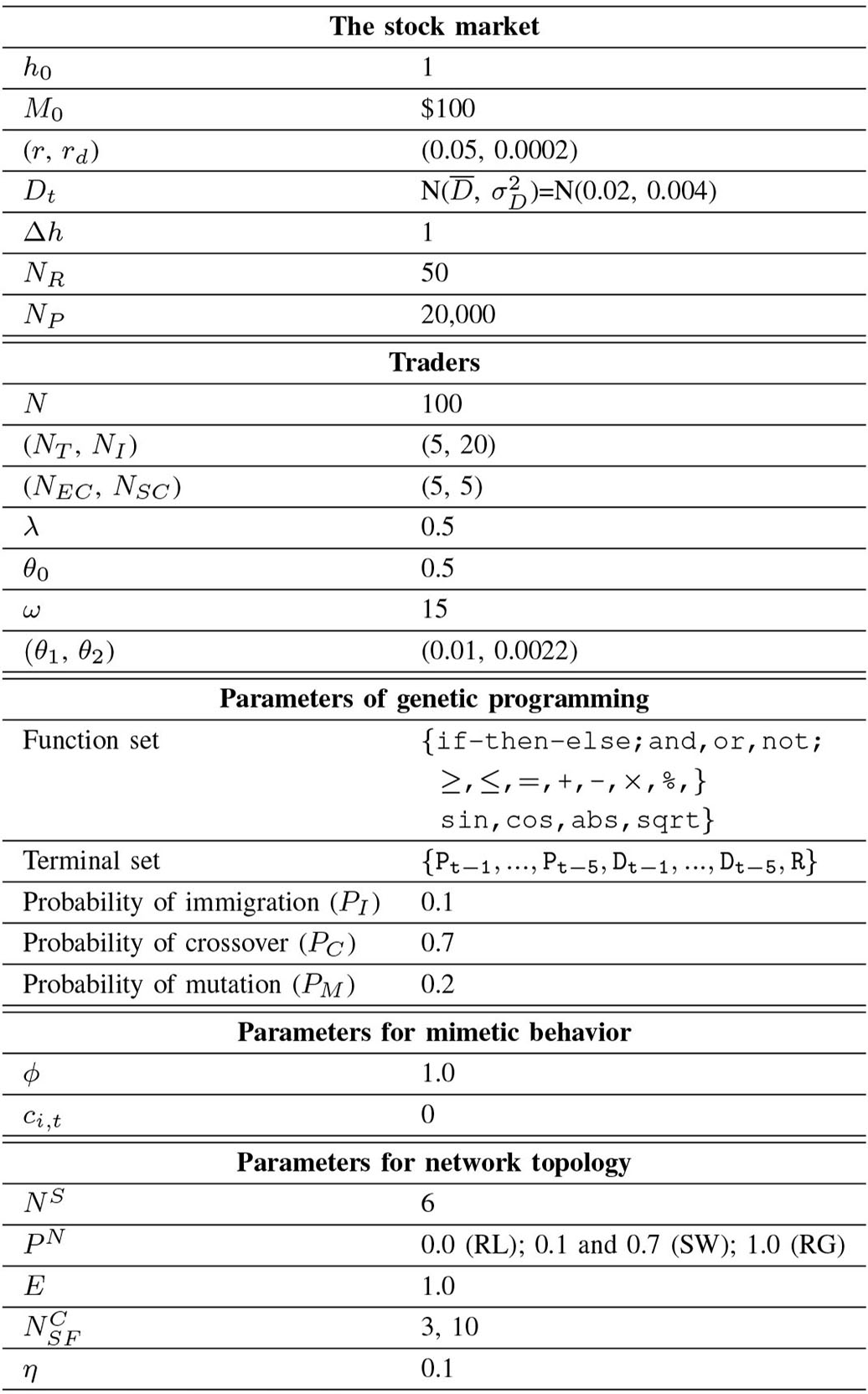
The environment uses a continuous double auction (DA) mechanism, where traders post bids and asks based on reservation prices derived from their GP-evolved expectations.
The Network Effect: Topologies of Information
The researchers tested five major network types, ranked by their Characteristic Path Length (L):
- Regular Lattice (RL): High L, slow information flow.
- Small-World (SW): Lower L, shortcuts for rapid dissemination.
- Random Graph (RG): Low L, fast and uniform dissemination.
- Scale-Free (SF): "Hub-and-spoke" model where "gurus" dominate.
- Fully Connected (FC): The theoretical extreme of perfect information spread.
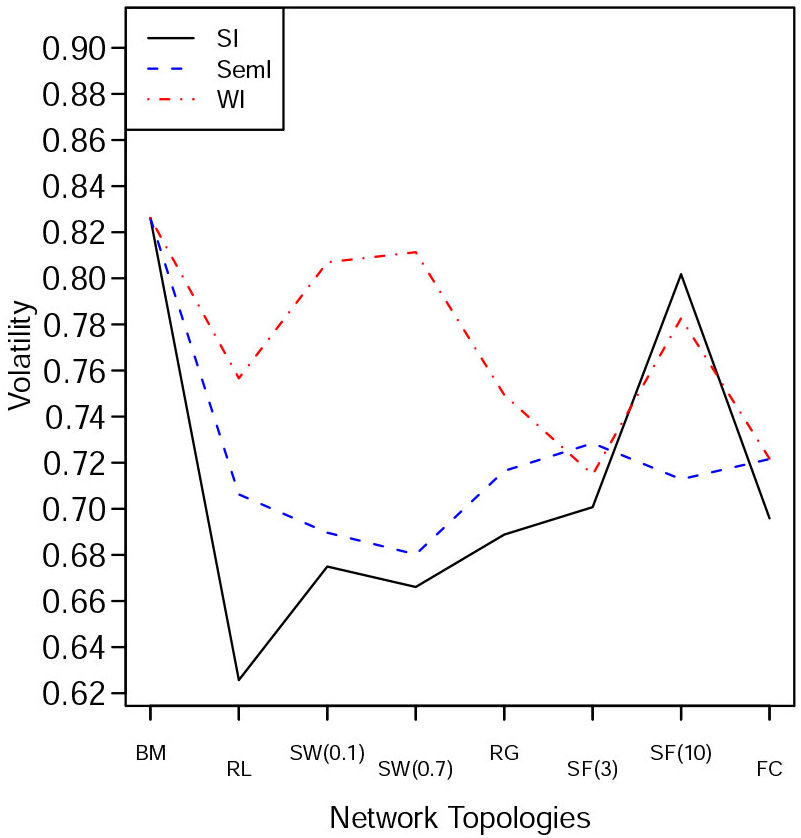 (Top: Volatility vs. Network Topology for NEC=1. Note how Strong Imitation fluctuates wildly across topologies compared to Semi-Strong/Weak styles.)
Key Insights: Why "Intelligence" Matters
The results challenge the simplistic view that "faster networks = more volatility."
- The Homogeneity Trap: In "Strong Imitation" mode, fast-transmitting networks (like Scale-Free) lead to homogenous expectations. This actually lowers trading volume because fewer people are willing to take the opposite side of a trade, yet it increases price distortion as everyone chases the same "best" rule.
- The Stabilizing Force of Prudence: When the evolutionary cycle (NEC) is increased to 5 (meaning traders update their strategy pools less frequently and evaluate performance longer), the "network effect" essentially disappears. Prudence acts as a form of heterogeneity maintenance.
- The Weak Imitation Advantage: Weak imitation (crossover/mutation) consistently results in lower volatility across almost all network types. By "tinkering" with ideas rather than absorbing them whole, traders maintain the necessary market diversity to absorb shocks.
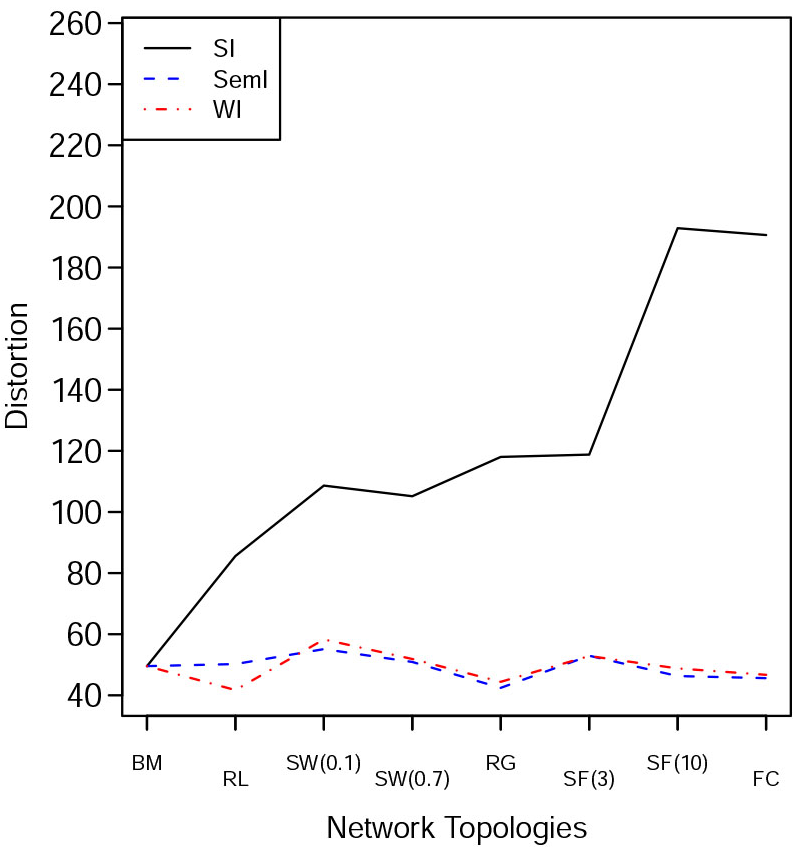 (Comparison of Price Distortion across networks. High-centrality networks like SF(10) show massive distortion under Strong Imitation.)
Critical Analysis & Conclusion
The paper successfully proves that strategy heterogeneity is the ultimate fuel for market stability. When social networks become too efficient at spreading a single "winning" strategy (Strong Imitation in Scale-Free networks), they paradoxically break the market mechanism by killing the volume—leading to "price limits" of a different sort.
Takeaway for Policy Makers: Regulating information flow isn't just about limiting who talks to whom; it's about encouraging a market environment where agents are incentivized to be "prudent" and "intelligent" evaluators of information rather than fast-copying mimics.
Limitations: The study assumes static network topologies. In real markets, networks are dynamic—wealthy traders might attract more followers over time, creating a feedback loop between market performance and network structure that is yet to be fully explored in this framework.