
Social Networks as a Weapon: Why Your "Safe" Apps are Profiling You
Social Networks as an Attack Platform: Facebook Case Study
The paper explores how social networks like Facebook can be weaponized as attack platforms. The authors develop a proof-of-concept Facebook application that, while appearing as a harmless slideshow, silently collects sensitive user data, including IP addresses, browser versions, OS details, and open port statuses to create "attack profiles."
TL;DR
Researchers have demonstrated that social networking platforms, particularly Facebook, can be surreptitiously converted into attack platforms. By exploiting the inherent trust users have in their digital social circles, an attacker can use a seemingly benign application to map a user's local network, identify open ports, and build a precise "attack profile" for future exploitation.
Background: This work moves beyond theoretical DDOS attacks to focus on targeted reconnaissance. It highlights a critical flaw in the Web 2.0 social model: the platform provides the infrastructure and the trust, while the attacker provides the payload.
The "Trust Gap": Why Firewalls Fail
The core problem identified by the authors is Embedded Trust. A user who would never open a suspicious email attachment will readily install a "Funny Dog Slideshow" app if invited by a friend.
Current security infrastructure (Antivirus/Firewalls) is largely blind to this because:
- The traffic occurs over standard HTTP/HTTPS ports.
- The application is "authenticated" and approved by the social platform.
- The execution happens within the browser, where standard network defenses are less granular.
Methodology: The Anatomy of a Stealth Scan
The authors built a proof-of-concept Facebook application using a combination of FBML (Facebook Markup Language) and PHP. The "malicious" insight was the use of a hidden iframe.
The Technical Workflow:
- The Bait: A simple slideshow application that is indexed on the official Facebook app directory.
- The Bypass: While Facebook masks user IPs, the authors used an
<iframe>to redirect the user's browser to an external server controlled by the attacker. - The Payload: Once the browser hits the external server, it executes AttackAPI—a Javascript-based port scanner. Because Javascript runs on the client-side, the scan originates from the victim's own machine, successfully mapping the local network and identifying open services like FTP (Port 21) or Telnet (Port 23).
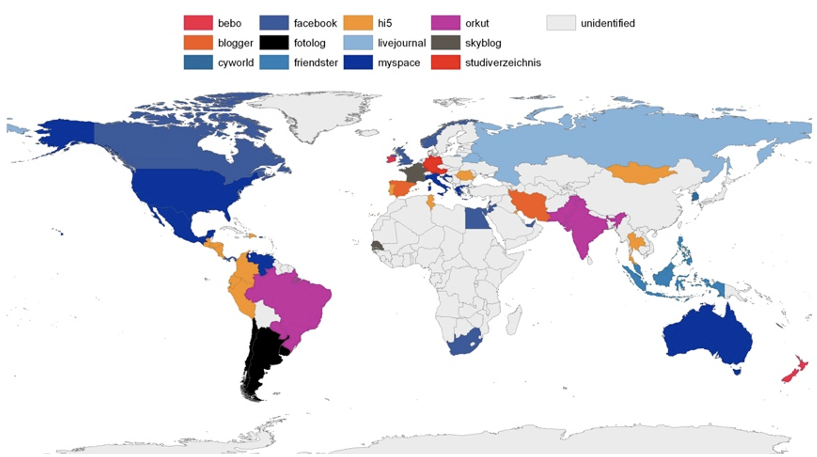 The study outlines the massive scale of potential victims across platforms like MySpace and Facebook.
Experimental Profiling
The researchers successfully received automated emails containing the "Perfect Attack Profile" of victims, including:
- Public IP Address: Bypassing Facebook's internal proxying.
- OS/Browser Fingerprint: Enabling targeted exploits for specific software versions.
- Port Map: Real-time status of whether common ports are open or closed.
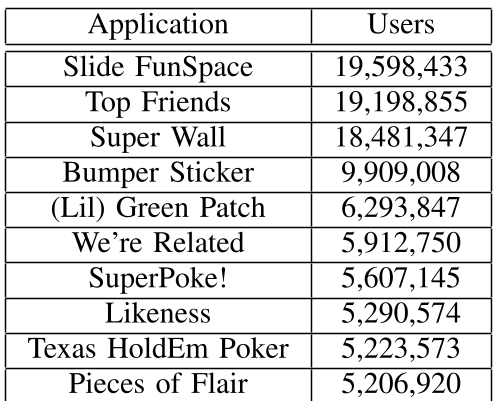 With applications reaching tens of millions of users, the "viral" nature of social platforms allows an attack to scale at a rate unreachable by traditional malware.
Critical Analysis: Is the Social Web Inherently Insecure?
The authors conclude that the "Web 2.0" paradigm of opening APIs to third-party developers has created a permanent security leak.
Key Takeaways:
- Detection is difficult: Because the scanning is "distributed" (each user's browser scans itself), there is no centralized malicious traffic for a Backbone ISP to block.
- The "Koobface" Comparison: Unlike traditional trojans that require users to manually install codecs or execution files, these API-based attacks run automatically within the context of a "trusted" app.
- Limitation: The study was conducted during the early "Platform" era of Facebook. While modern browsers have since implemented stricter Same-Origin Policies (SOP) and CORB, the fundamental logic of using social trust as a delivery mechanism for social engineering remains highly relevant today.
Conclusion
Social networks are more than just communication tools; they are powerful, distributed execution environments. As documented in this study, the shift from "Antisocial Networks" (botnets) to "Social Profiling" marks a transition toward more sophisticated, targeted cyber-espionage. Developers must treat third-party API permissions not as a convenience, but as a major security perimeter.