
BNCF: Transposing Social Network Transitivity to Solve Recommendation Sparsity
From Social Networks to Behavioral Networks in Recommender Systems
This paper introduces BNCF (Behavioral Network based Collaborative Filtering), a recommendation approach that replaces explicit user ratings with navigational patterns. By modeling users in a behavioral network and applying social network techniques like transitivity, the system identifies non-obvious relationships to achieve a 13% improvement in HMAE over classical collaborative filtering.
TL;DR
Recommender systems often struggle when users don't provide explicit ratings. This paper introduces BNCF (Behavioral Network based Collaborative Filtering), a framework that builds a directed graph of users based on their navigational sequences. By applying the social logic of "a friend of a friend is a friend"—or in this case, "a user who behaves like someone who behaves like me is similar to me"—the system uncovers latent neighbors, leading to a 13% boost in high-interest prediction accuracy (HMAE).
Problem & Motivation: The "Feedback Gap"
The primary bottleneck in Collaborative Filtering (CF) is the reliance on explicit feedback (votes/stars). In many enterprise environments, users consume content without rating it.
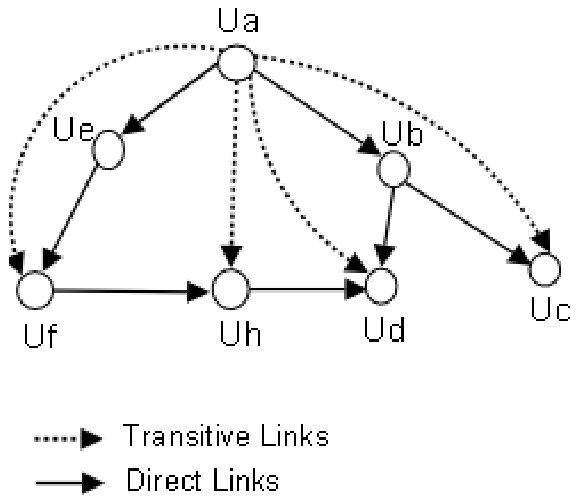
- Prior Work Limitation: Traditional systems look at direct overlap. If User A and User C have no common items, they are invisible to each other, even if User B bridges them both perfectly.
- The Insight: Navigational patterns (the order in which we browse) are "richer" than static ratings. By treating these patterns as a network, we can use graph theory to find "transitive" neighbors, effectively expanding the candidate pool for recommendations without requiring more data from the user.
Methodology: Engineering the Behavioral Network
The BNCF approach follows a three-stage pipeline:
1. Quantifying Behavioral Similarity
Instead of simple Pearson coefficients, the authors use the Longest Common Subsequence (LCS). This captures the sequential nature of browsing. The similarity is normalized to account for varying session lengths, ensuring new users with short sessions aren't unfairly penalized.
2. Building the Network with Floyd-Warshall
The system maps users as nodes in a graph. An edge exists if they share a navigational pattern. To find non-direct neighbors, the authors employ the Floyd-Warshall algorithm. By converting similarities into "distances," the algorithm finds the shortest path between any two users in the network, effectively identifying "transitive" neighbors.
3. Feature Inference
Since the final CF formula requires a "rating," BNCF infers implicit ratings by calculating:
- Frequency: How often a resource is visited.
- Duration: How much time is spent on a resource.
Experiments & Results: Precision where it counts
The model was tested on a 24-month log dataset from the Credit Agricole Banking Group (748 users, 3856 resources).
While the standard Mean Absolute Error (MAE) showed only marginal improvements, the High MAE (HMAE)—which measures accuracy for items the system thinks the user will actually like (rated 4 or 5)—showed a dramatic leap.

- BNCF vs. Classical CF: 13% improvement in HMAE.
- BNCF vs. Navigational (Direct only): 7% improvement in HMAE.
This proves that the "transitive" neighbors discovered by the graph algorithm are highly relevant for identifying top-tier recommendations.
Critical Analysis & Conclusion
Takeaway
BNCF successfully bridges the gap between Web Usage Mining and Social Network Analysis. It demonstrates that user behavior is not just a set of independent events but a structured graph where connectivity provides more signal than raw data points.
Limitations
- Computational Complexity: The Floyd-Warshall algorithm has a complexity of , which may not scale to millions of users without using sparser graph approximations or localized search.
- Implicit Bias: The reliance on "duration" as a proxy for interest can sometimes be misleading (e.g., a user might leave a tab open without reading).
Future Work
The shift from "Social" to "Behavioral" networks opens the door for Spreading Activation models and hybrid architectures that combine demographic links with active usage traces. As the authors suggest, the next step is combining these behavioral graphs with existing social structures to create a multi-dimensional recommendation engine.