
DBL-Browser: Mapping the Human Fabric of Computer Science Research
Analysing Social Networks Within Bibliographical Data
The paper introduces the DBL-Browser, a specialized retrieval and visualization tool designed to navigate multi-mode social networks within large-scale bibliographical databases like DBLP and io-port.net. It moves beyond traditional document-based search by mapping complex relationships between authors, conferences, and publications using social network theory.
TL;DR
The DBL-Browser transforms static bibliographic records into dynamic, multi-layered social networks. By moving beyond simple text searches, it allows researchers to discover "hidden" peers through collaboration patterns, shared conference histories, and a novel "Connected Triple" similarity algorithm. It bridges the gap between raw data (DBLP) and meaningful community insights.
The Problem: The Document-Centric Blind Spot
Most researchers find new papers through keyword searches. However, this document-oriented approach misses the social context of science. If two authors have never collaborated but consistently publish in the same niche conferences or share the same set of co-authors, they are likely working on the same problems. Traditional systems like Google Scholar emphasize what was written, but often obscure who is connected to whom and why a particular research community is evolving. The challenge lies in the vocabulary problem—different researchers use different terms for the same concept, but their social circles remain a stable indicator of their research domain.
Methodology: Beyond One-Mode Networks
The authors argue that a simple author-to-author graph (one-mode) is insufficient. Instead, they propose Multi-mode Social Networks that include authors, publications, and venues (conferences/journals).
1. The Hierarchy of Indirection
The system maps relationships across several layers:
- Direct Co-authorship: The strongest link.
- Friend-of-a-Friend (Connected Triples): Authors linked by a common collaborator.
- Institutional/Event Ties: Authors publishing in the same conference stream (e.g., VLDB or AAAI).
2. The "Connected Triple" Insight
To capture similarity between authors who haven't met, the paper utilizes the concept of a Connected Triple (). If Author A works with B, and Author C works with B, but A and C have no direct link, B acts as the "center." The number of such shared centers serves as a proxy for thematic similarity.

3. Multi-layered Browsing
The DBL-Browser implements a "multi-layered" interface where users can toggle between:
- Textual Views: Detailed publication lists and bibliographies.
- Graphical Views: Histograms of publication activity and visual maps of similar authors.
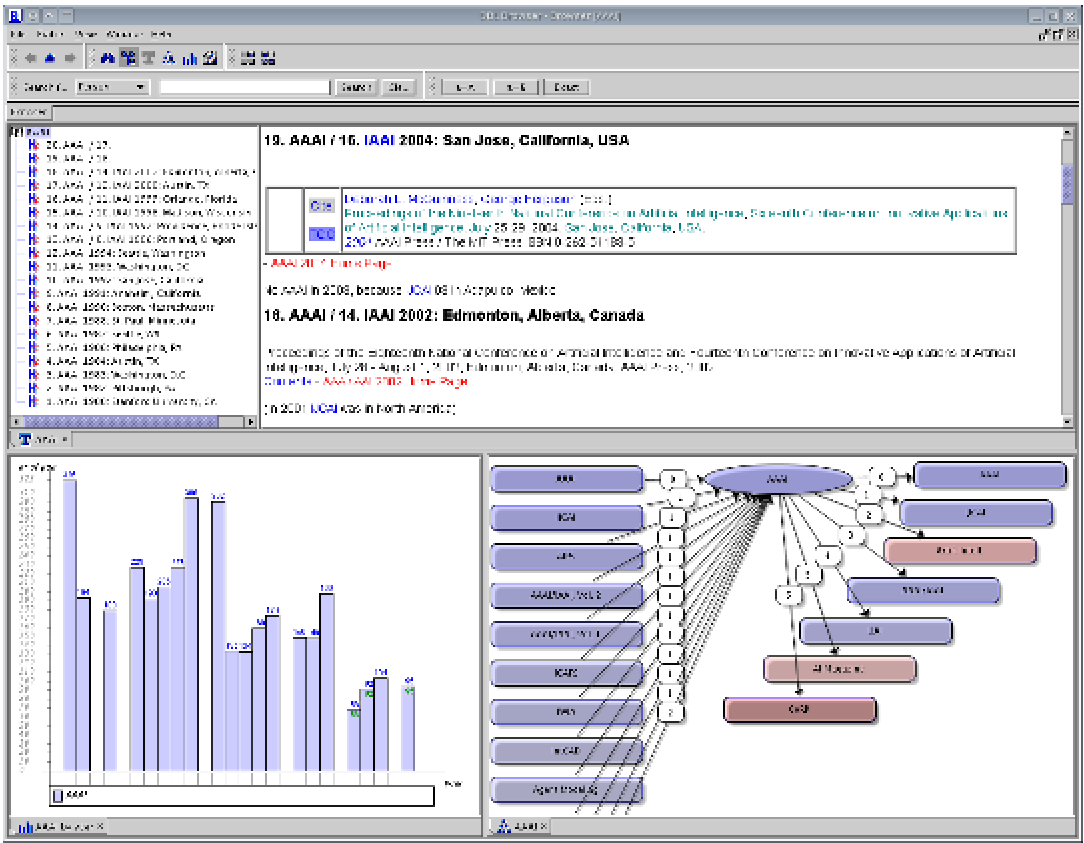 Figure 1: The interface allows users to see Table of Contents (TOC) alongside visual similarity metrics.
Experiments & Results: The Power of Hybrid Metrics
The study evaluated the Connected Triple approach against standard string-matching techniques (like Jaro-Winkler).
- Syntactic vs. Semantic: While string matching is good for finding name variations (synonyms), it cannot find related researchers with different names.
- The Synergy: The best performance in identifying related entities was achieved by combining syntactical (text-based) and semantical (graph-based) measures. This hybrid approach significantly reduced the noise in author disambiguation and similarity ranking.
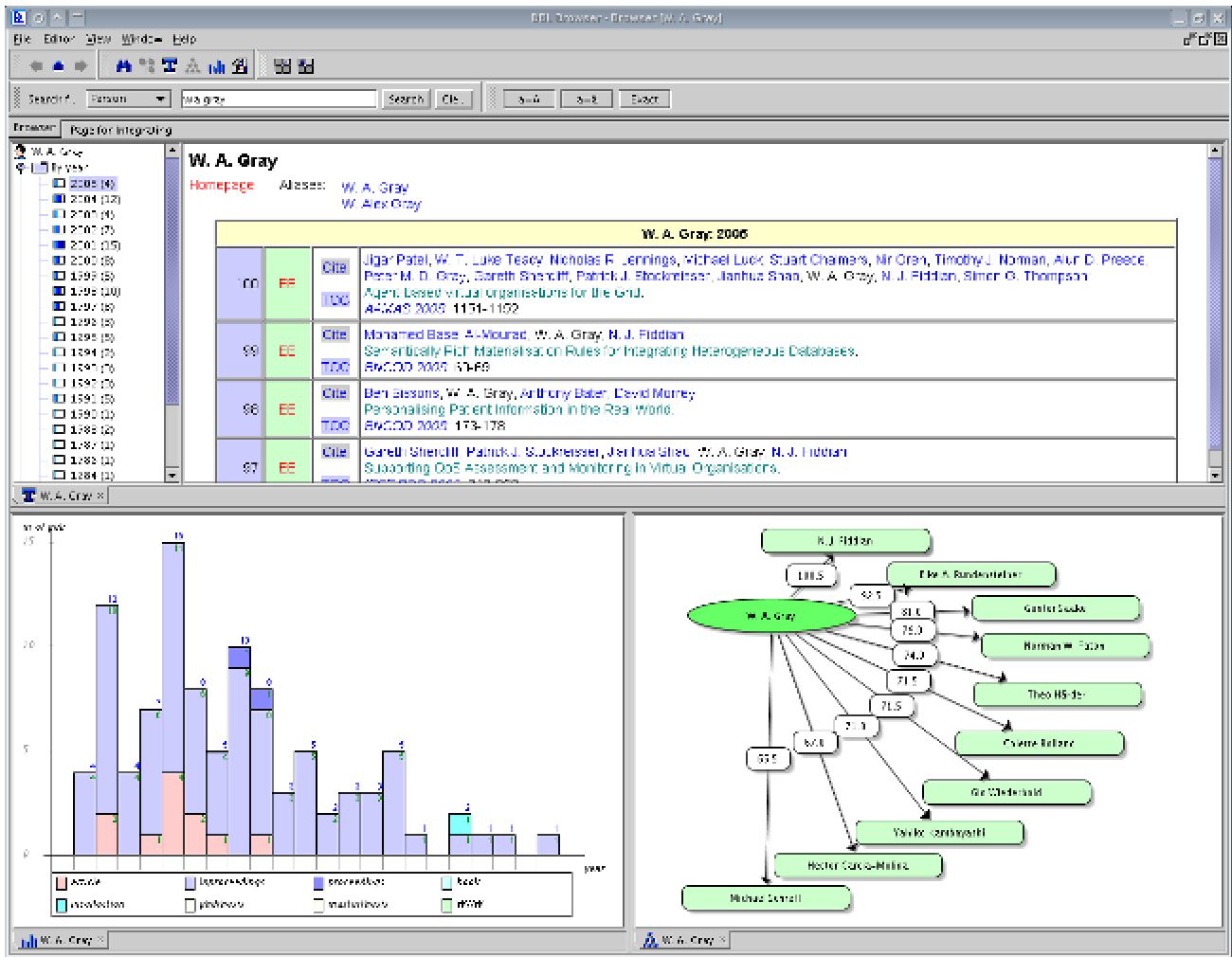 Figure 2: Visualizing similar authors using color-coding to distinguish between direct co-authors and thematic peers.
Critical Analysis & Conclusion
The DBL-Browser represents a shift toward Exploratory Search. Its strength lies in its high-quality data normalization—ensuring that "James L. Peterson" is the same entity across different records.
Limitations
- Affiliation Dynamics: The authors admit that tracking affiliation data is difficult because researchers move frequently.
- Computational Scaling: As the DBLP grows, calculating "Connected Triples" across millions of nodes requires increasingly efficient sparse matrix operations.
Future Outlook
This work laid the groundwork for modern "Academic Graphs." By treating bibliographical data as a social network, we can better predict emerging research trends and help young researchers find mentors and collaborators outside their immediate proximity. The DBL-Browser's modular design remains an invitation for the community to integrate more advanced AI-driven similarity algorithms.