
Detecting Social Bots with Benford’s Law: A Mathematical "Lie Detector" for Networks
Social networks bot detection using Benford’s law
This paper introduces a statistical approach for social bot detection on Vkontakte by applying Benford’s Law to user profile metrics. By analyzing the frequency distribution of the first significant digits of account data, the authors differentiate between automated "software bots" and legitimate users.
TL;DR
Researchers have found that while social bots can mimic human speech and profile pictures, they struggle to replicate the natural mathematical regularities of human social connections. By applying Benford’s Law to account metrics, this study provides a lightweight method to flag automated software bots with just a single API request per user.
Background: The Statistical Signature of Humanity
In social network security, the "cat and mouse" game between bot developers and detectors is constant. High-end bots—often called "live bots"—are increasingly difficult to catch because they are operated by real humans via exchange platforms. This paper investigates whether a 19th-century mathematical observation, Benford’s Law, can serve as a robust, low-cost filter for the modern bot crisis.
The Problem & Motivation
Current SOTA methods, such as BotOrNot, use nearly 1,000 features ranging from sentiment analysis to complex graph topology. While accurate, these methods are computationally expensive and difficult to scale across millions of accounts. The authors hypothesize that automated bots possess "unnatural" behavior that breaks the logarithmic distribution of leading digits (1 appearing ~30% of the time, 9 appearing ~4.6% of the time) found in genuine social growth.
Methodology: The First-Digit Test
The core of the approach is the Kolmogorov-Smirnov (K-S) test. The researchers analyzed seven distinct metrics for every account:
- Number of friends
- Number of groups/subscriptions
- Follower counts
- Post/Photo/Album counts
The process involves capturing the first significant digit of these counts and comparing the resultant distribution to the Benford curve.
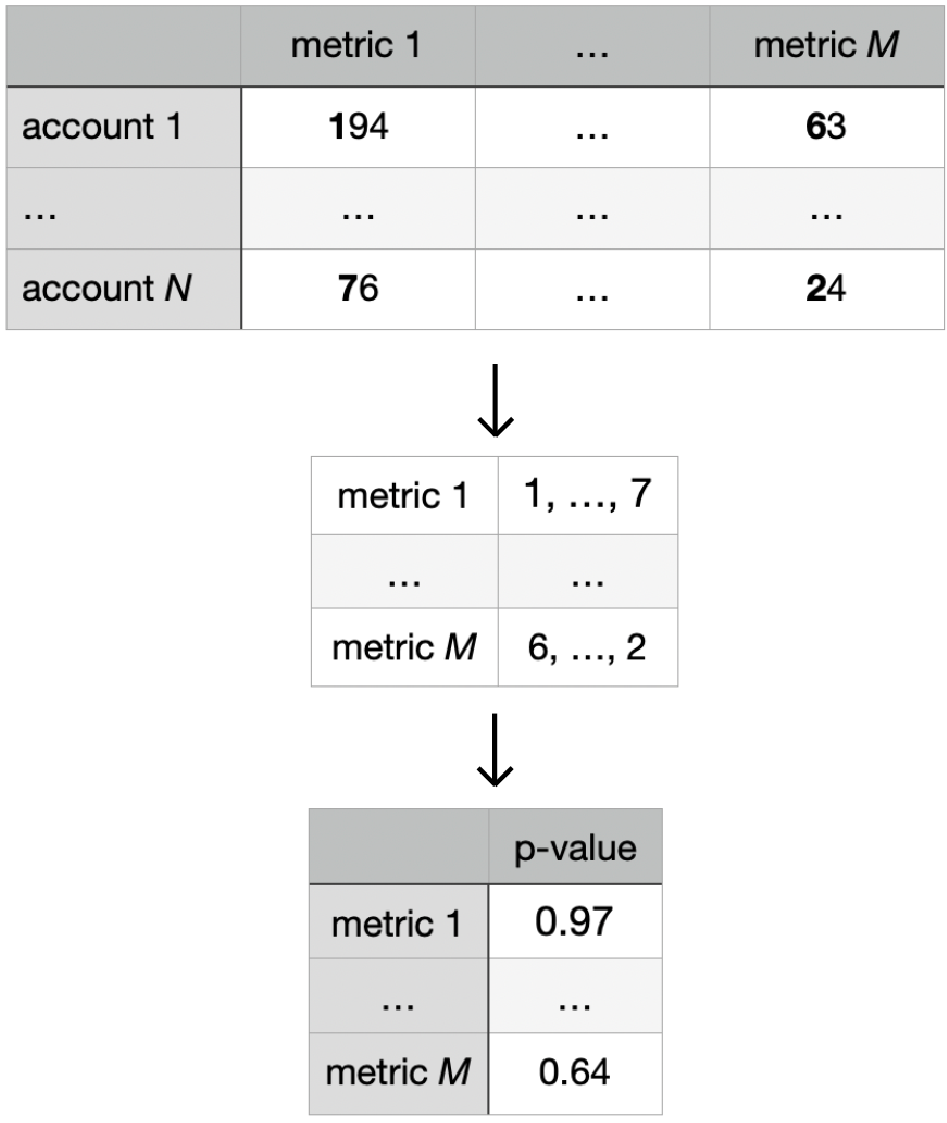
If a dataset passes the test (p-value > 0.95), it is categorized as human. If it fails across multiple metrics, it is flagged as a bot.
Experimental Battleground: Vkontakte (VK)
The team purchased bots from three different providers (Vtope, Martinismm, and Vktarget) representing various "quality" levels:
- Software Bots: Fully automated accounts.
- Live Bots: Human-orchestrated or exchange-based accounts (referrals).
They compared these against 10 real-user communities (e.g., developers, sports fans, activists).
Key Findings
The results revealed a clear divide in the effectiveness of the law:
- Automated Bots (Low/Mid Quality): Failed the Benford test significantly. Their growth is often linear or randomized, which does not match natural logarithmic distributions.
- Live Bots & Referrals: These accounts "passed" the test. Because these are real accounts owned by humans who are simply being paid to "like" or "follow," their underlying social metrics remain naturally distributed.
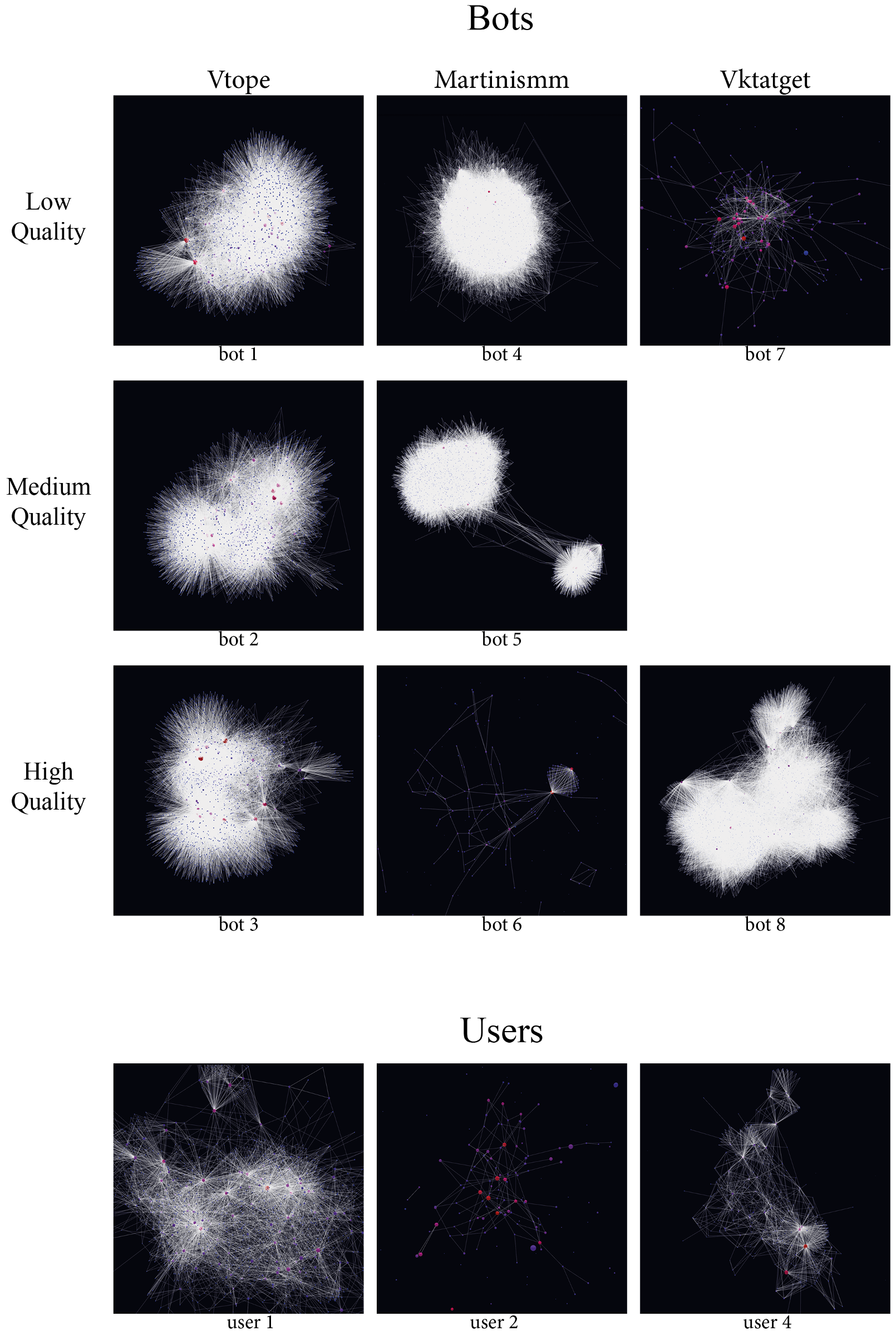 Figure: The visual graph analysis shows that "Live quality" bots (bot_3) often look identical to software bots, whereas exchange-market bots (bot_6/7/8) mimic the connectivity of real users.
Critical Analysis & Future Outlook
The study honestly addresses the limitations of the approach:
- The Privacy Paradox: Many human users hide their metrics via privacy settings. In VK, this led to "False Positives" where legitimate users were flagged as bots because the partial data available didn't conform to Benford's Law.
- The "Live" Bot Challenge: Benford's Law is a detector of automation, not of intent. A real human account used for malicious political influence will still look like a human account under this statistical lens.
Future Work
The authors suggest that while Benford's Law isn't a "silver bullet," it is a powerful feature for ML models. By using the p-value as one of many inputs, detection systems can drastically reduce the false-positive rate while maintaining high throughput.
Takeaway for the Industry
For platform moderators, Benford's Law offers a "cheap" way to perform mass triage. It allows for the immediate purging of low-quality automated scripts, forcing adversaries to move toward "live" bot platforms, which significantly increases the cost of conducting large-scale information attacks.