
Auctioning Knowledge: Driving the Cultural Engine through Competitive Distribution
Problem solving using social networks in Cultural Algorithms with auctions
This paper integrates auction-based knowledge distribution mechanisms—English, First-Price Sealed-bid Single-round (FPS), and Multi-round (FPM)—into the Cultural Algorithm (CA) framework. Utilizing a heterogeneous sub-cultured network, the authors demonstrate that auction models significantly enhance the efficiency of problem-solving in complex, real-valued functional landscapes compared to traditional weighted majority methods.
TL;DR
This research redefines the "Social Fabric" of Cultural Algorithms by treating the distribution of problem-solving heuristics as a competitive marketplace. By implementing English and First-Price Sealed-bid auctions, the authors transform how knowledge sources influence a population, achieving faster convergence in complex landscapes and providing a blueprint for a "Cultural Engine" that adapts in situ.
Context: The Social Fabric of Intelligence
Cultural Algorithms (CA) simulate the process of cultural evolution, where a Belief Space (containing knowledge sources like Normative or Situational knowledge) influences a Population Space. Historically, the "Influence Function"—the bridge between these spaces—has been a bottleneck. How do we decide which heuristic (KS) should guide which individual when multiple neighbors suggest different strategies?
The authors argue that the traditional Weighted Majority Win (WMW) is too blunt. Instead, they propose that knowledge should be "bid" for, allowing the most "valuable" (successful) heuristics to dominate the local social network through economic-inspired mechanisms.
Problem: The Search for a Strong Signal
Existing metaheuristics often struggle with the balance between exploration and exploitation. In dynamic landscapes, a fixed topology or a simple majority rule can lead to:
- Stagnation: Inefficient knowledge takes too long to be rotated out.
- Marginalization: Potentially useful network structures are discarded before they can prove their worth (the "Topology Dominance" problem).
Methodology: The Auction Mechanisms
The paper introduces a two-step "Social Fabric Influence" function. After a Direct Influence step, the Knowledge Distribution step commences via an auction.
The Three Bidding Models
- First-Price Sealed-Bid (FPS): KS bidders submit one hidden bid based on their historical performance. The highest bid wins immediately.
- First-Price Multi-round (FPM): Similar to FPS, but employs a multi-round tie-breaking scheme where tied KS spin their bidding wheels again until a winner emerges.
- English Auction: A classic ascending-price model. Bidders respond to each other until no higher bids can be generated.
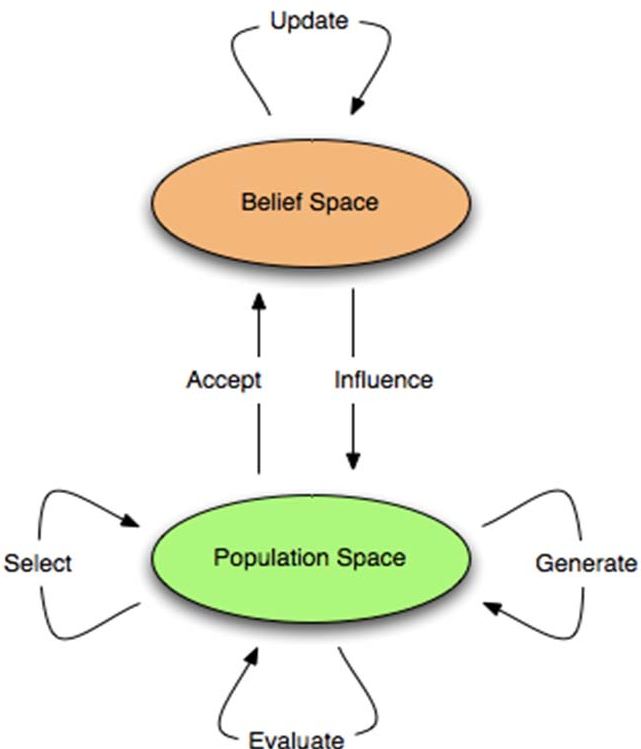 Figure 1: The Cultural Algorithm meta-heuristic framework.
The Sub-Culture & Wild Card Mechanism
To prevent a single topology (e.g., a "Global" or "Ring" network) from dominating prematurely, the authors implemented a Wild Card Mechanism. This grants a 5% fixed chance to select any topology regardless of performance, ensuring the system maintains "structural diversity" throughout the evolution.
Experiments: Cones World Complexity
The team tested these mechanisms on Cones World, a landscape generator where complexity is controlled via a logistics function (A-value).
- Fixed (A < 3.0): Predictable landscapes.
- Periodic (3.0 < A < 3.5): Landscapes with bifurcating signals.
- Chaotic (A > 3.99): High-entropy, unpredictable environments.
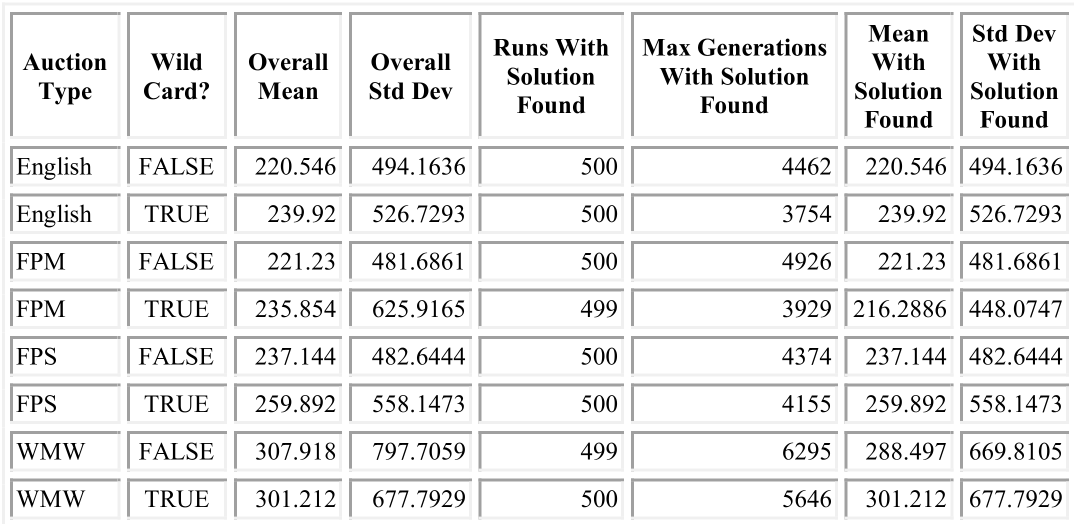 Table 1: Performance metrics for fixed landscape (A=1.1).
Key Findings
- Auction Dominance: In low-to-medium variability problems, auction mechanisms (specifically FPM and FPS) reached solutions faster than the baseline WMW.
- Exploitative Precision: The auction system acts as a high-precision filter. In sub-cultures with "strong signals," it makes rapid decisions that drive the population toward local optima.
- The Chaos Limit: As landscapes become chaotic (A=3.35 to 3.4), auctions begin to lose their edge. Without a clear signal of "value," bidding becomes as arbitrary as random selection.
Critical Insight: The "Cultural Engine" Concept
The most profound takeaway is the transition from a "closed system" to a Cultural Engine. By measuring metrics like dispersion coefficients and innovation costs, the CA can now be viewed as a mechanical system that "shifts gears" (topologies and distribution rules) on the fly based on internal sensors.
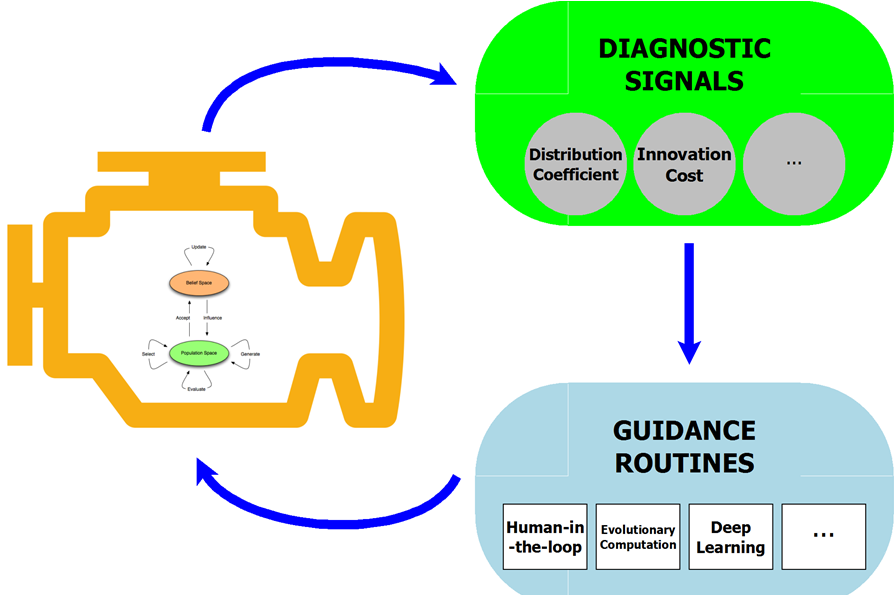 Figure 2: The Cultural Engine feedback loop.
Conclusion
This paper successfully demonstrates that market-based competition—auctions—can solve the coordination problem in social evolution algorithms. While not a silver bullet for chaotic systems where signals are lost, auction-based Cultural Algorithms offer a highly efficient, exploitative tool for complex optimization where precise, rapid decision-making determines success.