
Beyond the Feed: Fusing Social Networks with Affective Computing for Deeper Behavioral Insight
Using Social Networks Data for Behavior and Sentiment Analysis
This paper surveys data extraction methodologies from social networks (Facebook and Twitter) and proposes an integrated architectural framework that combines social media data with Affective Computing. It highlights the potential for multi-modality in detecting human behavior and sentiment to improve accuracy in fields like psychology and marketing.
TL;DR
Social networks are vast repositories of human behavior, yet textual analysis alone often fails to capture the complexity of human emotion. This paper proposes a transition from simple sentiment analysis to a multimodal architecture that integrates Social Graph APIs, NoSQL databases, and Affective Computing (sensors for facial and physiological signals) to unlock a more authentic understanding of user states.
Academic Positioning: This work serves as a high-level architectural survey, bridging the gap between data engineering (APIs/NoSQL) and behavioral psychology (Affective/Sentiment Analysis).
The Limitation of the "Digital Mask"
The primary challenge identified by Calabrese et al. is that social media users can simulate or hide their true feelings through text and emoticons. Prior works in sentiment analysis often focus on polarity (positive/negative/neutral) but struggle with the "why" and the authenticity of the expression. Furthermore, the technical hurdle of extracting data through restrictive APIs (OAuth 2.0) and managing unstructured graph data complicates large-scale behavioral modeling.
Methodology: A Multimodal Integration Framework
The core of the paper is the proposal of an integrated system that doesn't just look at what a user posts, but how they are physically behaving while interacting with the platform.
1. Data Acquisition and Graph Theory
The authors emphasize that social networks are best modeled as Graph Databases, where nodes represent entities and arcs represent actions or relationships. They detail the use of:
- Facebook Graph API: Utilizing the Open Graph Protocol (OGP) to fetch JSON/XML responses.
- Twitter Streaming API: Enabling real-time polling of tweets via OAuth 1.0/2.0.
2. The Integration Architecture
The proposed architecture moves beyond the screen. It suggests a pipeline where social data is complemented by:
- Affective Computing Sensors: Microphones for voice tone, cameras for facial expressions, and even pressure sensors on keyboards/mice to track posture and gesture patterns.
- Data Storage: Suggesting a NoSQL approach (Key-Value, Column-oriented, or Graph DBs) to handle the volume and lack of structure in physiological data.
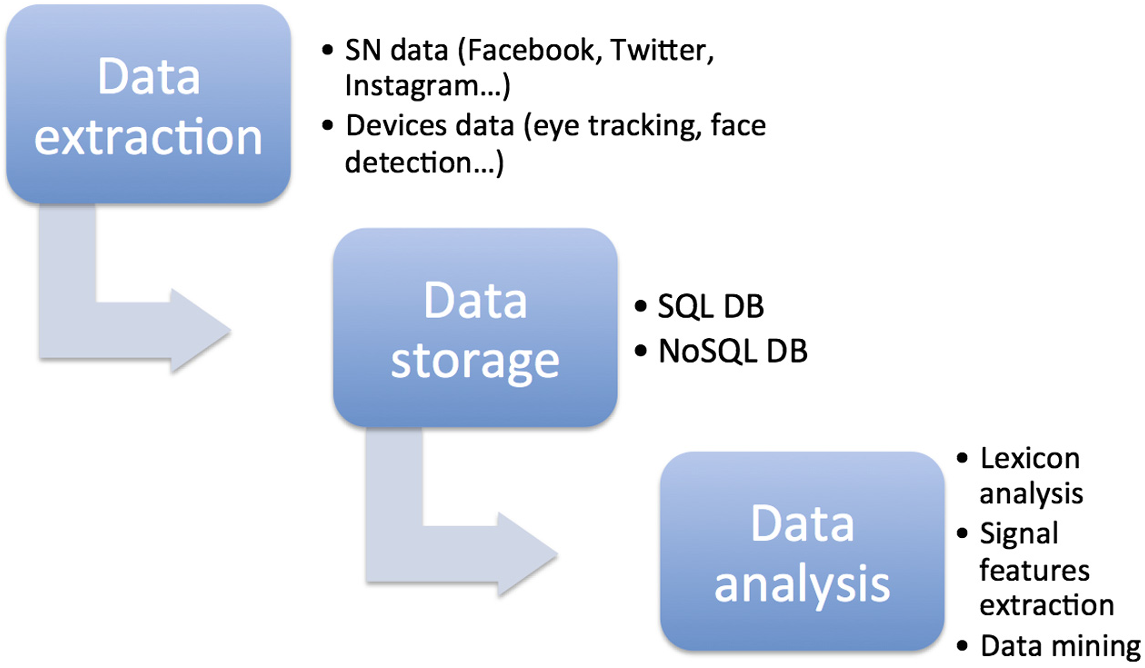 Figure 1: Proposed scheme for integrating social network data with external sensory inputs.
Experiments and Comparative SOTA
The paper cites several key benchmarks that validate the individual components of their vision:
- Social Monitoring: Textual posts on Facebook could predict psychological traits (Self-Monitoring skills) with ~60% accuracy.
- Sentiment Accuracy: The SentBuk application achieved 83.27% accuracy using a hybrid lexical and machine learning approach.
- Affective Recognition: Systems using Facial Animation Parameters (FAPs) reported over 70% accuracy in basic emotion recognition.
The authors argue that by fusing these methods (e.g., combining the 83% text accuracy with 70% facial accuracy), the overall robustness of behavioral detection—especially for critical cases like depression detection—would significantly improve.
Critical Insights & Future Outlook
Takeaway
The paper’s primary value is its advocacy for Unobtrusive Emotion Recognition. Instead of relying on a user to "check-in" or write a status, the system monitors behavioral patterns (typing speed, location, facial micro-expressions) via mobile devices to provide a continuous, high-fidelity emotional stream.
Limitations
- Privacy & Ethics: While mentioned, the ethical implications of tracking physiological data alongside social profiles are immense and require more rigorous framework designs.
- Technical Implementation: The paper provides the architecture but stops short of a full-scale implementation of the integrated prototype.
Future Work
The next step in this research lineage involves the application of Deep Multimodal Fusion. Moving forward, we expect to see models that use Attention Mechanisms to weigh "speech features" more heavily than "text features" when a user is likely masking their sentiment, creating a truly intelligent "Socioscope."
Conclusion
By treating social network data not just as text, but as a component of a larger affective ecosystem, we can move closer to applications that don't just "read" our posts, but "understand" our mental well-being.