
Beyond Random Walks: Leveraging Social Structure for Optimized DTN Routing
Impact of Social Networks on Delay Tolerant Routing
This paper investigates the performance of multi-copy routing in Delay Tolerant Networks (DTNs) by introducing a community-based social network model. It proposes a "Community-based Spraying" strategy that intelligently distributes message copies between the source's and destination's communities, outperforming traditional Spray-and-Wait algorithms.
TL;DR
Modern Delay Tolerant Networks (DTNs) aren't just collections of random moving points—they are reflections of human social structures. This paper argues that by acknowledging "communities," we can optimize the Spray-and-Wait paradigm. By strategically dividing message copies between the source's local community and the destination's global community, the authors achieve lower latency and 15% higher resource efficiency than traditional blind spraying.
Background: The DTN Routing Dilemma
In a Delay Tolerant Network, a complete path from source to destination rarely exists. We rely on the "Store-Carry-and-Forward" mechanism. The gold standard for "zero-knowledge" routing has long been Spray-and-Wait, where a source hands out copies to the first nodes it meets.
However, the authors point out a critical flaw: If I am in a "High School" community and the destination is in a "Hospital" community, giving copies to my classmates (who I meet often but who rarely visit the hospital) is a sub-optimal use of limited message copies.
Methodology: The Community-Based Network Model
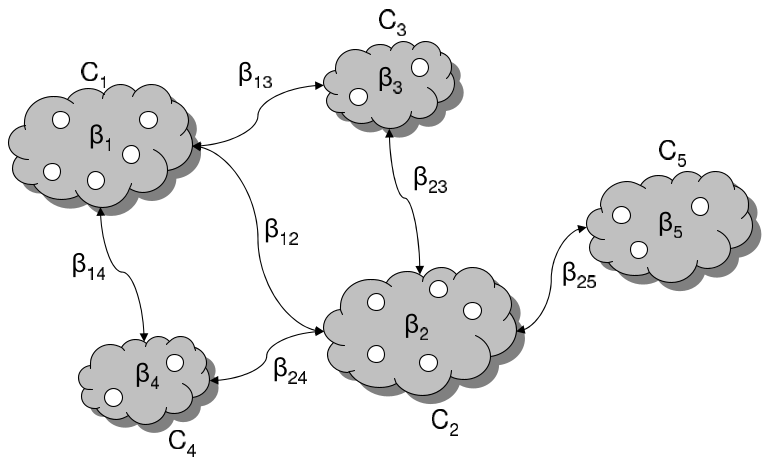
The authors propose a model that captures the heterogeneous nature of human movement. Instead of analyzing every individual interaction, they look at:
- Intra-community meeting time (): How often nodes in the same group meet.
- Inter-community meeting time (): How often a node from group A meets someone from group B.
- The Heterogeneity Factor (): The ratio . A higher means communities are more isolated.
Optimal Spraying Strategy
The core innovation is the split of copies into:
- Local Spraying (): Distributing copies within the source community. These are distributed quickly but have a lower individual chance of meeting the destination.
- Global Spraying (): Distributing copies specifically to nodes belonging to the destination's community. These take longer to distribute but have a much higher delivery probability once "carried."
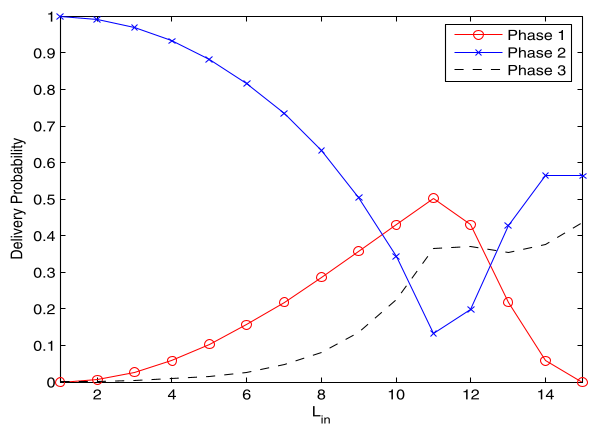
The authors provide a rigorous mathematical derivation using three phases: All Spraying, Mixed Phase, and All Waiting, finding the "sweet spot" for that minimizes total expected delay.
Experiments and Insights
The research moves beyond theory by validating the analysis through a Java-based simulator using the Random Direction Mobility Model.
1. Analysis vs. Reality
The expected delivery delay calculated by the authors' formulas matches the simulation results almost perfectly, proving that average inter-meeting times are sufficient for making high-level routing decisions.
2. Performance Gain
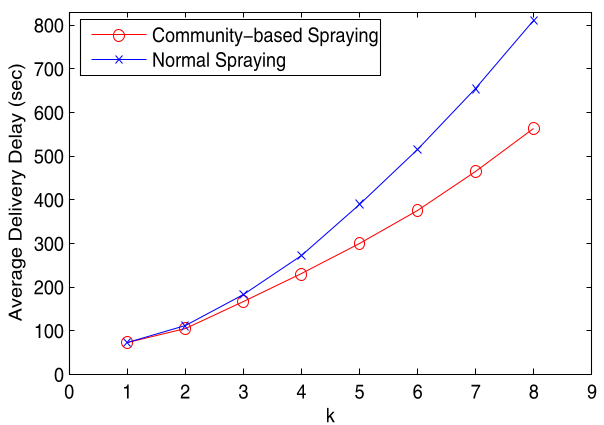
When compared to the "Traditional Spraying" (giving copies to anyone), the Community-based Spraying shines as the network becomes more socially partitioned (higher ).
- Delay: Significantly lower latency because copies reach the destination's "inner circle" faster.
- Efficiency: A 15% reduction in copy count was observed at . This is crucial for real-world devices with limited buffer space and battery.
Critical Perspective
While the paper provides a robust framework for two-community scenarios, real-world social networks are multi-layered (overlapping communities). The authors acknowledge this as a future direction, suggesting that a message might travel from if the direct bridge is too weak.
The primary takeaway for DTN architects is clear: Context is King. Blindly flooding a network is wasteful. By identifying community boundaries, we can transform an opportunistic "random walk" into a directed, efficient delivery system.
Conclusion
This work bridges the gap between social science and network engineering. By treating DTN nodes as social entities rather than just moving particles, it provides a blueprint for the next generation of Pocket Switched Networks (PSNs) and urban opportunistic routing.