
MinEC: Bridging the Gap Between Sybil Defense and System Churn
Social Networks Meet Distributed Systems: Towards a Robust Sybil Defense under Churn
This paper introduces MinEC (Minimum Expansion Contribution), a selective 2-hop neighbor selection heuristic designed to bolster Social Network-based Sybil Defenses (SNSD) under heavy churn. It effectively maintains network connectivity while preserving attack resilience, outperforming naive 1-hop and 2-hop overlay strategies.
TL;DR
Existing social-network-based Sybil defenses (SNSDs) break down in the real world because they ignore churn. When 90% of your users are offline, the social graph falls apart. This paper introduces MinEC, a smart "friend-of-a-friend" linking strategy that keeps honest users connected without letting the Sybils in.
The Reality Check: Is Your P2P System Actually Connected?
Most academic papers on Sybil defense (like SybilLimit or Gatekeeper) operate under a comfortable assumption: most honest nodes are online most of the time.
However, by analyzing 7 months of Skype data and Yahoo! Messenger traces, the authors found a harsh reality: only 5% to 25% of users are online concurrently. This "heavy churn" has a devastating effect:
- One-Hop Overlays Disintegrate: If you only connect to your direct friends, and 90% are offline, you become an island. Communication fails.
- Two-Hop Overlays Leak: If you connect to everyone your friends know (2-hop), you bridge the gap, but you also accidentally connect to thousands of Sybil nodes, creating "attack edges" that destroy the security of the system.
 Figure 1: Comparison of One-Hop, Two-Hop, and the proposed selective approach under churn.
Methodology: The MinEC Heuristic
The core contribution is MinEC (Minimum Expansion Contribution). Instead of blindly trusting every "friend of a friend," a node calculates a score for a potential 2-hop neighbor :
Why this works:
- The Logic: It prioritizes nodes that share many common neighbors (high trust) and penalizes nodes that introduce too many "new" unknown connections (high expansion).
- The Intuition: In a real social graph, honest circles are "cliquey." Sybil nodes, however, try to expand aggressively into the honest network. MinEC rewards the cliquey behavior of honest nodes, making it harder for Sybils to get selected as 2-hop links.
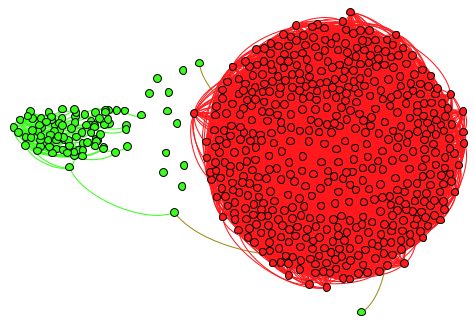 Figure 2: The disintegration of the overlay (a to b) and how different strategies (c vs d) recover connectivity.
Experimental Results: Best of Both Worlds
The authors tested MinEC across several massive social datasets. The results were striking:
- Connectivity: MinEC (with selective neighbors) mirrored the connectivity of a full 2-hop overlay. Even when 80-90% of the network was offline, honest nodes remained part of the "Largest Connected Component" (LCC).
- Security: While the naive Two-Hop approach saw Sybil "Escape Probabilities" skyrocket (meaning random walks ended up in the Sybil region), MinEC kept the escape probability as low as the original 1st-hop graph.
- Fast-Mixing: Crucially, the authors proved that the resulting graph remains "fast-mixing." Using Gatekeeper as a test case, they showed that MinEC allows these high-end security protocols to function correctly even in high-churn environments where they would otherwise fail.
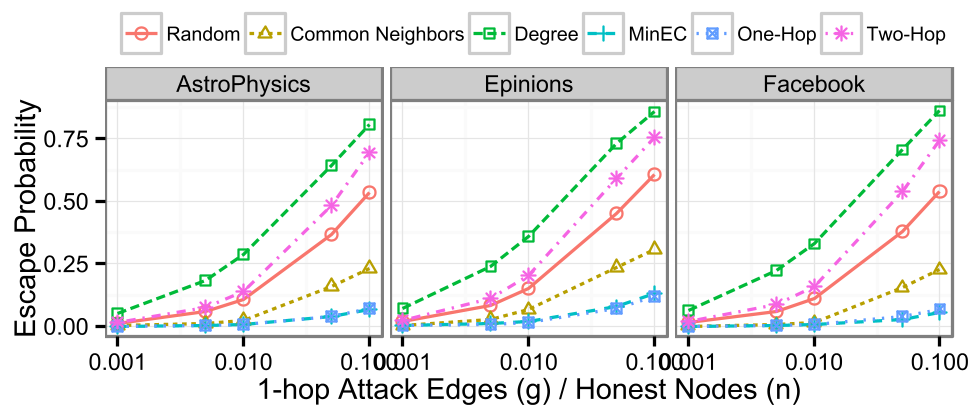 Figure 3: MinEC maintains low escape probability (Attack Resilience) while matching 2-hop Connectivity.
Critical Insights & Future Outlook
The value of this paper lies in its pragmatism. It moves Sybil defense from theoretical graph theory into the messy world of P2P dynamics.
Key Takeaway: Don't treat the social graph as a static backbone. In decentralized systems, the "active" graph is a fragile, shrinking subset of the "trust" graph. By using local heuristics like MinEC, we can build "elastic" overlays that expand and contract with churn while keeping Sybils at bay.
Limitations: While works for average social groups, extremely sparse networks might still struggle. Additionally, the paper assumes Sybil nodes stay online 24/7 (worst-case scenario), but future work could look at how Sybil nodes might use "fake churn" to mimic honest behavior.
Senior Editor's Note: This work is a foundational read for anyone building decentralized identity (DID) systems or P2P communication layers where user availability is intermittent.