
Decoding Crowdfunding Success: Why the "Mesh" Network Wins the Collaboration Game
How Social Networks Dynamics can Affect Collaborative Decision Making on Crowdfunding Platforms
This study investigates how four distinct social network structures—Null, Star, Weak-tie, and Mesh—impact group collaboration and decision-making on crowdfunding platforms. Using an economic experiment on Amazon Mechanical Turk, the researchers demonstrate that the Mesh network architecture achieve the highest efficiency in reaching fundraising goals.
TL;DR
Crowdfunding is more than just individual charity; it is a strategic coordination game. This research reveals that the way contributors are connected—the social network topology—drastically changes how they give. By testing four structures, the study finds that a Mesh network (where everyone sees everyone) leads to the most efficient coordination, while Star networks (leader-focused) often result in instability and lower success rates.
The Hidden Architecture of Giving
Why do some crowdfunding projects hit their target with surgical precision while others either fail or attract unnecessary surplus? The answer lies in the Social Network Structure.
Most platforms treat "social" as a generic feature—a "share" button here, a "comment" section there. However, the authors of this paper argue that the pattern of these relationships—the closeness and betweenness of the participants—functions as a vital information-sharing channel that dictates economic preferences.
Methodology: The MTurk Fundraising Experiment
To test this, the researchers set up a controlled environment on Amazon Mechanical Turk (MTurk). They used a modified Public Goods Game with 84 participants divided into groups of seven.
The goal: Reach a 17.5-point threshold. The catch: If the goal isn't met, you lose your contribution and get no reward. If it is met, everyone gets a bonus.
Four Experimental Topologies
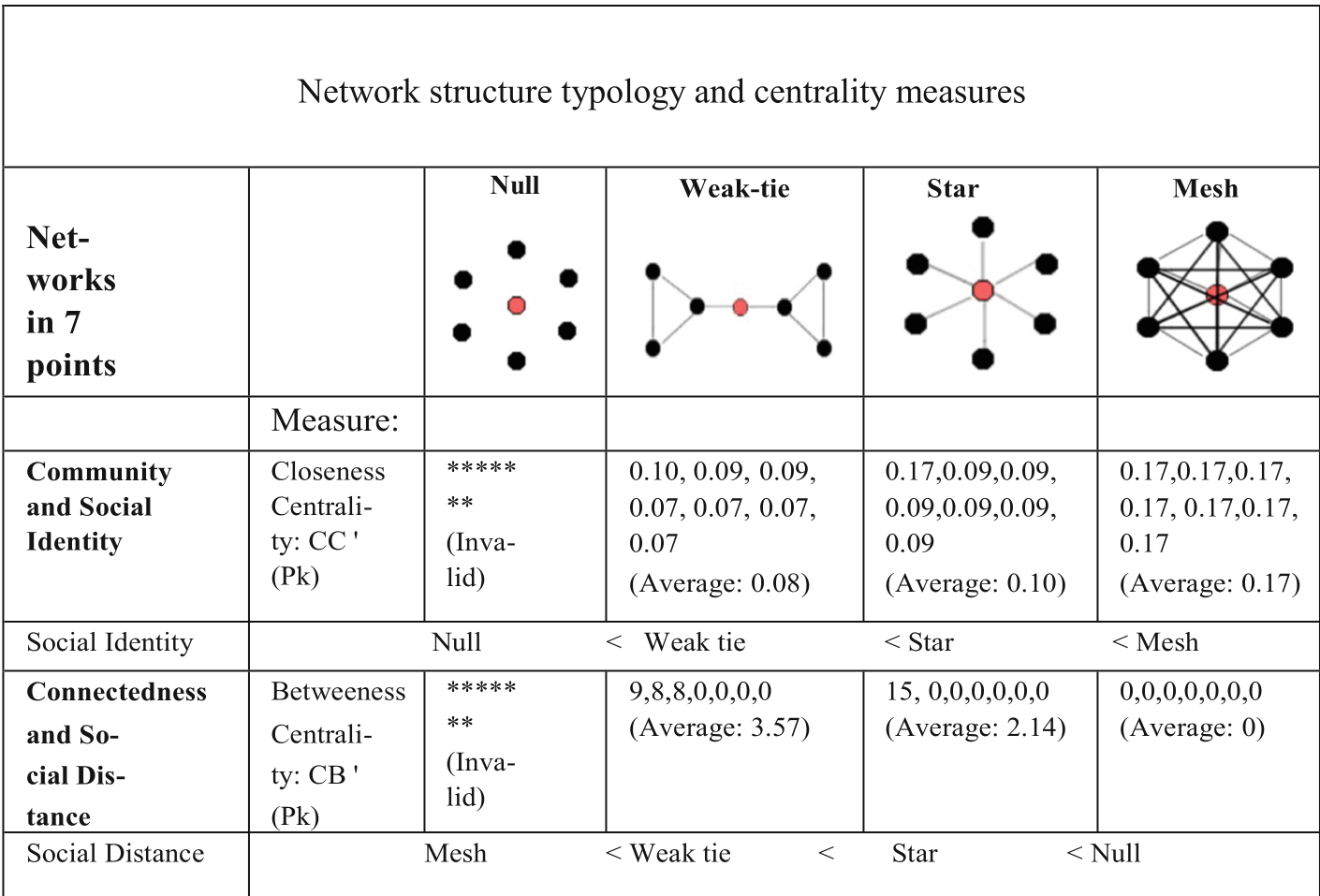
The researchers mapped the interaction based on four Freeman typologies:
- Null: No interaction; contributors are isolated.
- Star: A central "influencer" connects to everyone, but peers cannot see each other.
- Weak-Ties: Two subgroups linked by a single bridge.
- Mesh: A fully connected community where every member sees the actions of all others.
Key Insights: Efficiency vs. Generosity
The study distinguishes between Total Contribution and Collaboration Efficiency.
- The Problem with the Null Network: Isolated participants contributed the most (Mean 26.00), but this was actually inefficient. Since 17.5 was the goal, anything above that was a "waste" of contributors' resources.
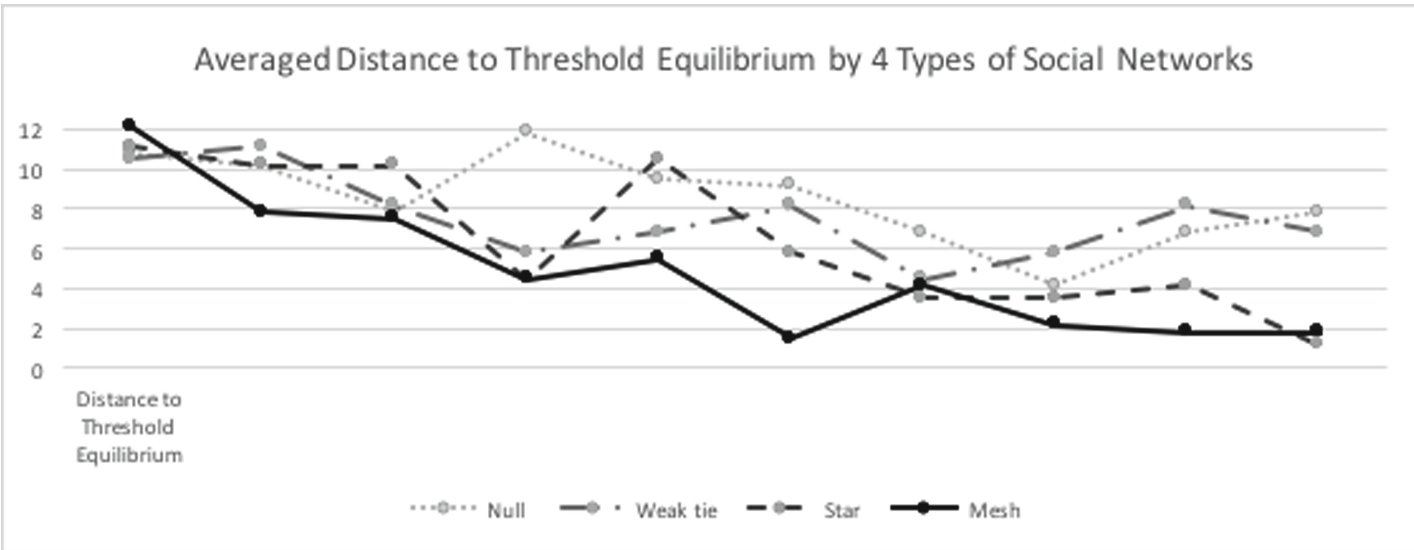
- The Mesh Advantage: In the Mesh network, the average group total was 22.40—the closest to the actual goal.
Why does the Mesh network work?
The authors point to two theories:
- Social Identity Theory: High "closeness" centrality in a Mesh network depersonalizes the individual and fosters group attachment.
- Social Distance Theory: Frequent interaction reduces "interactive social distance." When others are no longer "unknown nodes" but visible peers, empathy and cooperation levels rise.
The "Star" Network Trap
Surprisingly, the Star network yielded the lowest success rate. Why? The authors infer that a "dyad" relationship (leader-follower) is less efficient at transmitting the nuance of collective sentiment than a "triangle" (peer-peer interaction). Followers in a Star network relied solely on the leader's cues, leading to higher standard deviations and a failure to coordinate effectively around the threshold.
Critical Analysis & Future Outlook
Takeaway for Platforms: If you are building a crowdfunding site, don't just build a "broadcast" system for the project creator. Build a "Mesh" where backers can see and interact with one another. Transparency of social information is the most powerful "nudge" for efficient collaboration.
Limitations: The study used small groups (n=7). In the real world, crowdfunding involves thousands of backers. Whether the "Mesh" efficiency holds as the network grows—or becomes "information overload"—is a question for the next generation of academic technical inquiry.
Conclusion
Social networks are not just social; they are economic engines. By shortening the social distance between contributors, we don't just make them more generous—we make them smarter cohorts.