
From Society to the Command Room: Bridging the Emergency Information Gap with Social Media
Social networks and emergency: From society to the command room
This paper introduces a conceptual model designed to harness social media streams (SNS) to enhance situational awareness in emergency command centers. By utilizing a "Blue Bus" architecture, the researchers filter and categorize real-time social data into a domain-specific vocabulary tailored for official emergency responders and decision-makers.
TL;DR
In critical emergencies, official information is often too slow or too structured to capture the chaos on the ground. This paper proposes a transformation model—the Blue Bus Project—to turn the "buzz" of social media into actionable intelligence for command centers. By filtering organic social streams through a specialized semantic engine, the model aims to provide decision-makers with a "big picture" built from the perspective of citizens-as-sensors.
Contextual Blindness: The Core Motivation
During the emergency response phase, the primary hurdle isn't a lack of data; it's the information gap. Traditional Command and Control (C&C) environments rely on formal reports and official sensor networks. However, these sources often fail to capture localized nuances—a weakening hillside, a specific religious gathering in an unmapped area, or a localized power failure reported only via mobile data.
The authors argue that Social Network Sites (SNS) contain "hidden meaning" and "mutual support" facets that are frequently more useful than official bulletins. The challenge lies in translating this organic, unstructured conversation into a systematic format that an emergency manager can trust and use.
Methodology: The Engine of Transformation
The researchers define a collaborative framework that goes beyond the traditional "3C" model, adding Perception and Group Memory to the mix. The core of the proposal is a three-environment architecture:
1. Representation of the Real World
The intake layer where social media streams (like Twitter) are captured. It treats every user post as a signal of a "social sensor."
2. The Engine of Transformation
This is the technical heart of the project. It uses a Semantic Layer to map natural language into a controlled C&C vocabulary.
- Data Layer: Stores filtered incoming messages.
- Categorization Layer: Defines emergency subjects (e.g., Flood, Landslide, Medical Need).
- Semantic Layer: Maps the interrelations between these categories to create a sophisticated knowledge graph.
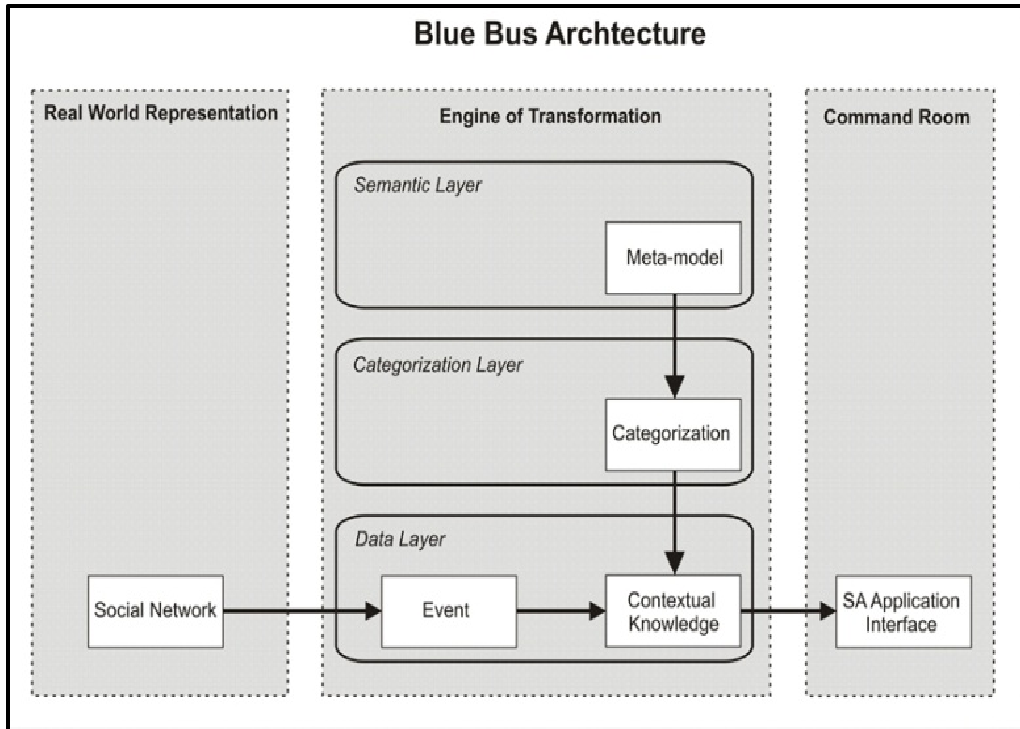 Figure: The "Blue Bus" Architecture showing the flow from publishing to interaction.
3. The Command Room
The final delivery stage. Instead of showing a raw feed of tweets, the system presents a matrix of contextual information or a "fulfillment percentage" of specific emergency tasks, allowing managers to see where situational awareness is high or dangerously low.
Usage Scenarios: Real-World Impact
The paper highlights the unique challenges of tropical urban areas (like Rio de Janeiro):
- The Landslide Scenario: While a city might have a static risk map, social media provides the likelihood based on physical sight. Dozens of messages about a specific slope provide "combined knowledge" that shifts a risk from "possible" to "occurring."
- Unmapped Regions: In informal settlements (favelas), official maps are often non-existent. Social media patterns during local events (weddings, parties) can help responders estimate the number of people in a building that has collapsed or been isolated.
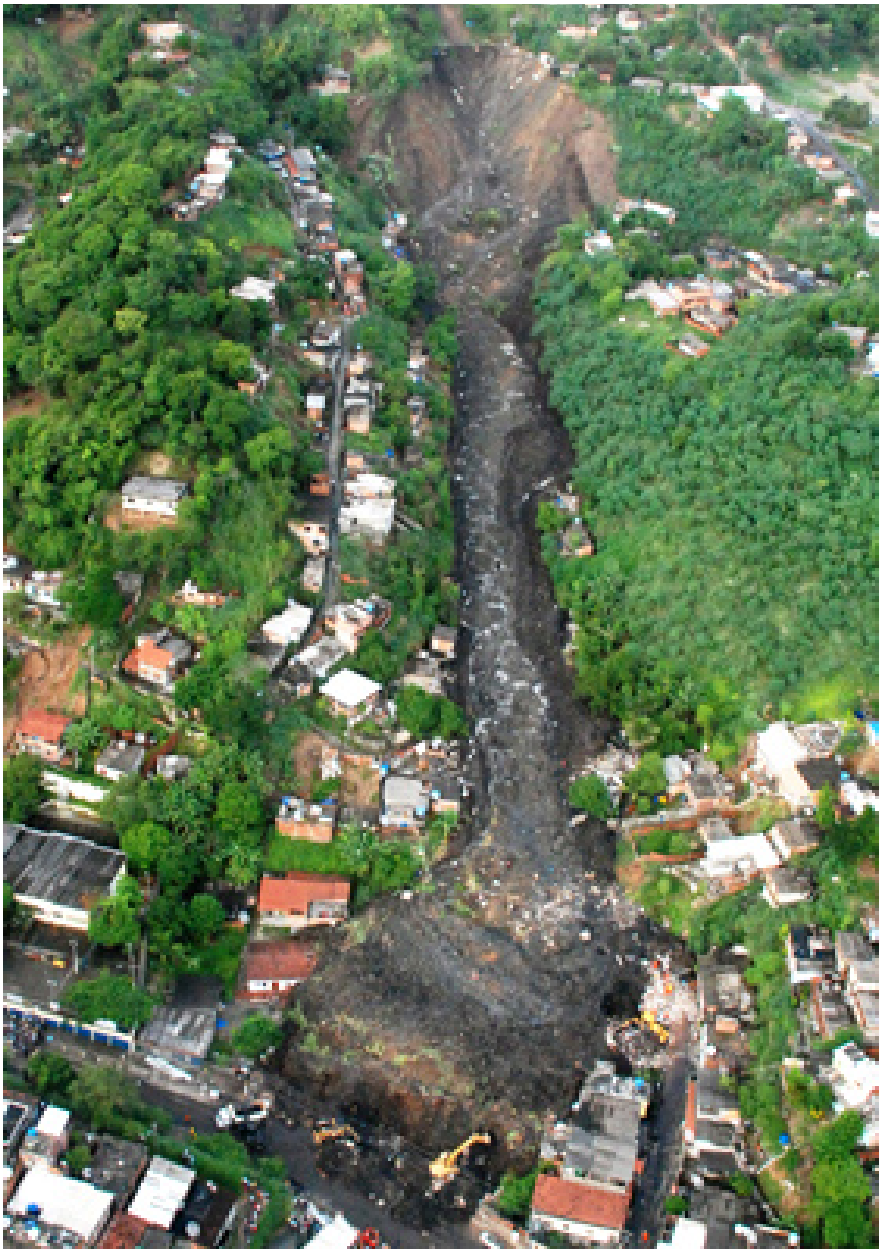 Figure: A visual representation of the complexity in landslide-prone urban zones.
Critical Analysis & Limitations
The authors are candid about the model’s current bounds:
- Temporal Sensitivity: The model is ineffective for "short duration" emergencies where there isn't enough lead time for a social "buzz" to form.
- Uncertainty & Misinformation: While collective intelligence is often accurate, "bad informers" or "fake news" pose a risk. The authors suggest a "black list" mechanism or potentially a dedicated disaster-response social network to mitigate this.
- Experimental Validation: Validating this in a live emergency is ethically and logistically difficult. The next steps involve using GATE (General Architecture for Text Engineering) to process historical social media datasets from past disasters to verify the engine's accuracy.
Future Outlook: Citizens as Sensors
The "Blue Bus" project represents a shift toward Web 2.0 principles in governance. By shortening the gap between the society and the command room, the researchers hope to foster trust. The future of emergency management lies not in better hardware alone, but in better co-production of information, where every smartphone becomes a tool for saving lives.