
Social Earthquakes: How the Nanjing Plane Tree Movement Rewrote Social Network Dynamics
Abstract-To gain insights into the evolution of social networks, in this paper, we study social networks constructed from the relationship of reposting and being reposted in Sina microblog, the most popular social networking website in China. We focus on a case of protecting plane trees in Nanjing, China. The event was aimed to protest Nanjing government for transplanting thousands of plane trees with superb historical value, for the purpose of constructing subway stations. The event lasted 8 days, culminating in a mass parading on the 6th day, and a subsequent compromise by the Nanjing government of leaving the remaining plane trees un-touched. Interestingly, we find that the network based on "reposting" is a scale-free power-law network. In contrast, the network based on "being reposted" is in general not a power-law network. Rather, the degree distributions there follow the celebrated Omori's law for earthquake after-shocks, suggesting that powerful microblog postings were like strong earthquakes that may elicit a sequence of after-shocks, i.e., numerous further postings and discussions. The parameters for the power-laws and Omori's laws changed from day to day, with the 6 th day being totally different from other days, coinciding with the fact that mass parading was on the 6 th day. Our study thus shows that much can be learned from the study of dynamical evolution of social networks
This paper examines the dynamical evolution of a Sina Weibo social network during the 2011 Nanjing "Plane Tree Protection" protest. By analyzing 23,971 microblogs, it identifies distinct structural behaviors for "reposting" (Scale-free) and "being reposted" (Omori’s Law) relationships, mapping network topology changes to real-world mass mobilization.
TL;DR
Researchers analyzing the 2011 Nanjing Plane Tree protection event on Sina Weibo discovered that social influence doesn't just spread—it "quakes." While participant activity follows standard scale-free patterns, the actual influence of posts mirrors Omori’s Law for earthquake aftershocks, revealing a world where leadership is fleeting and ordinary people drive mass mobilization.
Problem & Motivation: Beyond Static Networks
Most complex network research treats social structures as relatively stable. However, a protest is a "living" entity. In March 2011, when the Nanjing government planned to uproot thousands of historic plane trees for subway construction, a spontaneous microgroup formed.
The authors recognized that current models failed to explain how a group of 10,000+ strangers could reach a consensus and organize a mass parade in just six days. They sought to understand the dynamical evolution: How does the math of a network change when it moves from online debate to street protest?
Methodology: Reposting vs. Being Reposted
The study splits the network into two distinct directed behaviors:
- The Reposting Network (Out-degree): Measures the enthusiasm of users.
- The Being Reposted Network (In-degree): Measures the influence of the content.
The Structural Intuition
The authors discovered a fascinating duality. The "enthusiasm" network is Scale-free, meaning a few "super-posters" do most of the work. But the "influence" network follows Omori’s Law: This suggests that a powerful original post acts as a "Mainshock," triggering a sequence of "Aftershocks" (further discussions and reposts) that decay over time.
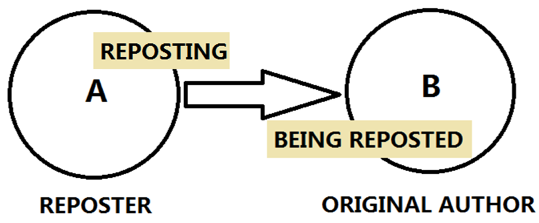 Fig 1: The web of interactions within the "Nanjing's Plane-Tree" microgroup.
Experiments & Results: The "Anomaly" of the 6th Day
The event lasted 8 days. On the 6th day, a physical mass parade took place. The mathematical parameters of the network shifted dramatically on this day:
- Activity (): The power-law exponent dropped below 1.0, implying a theoretical "infinite mean" of activity. Everyone was reposting everything.
- Influence Peaks: As shown in the chart below, the distribution shifted from standard power-laws to heavy-tailed seismic patterns.
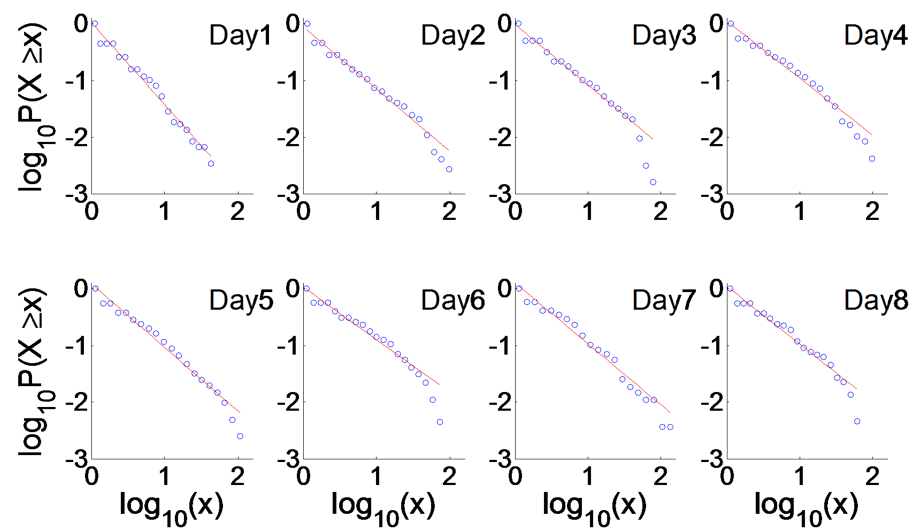 Fig 2: Complementary Cumulative Distribution Functions (CCDF) showing the shift in network scaling over the 8-day period.
The Disappearing Leader
One of the most striking findings was the decay of leadership. Initial "opinion leaders" (celebrities/influencers) who started the movement didn't stay in charge. As the event progressed, their influence plummeted, and new, "ordinary" leaders emerged based on the quality of their specific arguments regarding the trees.
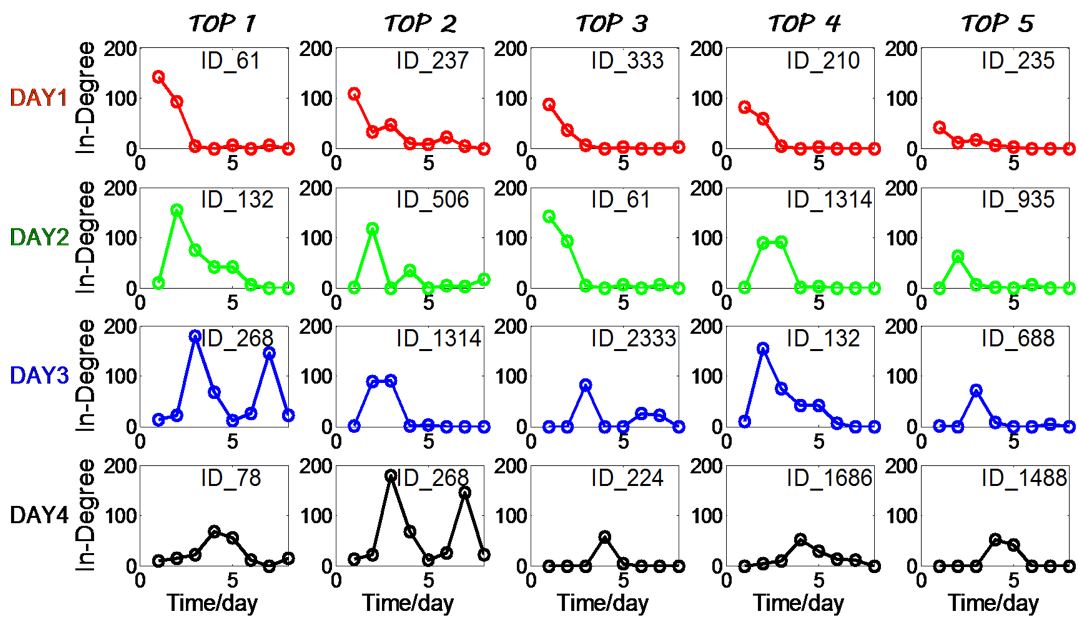 Fig 3: The rapid decline in influence of Day 1's top users as the movement evolved.
Critical Analysis & Conclusion
Takeaway
The study teaches us that digital activism is non-linear. The use of Omori’s Law is a masterstroke in technical intuition—it captures the "burstiness" and subsequent decay of social media attention far better than static power-laws.
Limitations & Future Work
While the data is robust for 2011, modern social media algorithms (like the "For You" feed) now manipulate these natural distributions. Future research should investigate if "algorithmic boosting" preserves or destroys the seismic Omori-style decay of organic movements.
Final Thought: In the digital space, leadership is a temporary gift granted by the collective to whoever captures the "Mainshock" of the moment.