
Who You Know Matters: How Social Capital Fuels Health Inequalities in Medical Breakthroughs
Social networks and the emergence of health inequalities following a medical advance: Examining prenatal H1N1 vaccination decisions
This sociological study investigates how social networks mediate the relationship between individual educational attainment and health decisions regarding medical advances. Using the 2009 H1N1 pandemic as a case study, it demonstrates that being embedded in networks of college-educated vaccine supporters significantly increases the probability of prenatal vaccination.
TL;DR
When medicine advances—be it a new vaccine or a breakthrough screening—socioeconomic inequalities don't just stay static; they often widen. This paper reveals that the "educational gap" in health isn't just about what you know, but who you know. During the H1N1 pandemic, pregnant women with college-educated friends who supported the vaccine were significantly more likely to get vaccinated, effectively turning social ties into a life-saving "flexible resource."
The "Fundamental Cause" of Health Inequality
Why does health inequality persist even when we improve medical technology? Sociologists Link and Phelan’s Fundamental Cause Theory suggests that high-status individuals possess "flexible resources" (money, knowledge, prestige) that allow them to pivot and avoid new risks faster than others.
However, the authors of this study argue that a critical piece is missing: The Social Network. Decisions about health are rarely made in a vacuum. Instead, they are "episodes" influenced by a person's "social convoy." The central question is: Does your education protect you, or is it the social capital provided by your educated peers that does the heavy lifting?
Methodology: Peering into the Pregnant Woman’s Network
The researchers focused on 225 first-time pregnant women during the 2009–10 H1N1 pandemic. This was a "clean" environment for study because:
- New Hazard: H1N1 was a novel threat.
- Priority Access: Pregnant women were prioritized, removing the barrier of supply.
- High Stakes: The risk of ICU admission for infected pregnant women was high.
They measured two types of social capital:
- Information Flow: Discussing the vaccine with college-educated peers.
- Normative Influence: Having college-educated peers who actively support the vaccine.
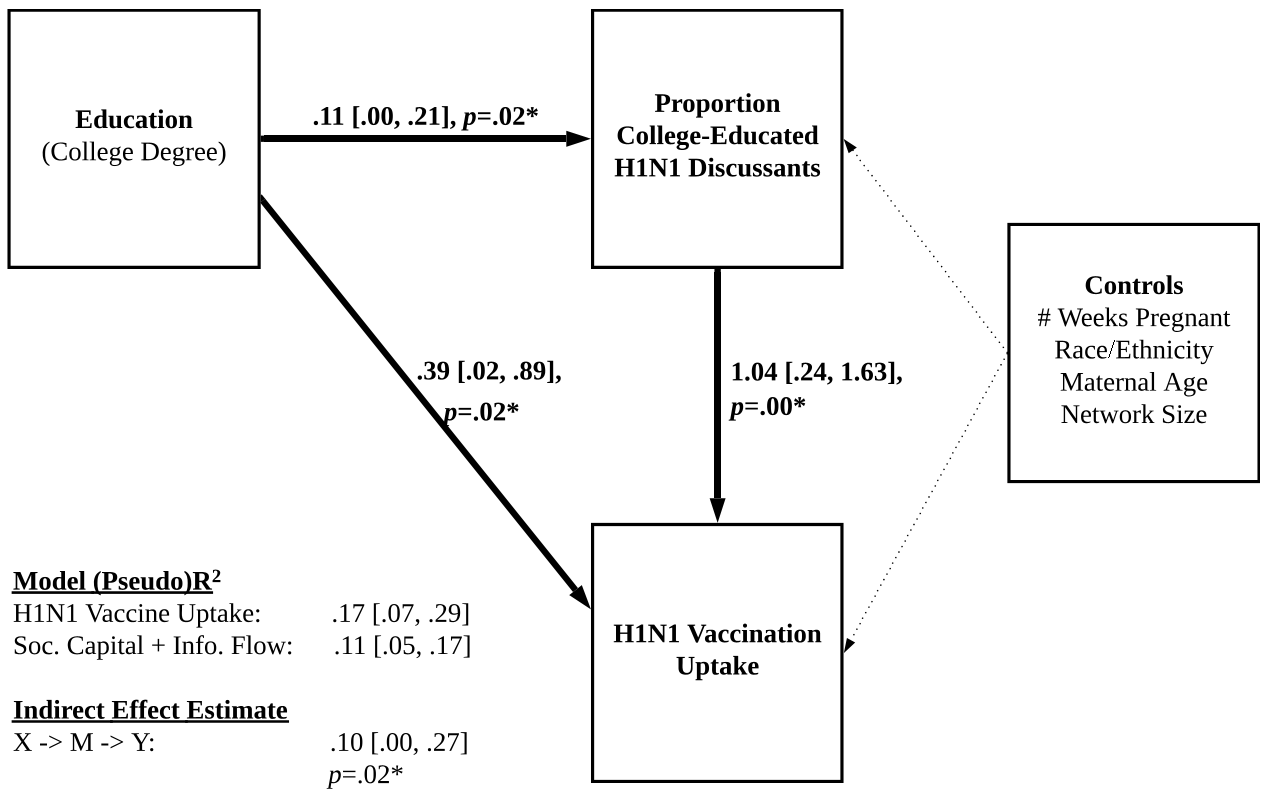 The model above illustrates how individual education flows through social network discussants to influence the final vaccination decision.
Key Findings: The Power of Influence
The results were striking. While individual education did predict vaccination (a 19% increase in probability for college graduates), the social network was the real engine of behavior.
- The Gradient: As the proportion of educated supporters in a woman's network increased, so did the vaccination rate.
- Influence > Information: Simply discussing the vaccine with educated people helped, but being influenced by educated supporters was the game-changer.
- The Mediation Effect: Once the "proportion of college-educated supporters" was added to the model, the direct effect of a woman's own education almost vanished. This suggests that the reason educated women were healthier was largely because they were embedded in "pro-science" social circles.
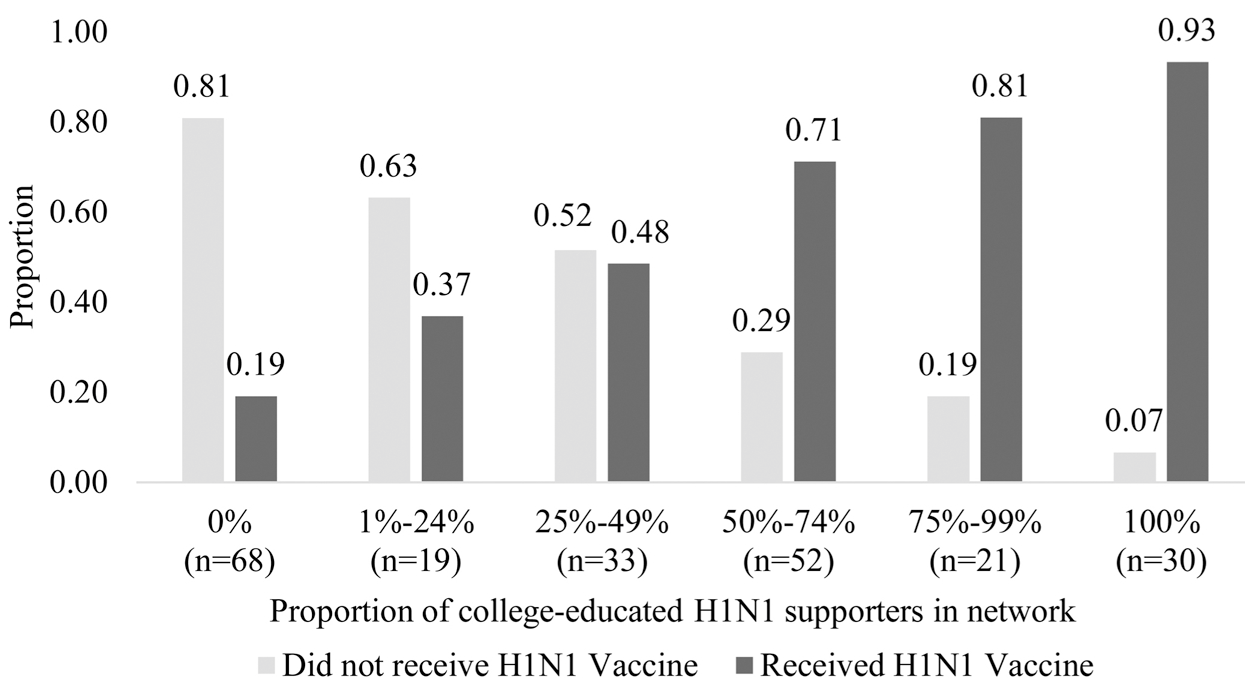 As shown in Figure 2, the probability of vaccination skyrockets only when a high proportion of the network consists of college-educated supporters.
Deep Insight: Beyond Individual Literacy
This paper challenges the traditional public health approach of simply providing "better information" to the public. If health behaviors are driven by normative influence within elite networks, then education campaigns that ignore social structure will naturally continue to favor the advantaged.
Limitations & Future Outlook
The study relies on "egocentric" data (the woman's perception of her friends' views), which may involve some self-selection bias. However, the qualitative follow-up confirmed that women specifically trusted the advice of educated family members in health fields.
Future health interventions should consider "network-based" targeting. Instead of just educating the patient, we should recognize that a patient's decision is a reflection of their social capital. To close the inequality gap, we must find ways to inject high-quality social capital into communities that lack it.
Conclusion
Social networks are more than just support systems; they are mechanisms of inequality. In the face of a new medical advance, your degree helps you, but your friends’ degrees might save you.