
HEALER: Scaling HIV Prevention in Homeless Youth via Dynamic Social Influence
Using Social Networks to Aid Homeless Shelters: Dynamic Influence Maximization under Uncertainty
This paper introduces HEALER, a software agent designed to help homeless shelters maximize HIV awareness through sequential peer-led interventions. It proposes a novel Dynamic Influence Maximization under Uncertainty (DIME) framework and solves it using HEAL, a hierarchical POMDP planner that significantly outperforms existing methods in both scalability and influence spread.
TL;DR
Researchers have developed HEALER, an AI agent that strategically selects "peer leaders" among homeless youth to spread HIV awareness. By treating social influence as a sequential decision-making problem under uncertainty (DIME) and applying a novel hierarchical POMDP planner, HEALER achieves massive scalability and efficiency improvements over previous SOTA models, making real-world deployment feasible.
The Challenge: Uncertainty in the Streets
Homeless youth are at a 10x higher risk of HIV infection than the general population. While shelters use peer-led interventions, they face three massive technical hurdles:
- Network Uncertainty: We don't know every friendship; we only see a fragment of the social graph.
- Sequential Complexity: Interventions happen in waves. Each wave provides new information, changing the optimal strategy for the next.
- Scalability: Conventional algorithms explode in complexity as the number of youth or the size of the peer-group increases.
Methodology: The HEAL Algorithm
HEALER moves beyond static "seed sets" to a sense-reason-act cycle. It conceptualizes the problem as a Partially Observable Markov Decision Process (POMDP).
1. Hierarchical Decomposition
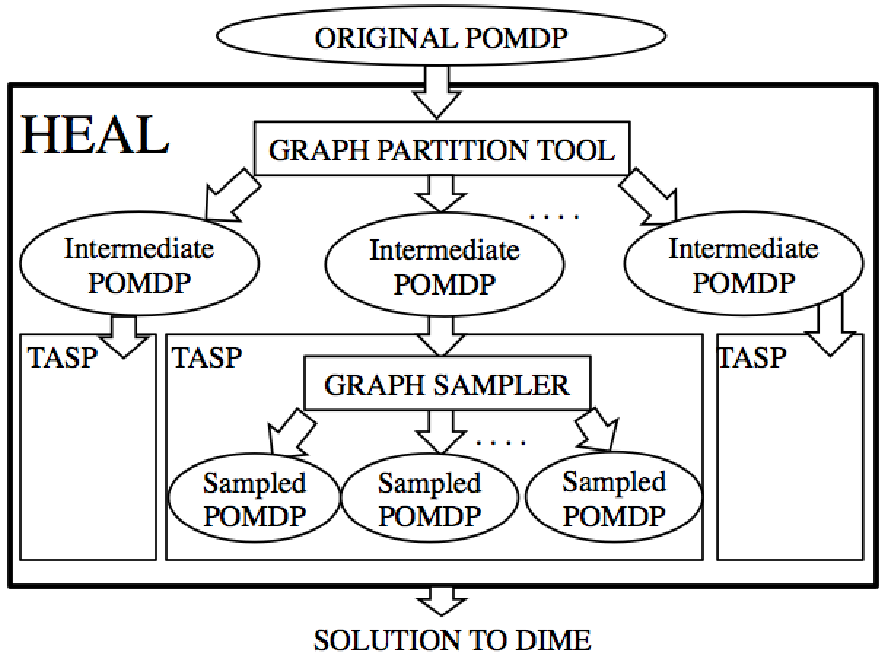
To prevent memory overflow, HEALER uses HEAL (Hierarchical Ensembling Algorithm for pLanning). It breaks down the massive social network into smaller, manageable clusters using the METIS graph partitioning technique. This allows the agent to solve local sub-problems without losing the global objective.
2. TASP & K-Level Tree Search
Within these clusters, HEALER uses TASP (Tree Aggregation for Sequential Planning). Unlike traditional Monte-Carlo searches that suffer from an exponential branching factor based on the number of nodes chosen ( choose ), TASP builds a -level tree where each level adds one node to the set. This keeps the branching factor linear relative to network size.
Experimental Performance
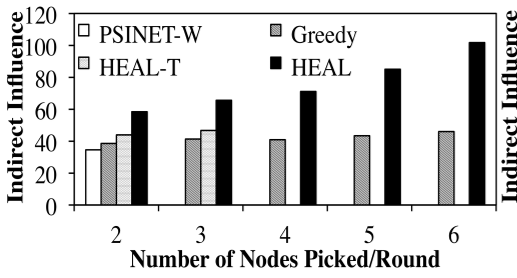
The researchers tested HEALER against PSINET-W (the previous gold standard) and Greedy baselines across several real-world datasets (VE, HD, Facebook, MySpace).
- Speed: HEALER delivered a 100x speedup, processing in seconds what took prior agents hours.
- Influence: In terms of "Indirect Influence" (people reached beyond the immediate participants), HEALER showed a 70% improvement.
- Robustness: The system is "deviation-tolerant." If a chosen youth doesn't show up to the shelter that day, HEALER instantly recalculates the next best action.
Deep Insight: Why It Works
The "magic" of HEALER lies in its rejection of Adaptive Submodularity. The authors prove that the DIME problem doesn't follow the nice mathematical properties that allow simple Greedy algorithms to excel. By instead embrace the full complexity of a POMDP and using ensemble-based approximations, HEALER captures the "value of information"—the idea that choosing a participant today is useful not just for their influence, but for the social links they reveal for tomorrow's planning.
Conclusion & Future Impact
HEALER represents a milestone in AI for Social Good. It moves high-level algorithmic theory into the messy, uncertain reality of social work. With its successful pilot testing at homeless shelters, this framework provides a scalable template for any public health initiative that relies on word-of-mouth spread in vulnerable, hard-to-reach populations.
Limitations
- Digital Divide: The current reliance on a Facebook app for network generation might miss the most marginalized youth who lack consistent internet access.
- Parameter Sensitivity: While robust, the model still requires initial estimates for "propagation probability," which are difficult to measure precisely in the field.