
Mapping the Invisible: Turning Telecom Metadata into Social Intelligence
Social networks identification and analysis using call detail records
This paper presents a framework for social network identification and analysis using Call Detail Records (CDR) within the telecommunications sector. It introduces methods to identify valued customers, "revenue generating groups," and sub-clusters by applying Social Network Analysis (SNA) metrics like Degree Centrality and Degree Prestige.
TL;DR
This research transitions Call Detail Records (CDR) from simple billing logs into a sophisticated tool for Social Network Analysis (SNA). By calculating Degree Centrality and Degree Prestige, the authors demonstrate how to identify "valued customers" for marketing and "kingpins" for law enforcement, moving beyond individual analysis to complex community (subnet) detection.
The "Blind Spot" in Telecom Data
In the early 2000s, telecom companies viewed users as separate data points on a spreadsheet. However, the value of a user isn't just their monthly bill—it's their connectivity. A user might spend little but be the "hub" that keeps ten high-paying customers in the network. If that "low-value" hub leaves, the whole cluster follows. This paper addresses the lack of automated structural analysis tools to visualize these hidden dependencies.
Methodology: The Core Mechanics
The authors propose a system that cleanses raw CDR data into a Summarized CDR Table. This reduces computational overhead by merging redundant call entries between the same two actors into a single weighted edge.
1. Centrality vs. Prestige
The paper utilizes two key mathematical measures to rank importance:
- Degree Centrality (): Focused on out-links. This identifies the "broadcasters" or the most active callers in the network.
- Degree Prestige (): Focused on in-links. This identifies "prominent" actors—those who are sought out by others. In a criminal context, a high-prestige actor might be a leader receiving reports; in business, they are influential nodes.
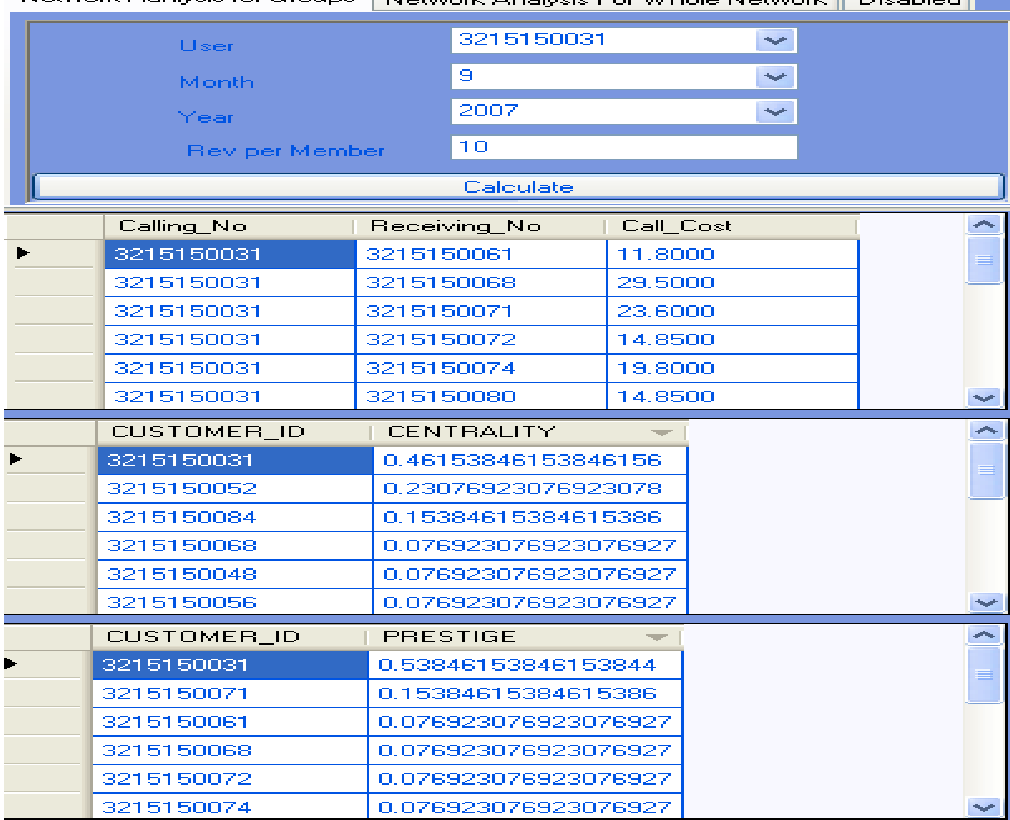 Figure: Network Metrics help distinguish between active callers and prestigious recipients within a specific revenue-generating group.
2. Identifying "Subnets" (Clustering)
Beyond immediate groups, the authors implement a clustering mechanism to find subnets. While a "group" only looks at direct connections, a "cluster" includes every user connected indirectly. This is vital for law enforcement: identifying one suspect allows the system to pull the thread on their entire hidden organization via a unique Cluster ID.
Performance and Visualization
The system generates Sociograms—visual maps of connections—allowing analysts to see the density of a network at a glance.
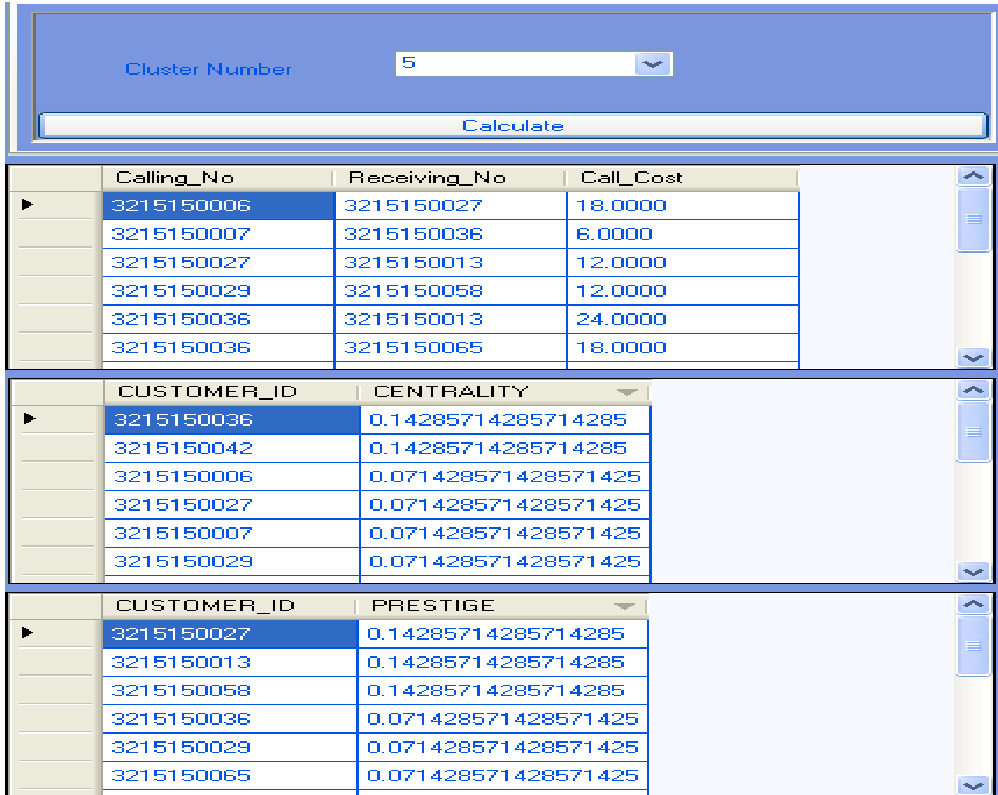 Figure: A sociogram visualizing how users in a specific cluster are interconnected, highlighting the "core" of the community.
The results proved that:
- Commercial Value: Identifying closely connected "Revenue Generating Groups" allows companies to offer group-based promotions, increasing "stickiness."
- Intelligence Value: High Degree Prestige often points to the "leader" of a suspicious cluster, as subordinates typically initiate the calls.
Critical Insight: Beyond the Dollar Sign
The most profound takeaway is that Degree Prestige is a better indicator of network importance than total billing. A customer receiving hundreds of calls is a "gravity well" for the network's revenue, even if they never make an outgoing call themselves.
Limitations & Future Directions
While groundbreaking for its time, the study relies on randomly generated data, and the authors acknowledge the need for real-world validation. Furthermore, the modern landscape involves SMS logs and data-based messaging (WhatsApp/Signal), which require this model to evolve beyond traditional voice CDRs.
Conclusion
This work provides a foundational framework for CDR-based SNA. It shifts the paradigm from analyzing what a user pays to who a user influences, providing a blueprint for modern churn prediction and digital forensics.