
Beyond Utility: Why We Truly Use Social Networks
Social networks: Intentions and usage
2013-01-01
Summary
Problem
Method
Results
Takeaways
Abstract
This research investigates the determinants of Social Network Services (SNS) adoption by proposing an extended Technology Acceptance Model (TAM). The study incorporates "Enjoyment" as a key intrinsic motivation and analyzes the reciprocal impact between "Effective Use" and "Intention to Use" across platforms like Facebook, LinkedIn, Twitter, and Hi5.
## Executive Summary
**TL;DR**: While we join social networks because we think they are "useful," we stay because they are "fun." This study deconstructs the psychological drivers of social network usage, proving that while **Perceived Usefulness** dictates our intention to use a platform, **Perceived Enjoyment** is the primary driver of actual, effective usage.
**Background**: Published in the context of the ISDOC 2013 Conference, this work sits at the intersection of behavioral psychology and Information Systems (IS). It serves as a critical pivot from the productivity-focused **Technology Acceptance Model (TAM)** toward a more "hedonic" understanding of modern digital ecosystems.
## The Motivation: Why TAM Isn't Enough
For decades, the IS field relied on the Technology Acceptance Model (TAM) to predict if employees would adopt new software. TAM posits two main levers:
1. **Perceived Usefulness (PU)**: Will this help me work better?
2. **Perceived Ease of Use (PEOU)**: Is it easy to learn?
However, social networks like Facebook or Twitter aren't just "tools"—they are experiences. The authors realized that the utilitarian focus of prior work missed a crucial element: **Enjoyment**. They argued that in social contexts, the "fun factor" might outweigh "efficiency."
## Methodology: The Extended TAM
The researchers proposed a model that integrates intrinsic motivation (Enjoyment) and behavioral feedback (Effective Use affecting Intention).
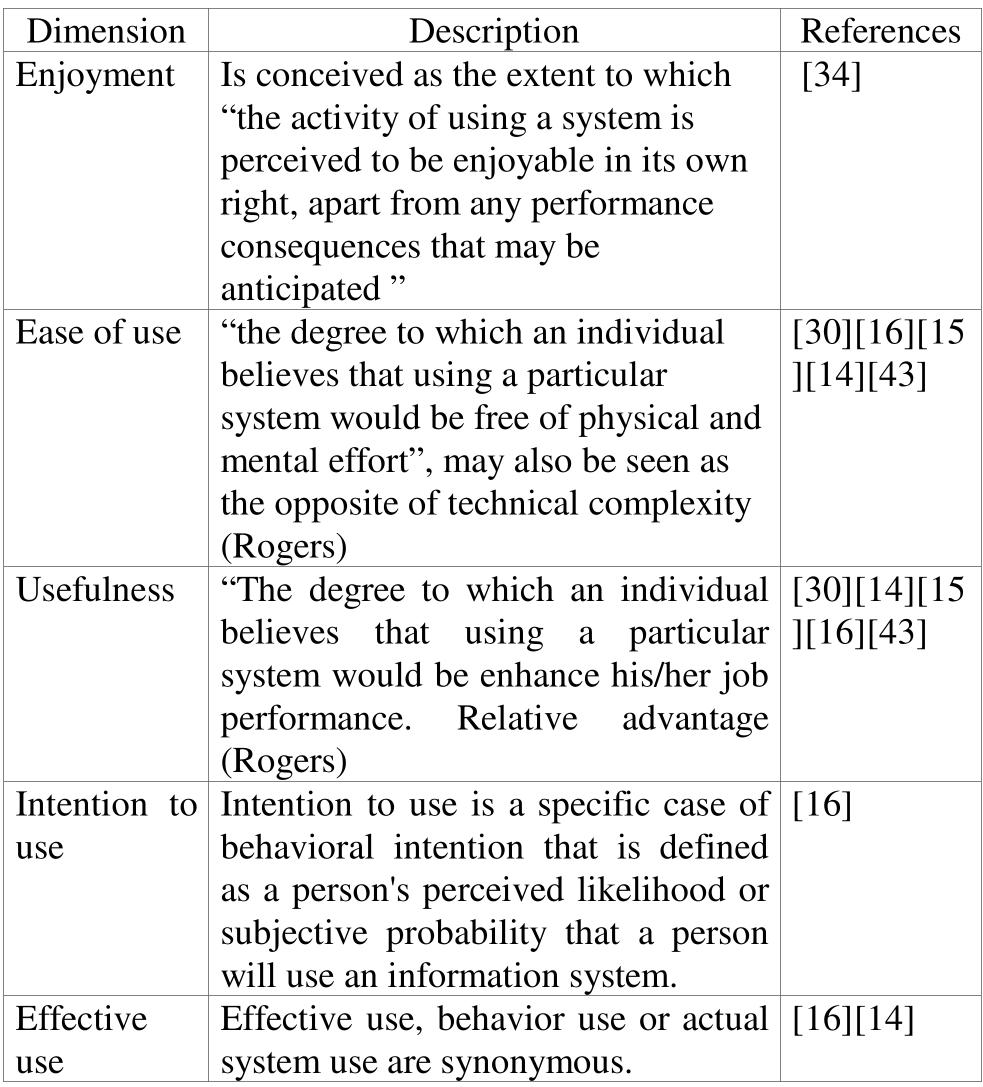
The study examined four major platforms—**Facebook, LinkedIn, Twitter, and Hi5**—collecting 656 observations from 164 users. They used regression analysis to see which factors statistically predicted "Intention" versus "Actual Use."
## Key Insights: Utility vs. Hedonism
The results provide a fascinating dichotomy between why we *plan* to use a site and how we *actually* use it.
### 1. The "Intention" Driver: Usefulness
When participants were asked about their *intention* to use a service, **Perceived Usefulness** was the strongest predictor ($t = 9.893$). Essentially, we justify our presence on social media through the lens of productivity or social capital.
### 2. The "Usage" Driver: Enjoyment
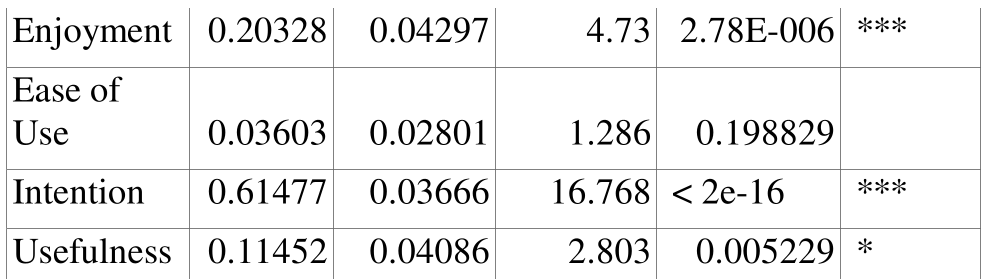
When looking at **Effective Use** (actual behavior), the landscape shifts. **Perceived Enjoyment** becomes highly significant ($t = 4.73$), while **Ease of Use** becomes statistically irrelevant.
### 3. The Death of "Ease of Use"
One of the most striking findings is that "Ease of Use" has a "minor impact in the intention to use" and "none impact on the effective use." In the modern era, users assume a system will be easy; therefore, a slick UI is no longer a motivator—it is a baseline expectation.
## Critical Analysis & Conclusion
**Takeaway**: This paper highlights a "Cognitive Dissonance" in social media usage. Users *intend* to use platforms because they perceive them as useful tools for networking or information. However, their *actual time spent* is governed by the dopamine loop of enjoyment.
**Limitations**: The study was conducted on a student population in 2013. In the age of TikTok and algorithmic "For You" feeds, the weight of "Enjoyment" has likely increased even further, potentially cannibalizing "Perceived Usefulness" entirely.
**Future Outlook**: For developers and product managers, the message is clear: You can market a platform based on its utility (LinkedIn's professional value), but to ensure high daily active usage (DAU), the core experience must prioritize the hedonic "Enjoyment" factor.
---
**Citation:**
Costa, C. J., & Aparicio, M. (2013). Social networks: intentions and usage. *ISDOC '13*. ACM.