
D-SNS: Solving the "Hub" Congestion in Global Software Collaboration
Supporting knowledge collaboration using social networks in a large-scale online community of software development projects
This paper introduces D-SNS (Dynamic Social Networking System), a prototype designed to foster cross-project knowledge collaboration within large-scale Open Source Software (OSS) communities like SourceForge. It leverages Social Network Analysis (SNA) to bridge isolated projects while protecting high-contribution "hub" developers from inquiry overload.
TL;DR
Open-source development is rarely a level playing field. Most projects die in isolation because they lack "social capital," while the few superstars (hubs) are overwhelmed with inquiries. This paper presents D-SNS, an Eclipse-based tool that uses Social Network Analysis to automatically connect developers across projects, ensuring knowledge flows without burning out the community's core contributors.
The "Small World" Problem in SourceForge
Our human society is a scale-free network. Whether it's the web or a developer community, a tiny minority of nodes (hubs) possess a massive number of links, while the majority are barely connected.
The authors analyzed SourceForge and found a striking reality:
- Isolation: Over 80% of projects have fewer than 3 developers.
- Congestion: Hub developers contribute disproportionately (e.g., in the Apache community, 4% of developers wrote 88% of the code).
The bottleneck is clear: if a developer in a small project needs help, they either don't know who to ask, or they ask a "hub" who is already too busy to reply. This leads to project stagnation.
Methodology: Engineering a Dynamic Social Network
The proposed D-SNS (Dynamic Social Networking System) moves away from manual user profiles, which are often outdated the moment they are written. Instead, it observes "digital exhaust."
1. Automated Knowledge Extraction
D-SNS scans communication logs, user registrations, and bug reports within SourceForge to build a "relative knowledge" map. It doesn't just ask "What does this person know?" but rather "Who is knowledgeable relative to this specific query?"
2. The Protective Recommendation Logic
To prevent "hubs" from leaving the community due to mental pressure, D-SNS acts as a traffic controller. It uses the Density of Social Networks to guide recommendations:
- Open-to-Closed (R1/Q1): If a user's network is too sparse, the system encourages deeper connections with closer peers (within 1 or 2 degrees of separation) to build trust.
- Closed-to-Open (R2/Q2): If a user is stuck in a "silo" (high density), the system recommends "U" (unconnected users or distant nodes) to expand their reach and discover new knowledge silos.
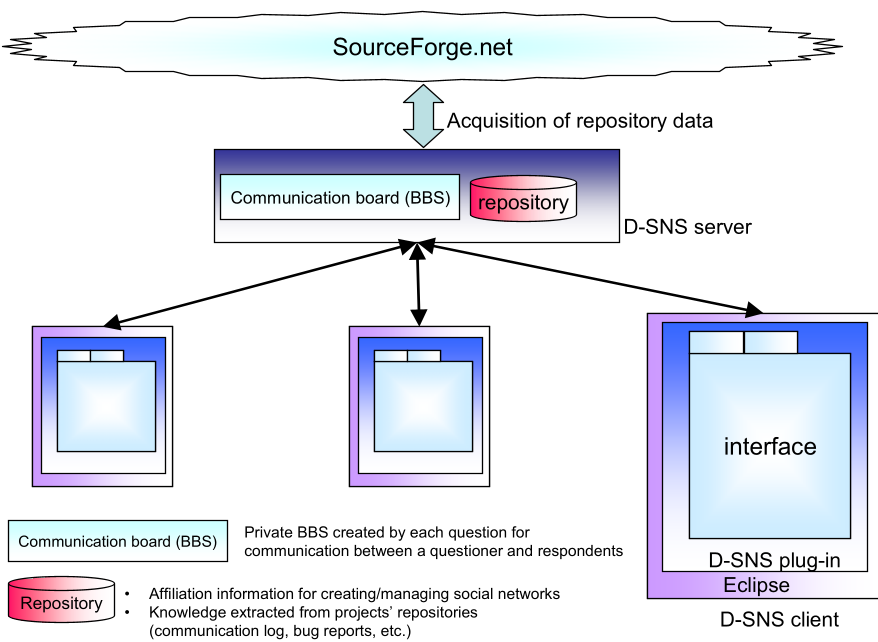 Figure: The D-SNS architecture showing how affiliation information and repository data are fused into knowledge networks.
Experimental Insight: The Power Law of Developers
The paper’s analysis of SourceForge (Feb 2005) provides empirical evidence for the scale-free nature of coding communities. The "Power Law" graphs demonstrate that while most developers only join one project, the "hubs" join dozens.
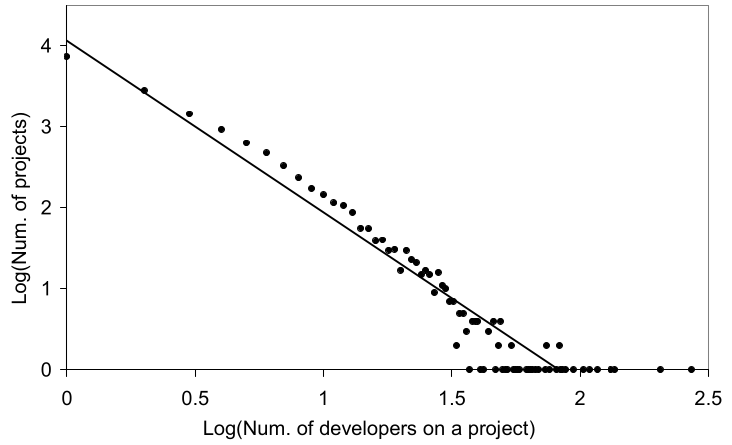 Figure: The distribution of developers per project and projects per developer, illustrating the scale-free characteristics.
By implementing D-SNS as an Eclipse Plug-in, the authors bring this social intelligence directly into the IDE. This reduces the "context switching" cost for developers, allowing them to ask for help or contribute knowledge without leaving their coding environment.
Critical Analysis & Future Outlook
The genius of D-SNS lies in its passive profiling. By extracting expertise from actual technical output rather than self-reported skills, it provides a much more accurate map of the community’s "hidden" experts.
Limitations:
- Privacy and Culture: As the authors note, OSS culture often values radical transparency. Some developers might prefer "broadcast" help (like Mailing Lists) over the "targeted" routing D-SNS provides.
- Cold Start: The system depends on existing repository data. Truly new projects might still struggle to enter the "knowledge cluster."
Future Directions: The next step for this research involves the visualization of social networks. Imagine a "Social Map" within your IDE that shows you exactly how far you are from the knowledge you need. In an era where GitHub has replaced SourceForge, these principles of "Silo-Busting" are more relevant than ever.
Takeaway
Knowledge collaboration isn't just about having a repository; it's about the topology of the people behind it. D-SNS shows that by intelligently routing inquiries, we can make the "Small World" of software development feel a lot more supportive.