
Decoding the Hidden Structure: Leveraging Social Network Analysis for Knowledge Management
Social networks and its impact on knowledge management
This paper presents a critical review of Social Network Analysis (SNA) and its application in Knowledge Management (KM) within organizations. It advocates for a transition from viewing social networks solely as technological tools to leveraging them as managerial frameworks for improving collaboration and information flow.
TL;DR
Social networks are often dismissed as mere communication tools (Facebook, LinkedIn). This paper argues they are actually the "nervous system" of an organization. By applying Social Network Analysis (SNA), organizations can map informal relationships to eliminate collaboration bottlenecks, locate hidden experts, and drive innovation in ways traditional hierarchies cannot.
The "Technology Trap" in Knowledge Management
Modern ICT firms invest millions in process maturity (like CMMI) and communication software. However, the authors point out a critical blind spot: the informal network. Even in high-tech environments, information doesn't just flow through official channels; it moves through trust-based, informal relationships.
The problem is that current management often treats social networking as a product rather than a process. When we ignore the managerial aspect of these networks, we lose the ability to see why certain teams innovate while others stagnate despite having the same tools.
Methodology: The Three Levels of Network Analysis
The paper categorizes the application of SNA into three distinct analytical layers:
- Micro Level (Individual): Focuses on behavioral issues like trust building, leadership, and individual performance.
- Meso Level (Unit/Department): The core focus of this research. It examines how departments interact with the whole organization and external suppliers. This is where "collaboration inefficiencies" are most visible.
- Macro Level (Industry): The broad inter-relationships between producers, buyers, and competitors.
The Dimensional Framework
To analyze these networks, the authors utilize a multi-dimensional framework:
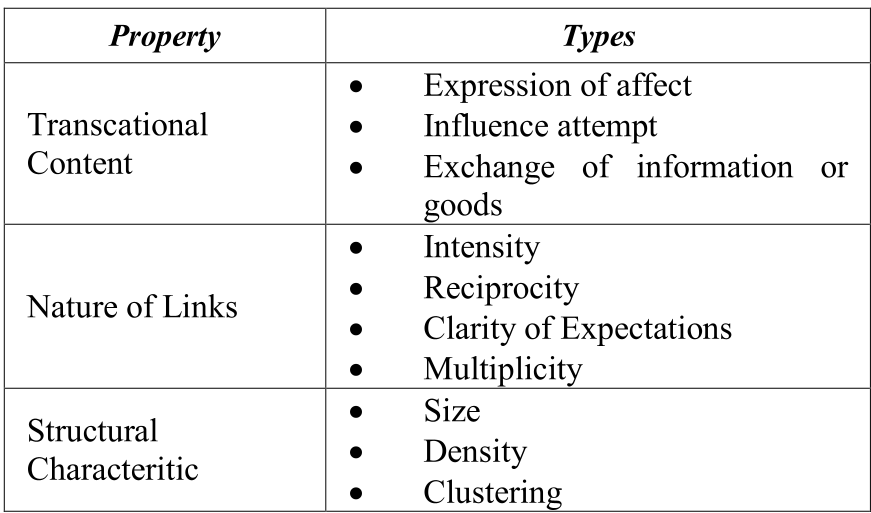
- Transactional Content: What is actually being moved? (Goods, information, or affect).
- Nature of Links: How strong is the bond? (Intensity, Reciprocity).
- Structural Characteristics: What does the "map" look like? (Density, Clustering).
Why SNA Changes the Game for KM
The authors argue that Knowledge Management isn't just about storing documents (People-With-Content or PWC); it's about connecting experts (People-With-People or PWP).
SNA acts as a "diagnostic X-ray" for the organization:
- Localizing Expertise: Identifying the "central nodes" or go-to people who hold tacit knowledge.
- Reducing Search Costs: Understanding network pathways helps people find info faster.
- Dynamic Response: While formal structures are static, informal networks are dynamic, allowing organizations to adapt to market changes more fluidly.
Critical Insights & Future Outlook
The primary contribution of this work is moving the conversation from "social media tools" to "social network theory." However, a notable limitation is that despite the popularity of the concept since the 1980s, a fully integrated, comprehensive model for applying ONA (Organizational Network Analysis) consistently across different industries is still maturing.
The Takeaway for Leaders
If you want to improve knowledge sharing, stop looking at your Org Chart. Start looking at your Network Map. The real work happens in the clusters and informal links that your official diagrams simply don't show.
Reference: Rashid, A., Wang, W. Y. C., & Hashim, K. F. (2026). Social Networks and its Impact on Knowledge Management.