
The Irony of Embeddedness: How Social Ties Protect Investors in Fraudulent Markets
Social networks and loss of capital ଝ
This study investigates the dual nature of social networks in fraudulent financial environments through a strategic case analysis of Fountain Oil & Gas Company. It demonstrates that while social ties can facilitate fraud, "within-network exchange" (direct ties to company principals) significantly reduces the probability of capital loss by 30-65% compared to impersonal investments, establishing a protective effect even in partially illegitimate enterprises.
Executive Summary
TL;DR: In the murky waters of "intermediate fraud"—businesses that are part legitimate and part criminal—your social connections might be your best insurance policy. This research reveals that having a direct personal relationship with company principals reduced the likelihood of losing everything by over 50%. Ironically, the study finds that the company’s fraudulent acts (like shifting funds between accounts) were the very mechanisms used to favor "friends" and protect them from loss.
Academic Positioning: This work bridges the gap between Economic Sociology and Criminology. It moves beyond the binary view of social networks as either purely beneficial or purely exploitative, positioning itself as a critical test of the "Embeddedness" theory in a high-stakes, real-world failure.
Problem & Motivation: The Bright vs. Dark Side of Ties
Why do we use social networks when investing?
- Ex Ante (Before the deal): Ties reduce "Information Asymmetry." You know the person; you trust the pitch.
- Ex Post (After the deal): Ties reduce "Opportunism." A seller is less likely to cheat a friend because of the threat of social "mortification" and exclusion from the community.
However, White-Collar Criminologists argue that these same ties are vectors for victimization. Trust creates a "soft target." If the seller has criminal intent, your social bond isn't a shield; it's a handle for them to grab onto. The authors sought to resolve this tension: In a business that is both making money and stealing money, do your friends save you or sink you?
Methodology: The "Fountain Oil" Case Study
The authors analyzed the Fountain Oil & Gas Company, which raised $11.5 million from 230 investors. While they actually drilled successful wells, the principals also engaged in embezzlement and "Ponzi-like" fund diversion.
The study categorized investors into three groups:
- Within-Network Exchange: Knew the owners or employees personally.
- Search Embeddedness: Came in via word-of-mouth (friends of friends).
- Impersonal Sources: Responded to cold calls or telemarketing.

The Findings: Double Protection and "Ironical Fraud"
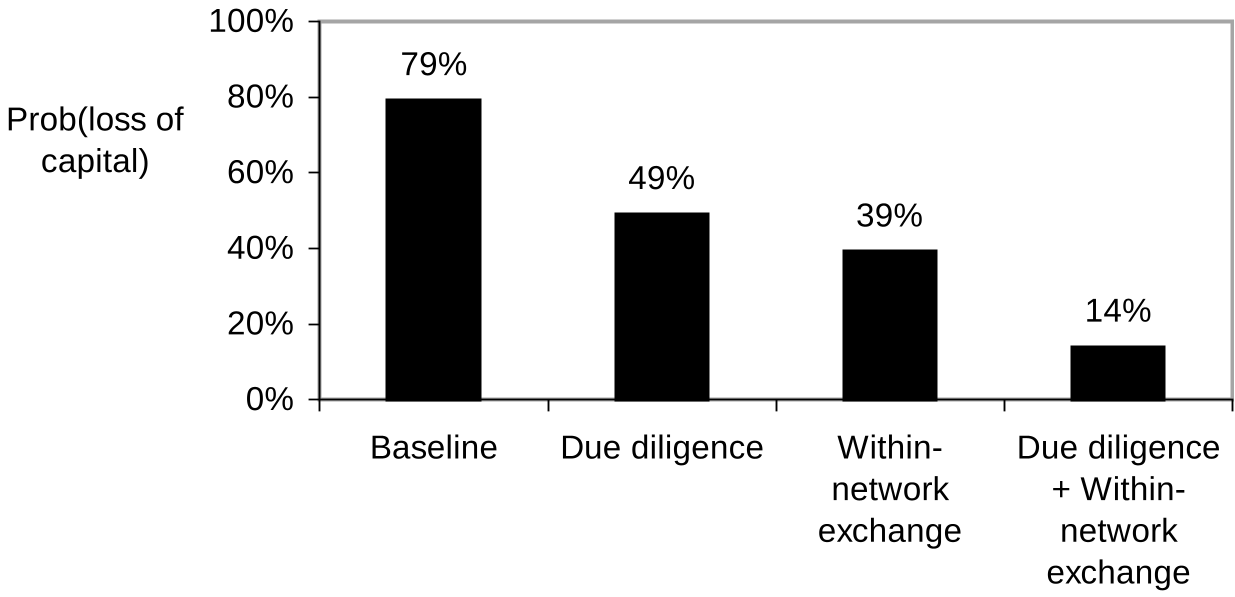
The data shows a stark hierarchy of risk. The "anonymous" investor who does no homework is almost certain to lose everything (79% probability).
1. The Protective Power of Within-Network Ties
Direct ties to the company's "center" dropped the risk of loss to 39%. When combined with Due Diligence (checking with the Better Business Bureau or geological reports), the risk plummeted to 14%.
2. The Substitution Effect
A fascinating behavioral insight: Investors use social ties as a substitute for formal research. Those with direct ties were significantly less likely to conduct due diligence. They relied on "personal trust" instead of "institutional trust." While this substitution is risky, the social tie was strong enough to compensate for the lack of homework.
3. The Mechanism of "Preferential Treatment"
Why did the "friends" lose less? The archival records show that the principals used fraudulent practices—specifically the co-mingling of funds—to pay back people they knew personally. They "robbed Peter to pay Paul," where "Paul" was a friend and "Peter" was a stranger reached via a telemarketing list.
Critical Insights & Conclusion
Takeaway
Social networks are effective enforcement mechanisms even when the underlying economic activity is illegal. Criminals are not "homo economicus" in a vacuum; they remain "social animals" who fear the loss of their local reputation.
Limitations
This study focuses on Intermediate Fraud. The findings likely do not apply to "Boiler Rooms" or pure Ponzi schemes (Pre-planned frauds) where the perpetrator has no intention of ever finishing a legitimate project and plans to abscond with all funds regardless of ties.
Final Thoughts
This paper provides a sobering look at market morality. It suggests that in volatile or semi-legal environments, "Universal Fair Treatment" is a myth. Instead, a "Tribal Ethic" prevails where the inner circle is protected by the very crimes that exploit the outer circle. For the modern investor, the message is clear: Personal ties are a powerful hedge, but they aren't a replacement for due diligence.