
ETV: Measuring Trust Online through Social Distance and SOM
How Can Social Networks Help Us Measure Trust Online?
The paper introduces a novel Trust Model for Online Rating Systems (ORS) that calculates an Estimated Trust Value (ETV) for content and creators. It leverages Self-Organizing Maps (SOM) to determine "social distance" between users and integrates this with user-generated ratings to filter information in social networks.
TL;DR
Information overload is a modern tax on attention. This paper proposes a dual-layered Estimated Trust Value (ETV) model. By using Self-Organizing Maps (SOM) to calculate "social distance" and combining it with weighted user ratings, the system provides a personalized trust metric to sort through the noise of online social networks.
Background & Positioning
In the digital era, the definition of trust is shifting. We no longer rely solely on institutional authority; we rely on our peers. However, current Online Rating Systems (ORS) often treat all ratings equally. This work positions itself as a bridge between unsupervised competitive learning (machine learning) and sociometrics (social distance), creating a more human-centric filtering mechanism.
The Core Problem: Why Traditional Ratings Fail
Standard filtering techniques fail because they lack "context." A 5-star rating from a stranger is mathematically identical to a 5-star rating from a close friend in most systems. The authors argue that this ignores the Inductive Bias inherent in human social structures: we naturally prioritize recommendations from those we "know" or who are "similar" to us.
Methodology: The Two-Step ETV Model
The authors propose a rigorous two-step process to quantify subjective trust.
1. The SOM & Social Distance
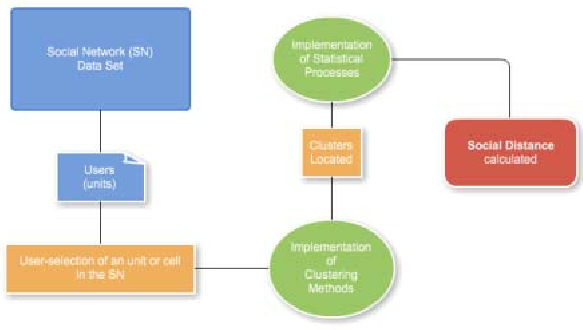
The first step utilizes Self-Organizing Maps (SOM). Through competitive learning, the SOM organizes high-dimensional statistical data of the user base into a 2D map.
- Competitive Learning: Nodes compete to respond to input data, effectively finding clusters (neighborhoods) of similar users.
- Social Distance (): Using the Euclidean method, the system calculates the distance between the "Enquirer" and the "Content Creator" on this map. A smaller implies a higher degree of similarity.
2. Calculating the Estimated Trust Value (ETV)
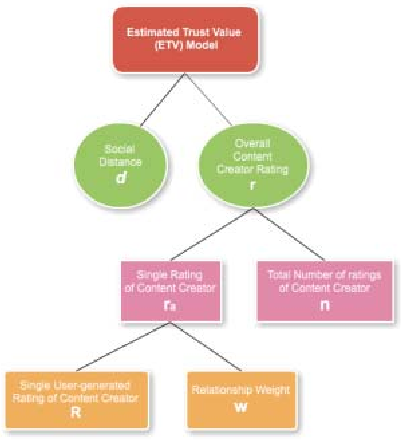
The second step integrates this distance with qualitative data. The ETV is calculated using the following logic:
Where:
- : The social distance.
- : The overall rating, which itself is a product of relationship weight () and the raw rating ().
Insight: Why This Works
The genius of this approach lies in the variable (weight of relationship). By allowing users to assign different levels of importance to different types of relationships, the model moves away from a "one-size-fits-all" algorithm and toward a personalized trust manifold. The SOM ensures that even if you don't have a direct relationship with a creator, the system can infer trust based on your proximity to them in the feature space.
Critical Analysis & Conclusion
Takeaway
The integration of SOM-based clustering and weighted ORS offers a sophisticated way to manage information overload. By quantifying "closeness," the model mimics human social intuition.
Limitations
While the theoretical framework is sound, the paper's dependency on the Euclidean method for distance might be oversimplified for extremely complex, non-linear social structures. Additionally, the computational cost of re-training SOMs as user bases grow remains a challenge for real-time applications.
Future Outlook
This work lays the groundwork for applying unsupervised neural networks to social trust. Future research could replace SOM with more modern Graph Embedding techniques or Transformers to better capture the latent relationships between users in even higher dimensions.