
Mining Social Networks via Bee Swarm Optimization: A Semantic Shift in Community Detection
Social Networks Mining Based on Information Retrieval Technologies and Bees Swarm Optimization: Application to DBLP
This paper introduces a novel methodology for community detection that shifts the focus from traditional graph-based mining to textual document analysis using Information Retrieval (IR). The core method integrates Bee Swarm Optimization (BSO) to accelerate document retrieval, effectively clustering authors based on shared research interests specified by a query.
TL;DR
Instead of mining social networks from existing graphs, this paper extracts them from textual documents using a query-driven Information Retrieval (IR) approach. By leveraging Bee Swarm Optimization (BSO), the authors significantly accelerate the discovery of research communities in the DBLP database, achieving near-instant network construction.
Problem & Motivation: Beyond the Graph
Most social network research starts with a graph (nodes and edges). But where do these edges come from? In academic circles, links are often forged by shared interests that aren't yet captured in a formal graph.
The authors identify two main challenges:
- Semantic Latency: Graph-based methods find existing communities, but IR-based methods can find potential communities based on what people are currently writing about.
- Search Efficiency: Searching through millions of documents (like in DBLP) to find authors sharing a specific niche interest is computationally taxing.
Methodology: The "Bee" Logic in Text Space
The authors propose a system that combines professional-grade indexing with bio-inspired search.
1. High-Performance Indexing
The system uses Lex (a lexical analyzer generator typically used in compiler construction) to build three core structures:
- The Dictionary: Key terms.
- The Documents File: Mappings of docs to terms.
- The Inverted File: Mappings of terms to docs.
2. BSO for Information Retrieval
BSO mimics the foraging behavior of honeybees. In this context:
- The Solution Space: The collection of documents.
- A "Solution": A retrieved document.
- Evaluation Function: The Cosine Similarity between document and query vectors.
The BSO process uses a BeeInit (scout) to find a starting point, then generates a SearchArea of dispersed solutions. Multiple "bees" explore these regions locally, communicating their findings via a Dance Table. This iterative process ensures the algorithm doesn't get stuck in local optima while searching the vast document space.

Experiments & Results
The approach was validated on the CACM collection and a substantial subset of the DBLP database (50,000 documents).
Performance Gains
The BSO-based search consistently outperformed traditional inverted file searches in terms of speed:
- CACM (Computer Algorithm): BSO took 1s vs. 3s for traditional search.
- DBLP (Web IR): BSO took 2s vs. 7s for traditional search.
Community Visualization
The final output is a star-shaped social network where the center is the "Topic" and the surrounding nodes are the authors of the most relevant papers.
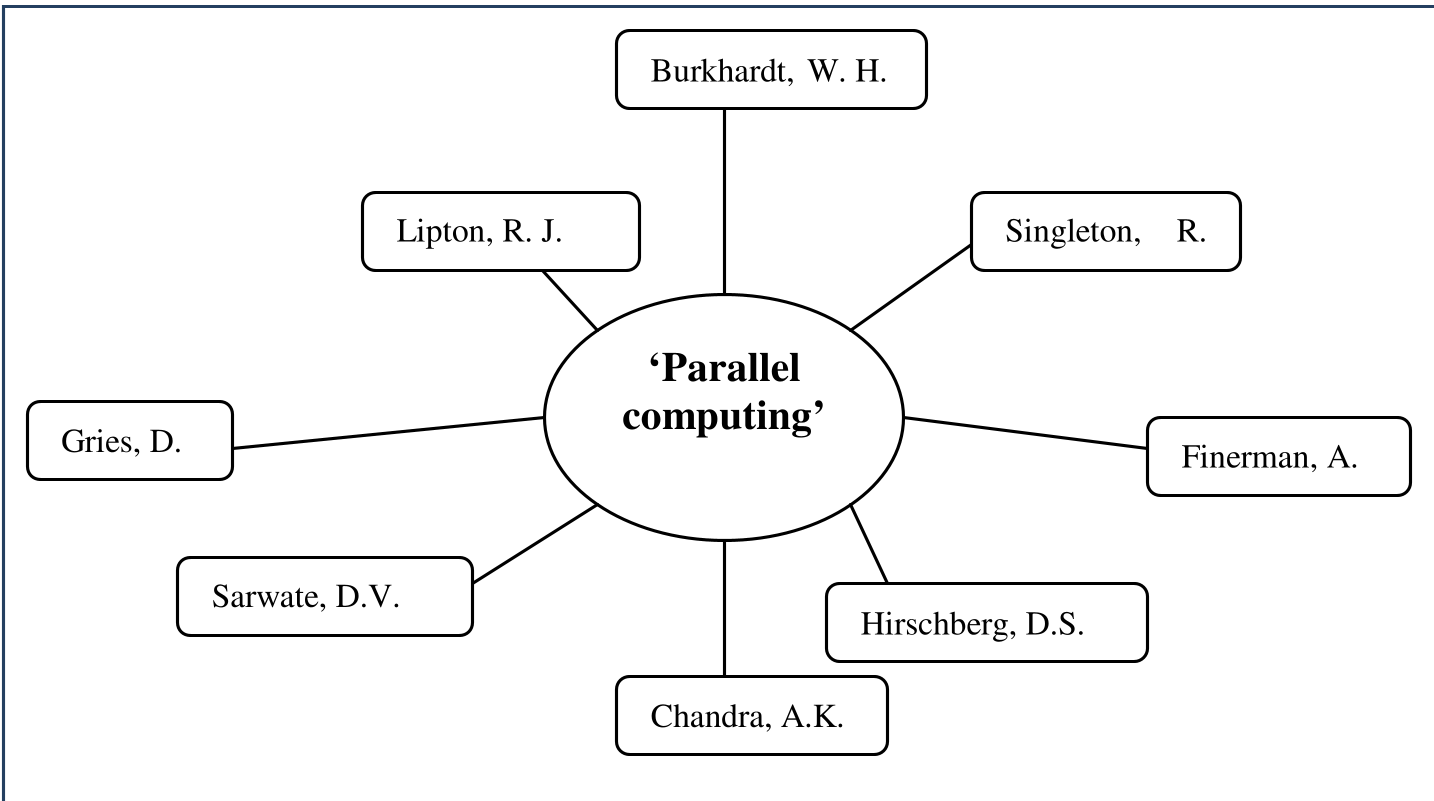 Fig: Discovering the core community for 'Parallel Computing' using BSO-optimized IR.
Critical Analysis & Conclusion
Takeaway
The paper successfully demonstrates that community detection does not need to be a static graph problem. By treating it as a dynamic IR problem optimized by a swarm-based metaheuristic, we can discover communities "on-the-fly" based on evolving topics of interest.
Limitations
- Network Depth: The current model creates a "flat" star-shaped network. It does not yet weight the edges between authors (e.g., co-authorship) to show internal community structure.
- Scale: While tested on 50,000 documents, modern DBLP has millions. Further testing on larger distributed indices is required.
Future Outlook
The authors aim to develop Scoring Functions to evaluate the "efficiency" of the discovered communities. This could lead to tools that not only help researchers find collaborators but also quantify the health and impact of specific research niches.