
Hyperbolic Backpressure: Revolutionizing Social-Wireless Networks via Geometric Intuition
Social networks over wireless networks
The paper introduces a "Greedy Backpressure" framework for integrated social-wireless networks, combining hyperbolic graph embedding with congestion-aware scheduling. By mapping the network into a Poincaré Disc, the authors propose two routing variants (Greedy and Greediest) that achieve SOTA throughput-delay performance while remaining throughput-optimal.
TL;DR
The classic Backpressure algorithm is a "clumsy giant"—mathematically guaranteed to maximize throughput but notorious for high latency due to its aimless exploration of the network. This paper introduces a specialized "Greedy Backpressure" framework that uses Hyperbolic Geometry to give the algorithm a "sense of direction." By embedding social-wireless networks into a hyperbolic disc, the authors achieve superior delay-throughput trade-offs while respecting social priorities and trust.
The Problem: The Latency Curse of Backpressure
In the realm of wireless ad-hoc networks, the Backpressure algorithm (Tassiulas & Ephremides, 1992) is the gold standard for stability. It routes packets based on "queuing gradients"—moving data from congested nodes to less congested ones.
However, there is a catch: The Delay Problem. In light traffic, Backpressure acts like a random walk. Without a clear distance metric to the destination, packets may bounce aimlessly around the network before finding their target. In human-centric social networks—where video calls and chatting demand low latency—this behavior is unacceptable.
Methodology: Mapping Social Logic to Hyperbolic Space
The authors' core insight is to provide a "geographic" map that doesn't actually require GPS. They use Hyperbolic Graph Embedding.
1. The Poincaré Disc Map
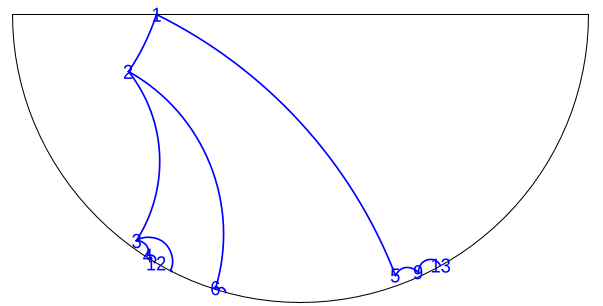
The network is embedded into a two-dimensional hyperbolic plane (the Poincaré Disc). Why hyperbolic? Because social networks and complex graphs naturally exhibit hierarchical structures that can be mapped into hyperbolic space with minimal distortion.
2. Greedy & Greediest Backpressure
Instead of allowing a packet to move to any neighbor with a lower queue size, the authors impose a Greedy Constraint:
- Greedy Backpressure: Only neighbors that are closer to the destination in the hyperbolic space are considered.
- Greediest Backpressure: Specifically targets the neighbor that reduces the hyperbolic distance the most.
This effectively combines Congestion Gradients (from Backpressure) with Distance Gradients (from Hyperbolic Geometry).
Social Awareness: Breaking the Ties
A unique feature of this work is the "Social Overlay." Users aren't just nodes; they have priorities. When the algorithm finds two flows with the same congestion gradient, it uses Social Priority Weights to break the tie. This ensures that a high-priority "Live Video" packet is scheduled before a low-priority "Email" packet.
Experimental Results: Pareto Dominance
The authors tested their algorithms against the "Pure Backpressure" baseline in both static and dynamic (node churn) scenarios.
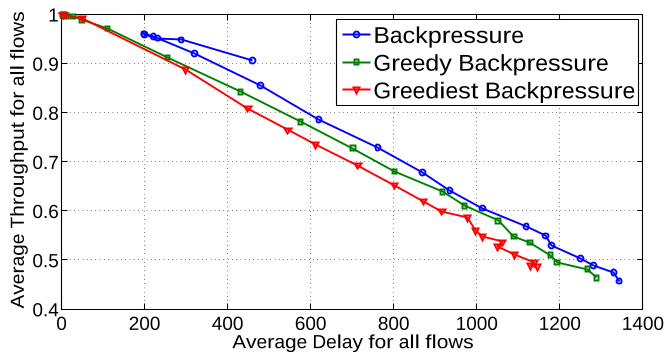
- Throughput-Delay Trade-off: The "Greediest" variant consistently outperformed the rest. At the same throughput levels, it achieved significantly lower delays.
- Priority Validation: High-priority social flows successfully secured lower latency, proving that the tie-breaking mechanism works in practice.
Critical Insight & Conclusion
This paper bridges the gap between Statistical Physics (Hyperbolic Graphs) and Control Theory (Backpressure).
Takeaway: The "Greediness" doesn't sacrifice stability. The authors proved that as long as the arrival rates stay within the "Greedy Capacity Region," the network remains stable. This work proves that we can make wireless networks "socially aware" and "geometrically smart" without losing the rigorous guarantees of classical networking theory.
Limitations: The reliance on a spanning tree for embedding means that if the tree is poorly chosen, the "hop count" could still be sub-optimal. Future extensions using multi-tree embeddings or dynamic hyperbolic re-positioning could push these boundaries even further.