
Beyond Trust: Decoding the Structural DNA of Secure Social Networks
Understanding Social Networks Properties for Trustworthy Computing
This paper investigates the topological characteristics of social networks—specifically mixing time and graph expansion—to validate their use in trustworthy computing and Sybil defenses. It introduces an empirical correlation between a graph's "fast-mixing" nature and its k-core degeneracy, demonstrating that effective security primitives rely on a dense, cohesive set of core nodes.
TL;DR
Social network-based security relies on a hidden mathematical assumption: that the network is "well-connected" enough for random walks to behave predictably. This paper bridges the gap between graph theory and security by proving that a network's ability to defend against Sybil attacks (fake identities) is directly tied to its coreness and expansion properties.
The "Fast-Mixing" Mystery
In the world of Sybil defenses, protocols like SybilLimit and GateKeeper are the gold standard. They work on a simple premise: honest users belong to a tightly knit social graph that is "fast-mixing," while attackers (Sybils) are stuck in a peripheral region with limited "attack edges" to the honest core.
But here is the problem: What actually makes a graph fast-mixing? Is it just the number of edges? The density? Prior work used these properties as black boxes. This paper dives into the "Why," exploring the relationship between mixing time and graph degeneracy.
Methodology: Peeling the Onion with k-Cores
The authors use the concept of k-cores—a maximal subgraph where every node has at least degree k—to measure the "cohesiveness" of a network.
1. The Coreness Hypothesis
The researchers hypothesized that the "backbone" of a secure social network is a large, dense core. Using an pruning algorithm, they stripped away peripheral nodes to reveal the inner structure.
- Fast-mixing graphs: Tend to have a larger single core.
- Slow-mixing graphs: Tend to fragment into multiple smaller cores as k increases.
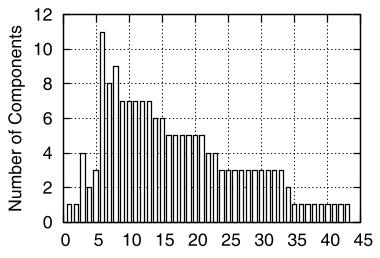 Figure 1: Coreness distribution in Physics and Wiki datasets, showing how nodes are clustered in the network's heart.
2. Measuring Expansion
Expansion refers to how quickly a set of nodes "reaches out" to the rest of the graph. The authors calculated the vertex expansion factor by building BFS trees from every node. This is a critical metric for GateKeeper, a Sybil defense that requires "good expansion" to limit attacker influence to identities per attack edge.
Key Insights from the Lab
The results provide a quantitative reality check for security assumptions:
- Expansion is Real: Most social graphs (Slashdot, Facebook, LiveJournal) exhibit strong expansion factors, validating the feasibility of protocols like GateKeeper.
- The Single Core Advantage: The Epinion dataset, despite its size, mixes faster than Physics 2. The reason? Epinion has a massive single core, whereas Physics 2 breaks down into three isolated components (islands), which traps random walks and slows down mixing.
- Quantity vs. Quality: The study shows that the strictness of the "trust model" (how links are formed) dictates mixing time. Informal networks mix faster, but might be easier for Sybils to penetrate.
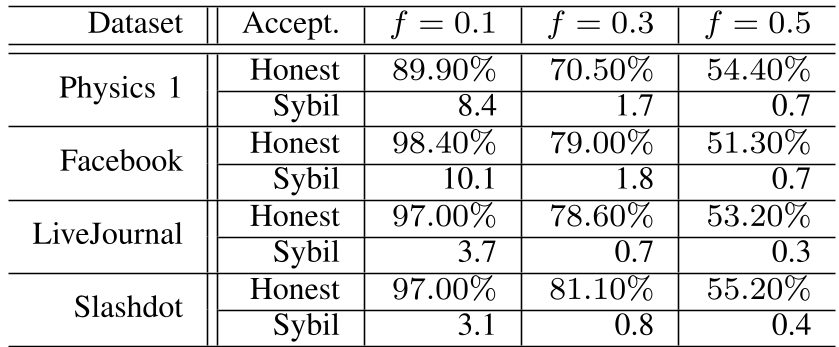 Table 1: Operating GateKeeper on various graphs. Notice high honest acceptance (up to 98.4%) across different topologies.
Critical Analysis & Future Outlook
The paper successfully links Mixing Time (a spectral property) to Coreness (a topological property). This provides a more intuitive way for system designers to "stress-test" their networks before deploying security primitives.
Limitations: The study primarily looks at static snapshots. In reality, social networks are dynamic organisms. As links are added or removed, does the "single core" hold, or does the network's defensive capability collapse during evolution?
Conclusion: If you are building a decentralized communication system or a Sybil-resistant voting platform, look at your k-core distribution. A network with a fragmented core is a network waiting to be compromised.