
Deciphering the Social Architecture of Cancer Care: A Network Science Perspective
Social Networks and Quality of Life: the National Health Interview Survey
This study investigates the impact of egocentric social network properties on the Quality of Life (QOL) of cancer patients using the U.S. National Health Interview Survey (NHIS) 2010 dataset. By extracting relational data from traditional survey variables, the researchers demonstrate that structural metrics like degree centrality, tie strength, and constraint are significantly associated with overall QOL.
TL;DR
Is your social circle a safety net or a reflection of your illness? This research analyzes the 2010 National Health Interview Survey (NHIS) to reveal how the structure of a cancer patient's social network—not just the presence of support—correlates with their Quality of Life (QOL). The study finds that while high-frequency medical ties characterize low QOL, dense family-centric clusters (High Constraint) are clinical indicators of high well-being.
Problem & Motivation
For decades, "social support" has been treated as a monolithic resource. However, from a Network Science perspective, the geometry of these connections (who knows whom, and how often they interact) matters as much as the support itself.
The authors identify a critical gap: most health studies ignore structural, dyadic, and network-level perspectives. Furthermore, massive datasets like the NHIS contain untapped relational gold, but they lack explicit "edge" data. The motivation here was two-fold:
- To prove that network properties (like Centrality and Constraint) impact QOL.
- To provide a methodological blueprint for extracting social graphs from traditional "attribute-only" surveys.
Methodology: From Survey Responses to Social Graphs
The researchers transformed 6,775 individual records into egocentric networks. Using a custom PHP application, they inferred ties based on patient interactions with health professionals, support groups, and family members.
The Theoretical Framework
The study tests six hypotheses across different network levels:
- Actor Level (Degree Centrality): Does having more contacts help?
- Dyadic Level (Tie Strength & Functional Diversity): Does the intensity or variety of peers matter?
- Positional Level (Efficiency & Constraint): Does being a "bridge" (Efficiency) or being "embedded" (Constraint) improve QOL?
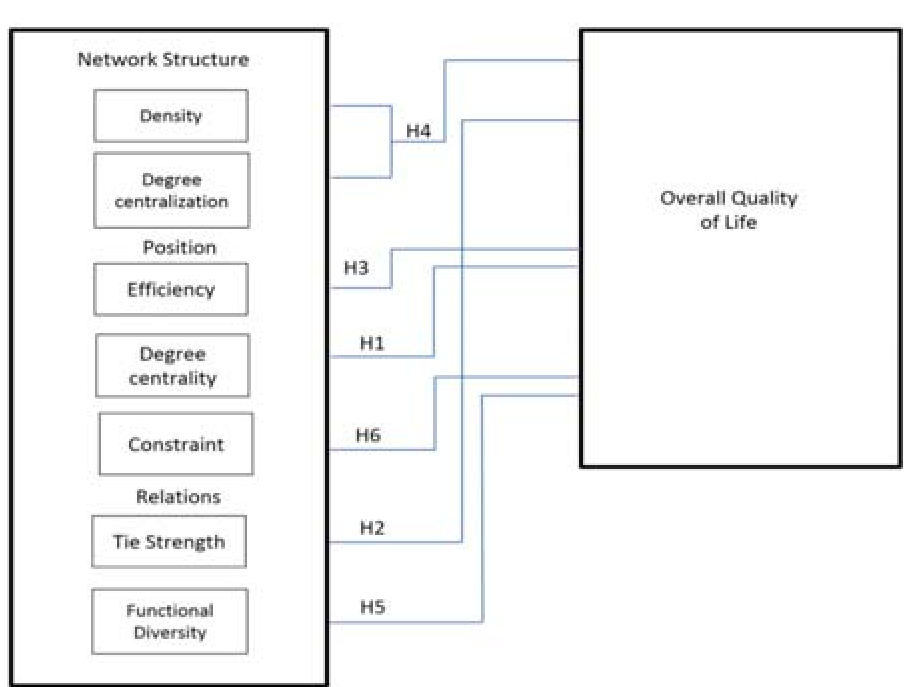 Figure 1: The theoretical model linking network levels to QOL outcomes.
Key Results & Insights
The findings present a fascinating paradox in cancer care:
- The "Dependency" High Degree: Patients with Low QOL actually had higher Degree Centrality and Tie Strength. Why? This isn't necessarily "better" social health; rather, it reflects a heavy reliance on a large number of health professionals and community services due to physical or mental limitations.
- The Power of Constraint: Contrary to business "brokerage" theories (where being a bridge is good), for cancer patients, High Constraint—having a network where contacts are closely connected to one another (typically family)—was significantly associated with High QOL.
- Family vs. Professionals: A higher number of family contacts directly correlated with better QOL, whereas high contact with professional "alters" was a marker for lower QOL.
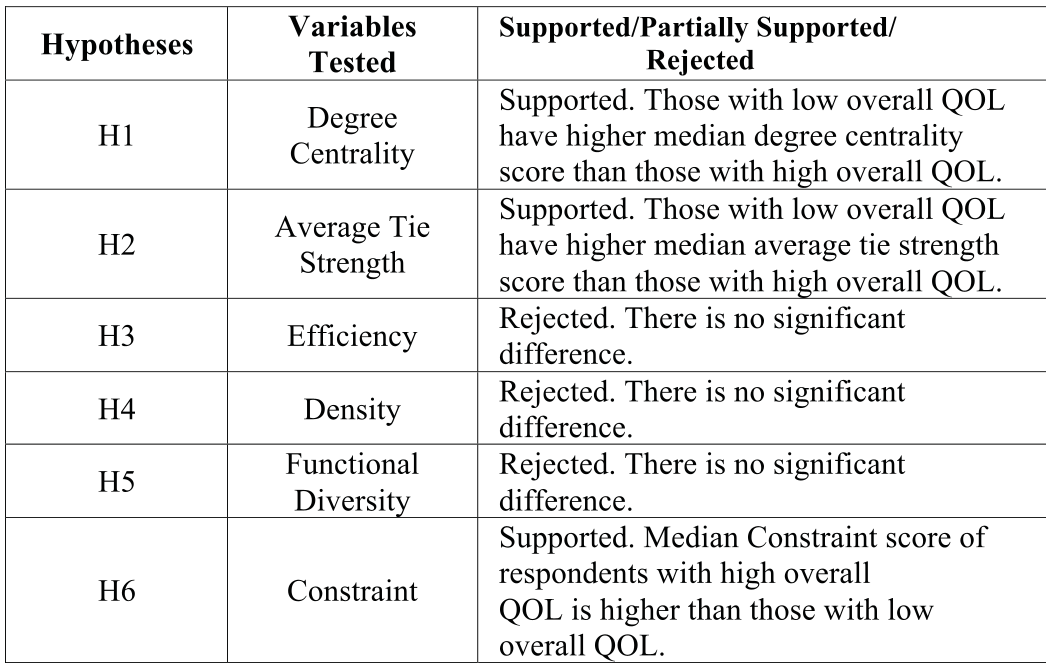 Figure 2: Summary of hypotheses testing showing supported vs. rejected structural metrics.
Critical Analysis & Conclusion
This paper serves as an "exploratory bridge." It successfully demonstrates that Social Network Analysis (SNA) can be retroactively applied to census-level data, which is a major win for computational sociology.
Takeaways for Healthcare Policy:
- Intervention Targeting: Isolated individuals with few family ties are at the highest risk for low QOL and should be prioritized for community-based social interventions.
- Network Calibration: Simply increasing the number of ties isn't the goal; fostering dense, supportive clusters (high constraint) appears more beneficial for emotional stability in chronic illness.
Limitations:
The study is cross-sectional and observational, meaning we cannot definitively say that a high-degree network causes low QOL—it is likely that low QOL forces a patient to expand their medical network. Future longitudinal studies are needed to determine the direction of causality.
In conclusion, the "Quality of Life" is not just an internal psychological state; it is a structural phenomenon embedded in the web of our relationships.