
Social Networks & Deep Learning: A New Frontier in Railway Capacity Prediction
Social Networks and Railway Passenger Capacity: An Empirical Study Based on Text Mining and Deep Learning
This paper presents a hybrid prediction framework for railway passenger capacity that integrates social network text mining with Deep Neural Networks (DNN). By leveraging Sina Weibo data and macro-economic factors, the proposed model achieves a State-of-the-Art (SOTA) prediction accuracy with an average error percentage as low as 0.0326%.
TL;DR
Improving the accuracy of railway passenger capacity prediction is critical for China's transport safety and infrastructure planning. This paper introduces a novel framework that combines text mining of social media (Sina Weibo) with Deep Neural Networks (DNN). By fusing "micro" travel intentions with "macro" economic data, the model achieves a remarkable average error of less than 0.1%, significantly outperforming traditional SVR and shallow neural networks.
Background & Motivation: Beyond Macro-Statistics
Historically, railway forecasting was a game of macro-economics—looking at GDP, population density, and historical throughput. However, these "lagging indicators" fail to capture real-time human behavior. The authors identify a key research gap: while people increasingly share travel plans on social networks, this unstructured data is rarely used in official capacity planning. Furthermore, the high dimensionality of text data makes traditional machine learning models (like SVM) prone to the "curse of dimensionality," necessitating a deep learning approach.
Methodology: The Fusion of Micro and Macro Data
The proposed framework (see Figure 1) operates on a two-stream input logic:
- Macro-Data Stream: Includes GDP, Per Capita Disposable Income (PCDI), and cross-modal transport data (airline/road capacity).
- Micro-Data Stream: Crawls Sina Weibo for keywords (e.g., "train ticket," "high-speed rail"). Using TF-IDF, the importance of these keywords is quantified and transformed into numerical weights.
Architecture Analysis
The core engine is a Deep Neural Network (DNN). Unlike shallow networks, the DNN uses multiple hidden layers and the ReLU (Rectified Linear Unit) activation function to prevent gradient vanishing, allowing the model to learn complex, non-linear relationships between social sentiment and actual passenger volume.
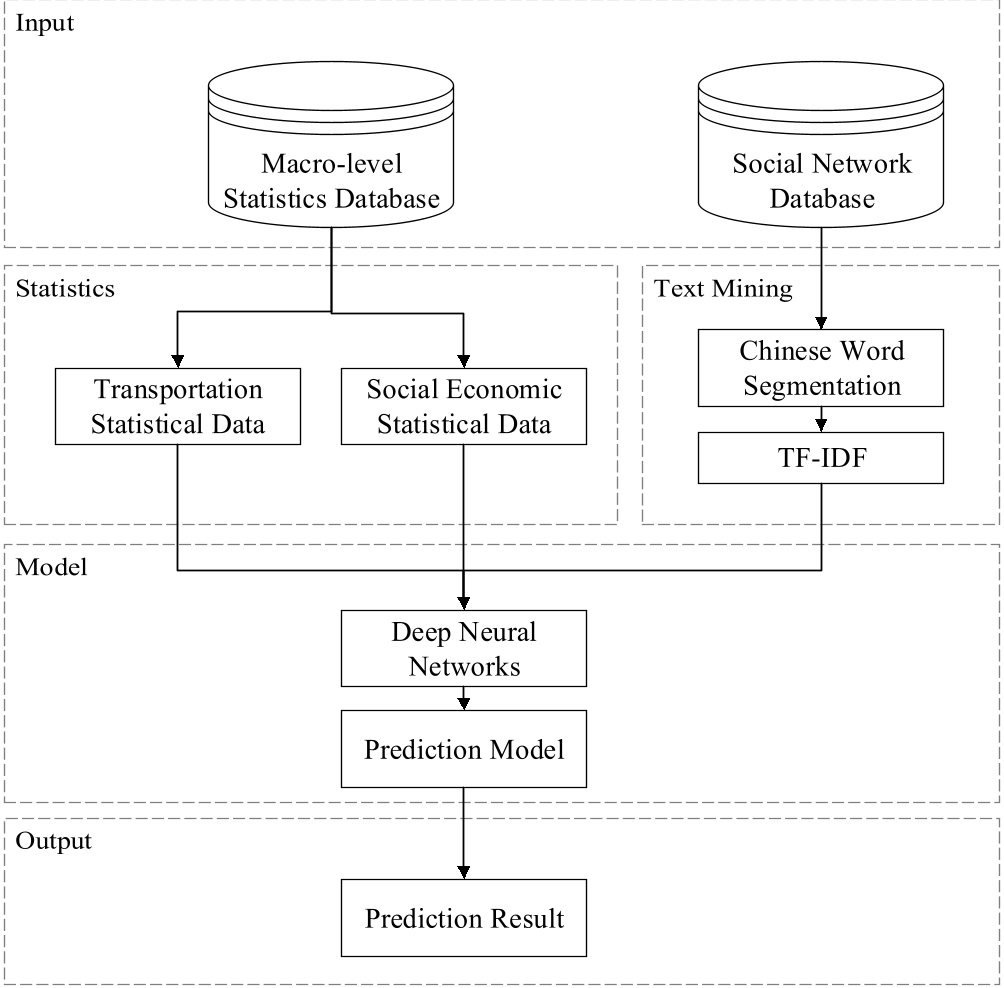 Figure 1: The integration of social network mining and deep learning for capacity prediction.
Experimental Validation
The authors conducted an empirical study using data from 2007 to 2016. Testing on the 2013-2016 period, the DNN model demonstrated exceptional precision.
1. The "Social Data" Advantage
An ablation study was performed to see if social media really helps. The results were definitive:
- Without Social Data: RMSE resulted in 220.86.
- With Social Data: RMSE dropped to 97.73. Integrating public sentiment effectively halved the prediction error.
2. Deep Learning vs. Shallow Models
The paper compares the DNN against Support Vector Regression (SVR) and standard Backpropagation Neural Networks (NN).
| Method | Root Mean Square Error (RMSE) |
|---|---|
| Support Vector Regression (SVR) | 997.66 |
| Neural Network (NN) | 415.77 |
| DNN (Proposed) | 97.73 |
The DNN's ability to abstract high-dimensional data allowed it to outperform SVR by a factor of 10.
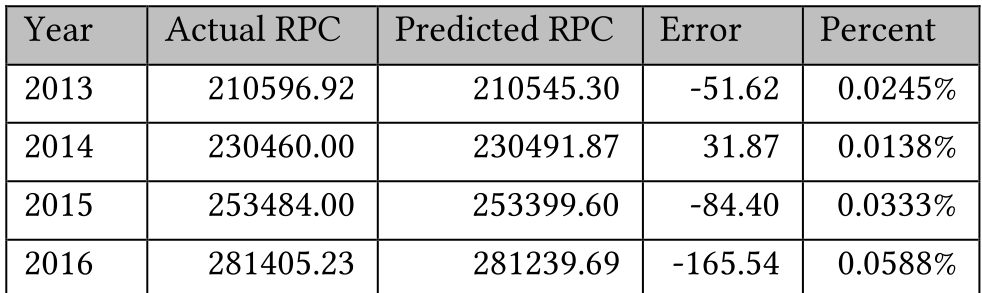 Figure 2: Year-by-year prediction accuracy showing minimal variance from actual RPC.
Critical Insight & Future Outlook
This work represents a shift toward "Social Transportation"—a field where digital footprints become primary sensors for physical infrastructure.
Why does it work? The "physical" capacity of a railway is limited, but "demand" is psychological. By capturing keywords like "Spring Festival tickets" or "High-speed rail travel" via TF-IDF, the model captures the pulse of national mobility before it hits the ticket gates.
Limitations: While TF-IDF is effective, it lacks the contextual understanding of modern Transformers (like BERT or GPT). Future iterations could benefit from Sentiment Analysis to distinguish between someone complaining about a ticket shortage (high demand) versus someone praising a new line (interest, but not necessarily immediate demand). Additionally, exploring Graph Neural Networks (GNNs) could capture the spatial relationships between city nodes in the railway network.
Conclusion
By bridging the gap between social media analytics and deep learning, Chao Wang et al. provide a robust tool for railway administrators. It’s a compelling case study of how "noisy" social data, when filtered through the right deep learning architecture, becomes a high-value signal for national logistics.