
Domain Matters: Why Specialized Social Networks are the Key to Solving OCCF Sparsity
Using Social Networks to Solve Data Sparsity Problem in One-Class Collaborative Filtering
The paper investigates the utility of social networks in solving One-Class Collaborative Filtering (OCCF) data sparsity. It proposes a comparative framework to evaluate how well domain-specific vs. generic social networks resemble the "neighbor graphs" formed by collaborative filtering algorithms.
TL;DR
One-Class Collaborative Filtering (OCCF) is notoriously difficult due to the absence of negative feedback. This paper demonstrates that not all social networks are created equal in helping models bridge this gap. By comparing Del.icio.us social graphs with kNN-generated neighbor graphs, the authors prove that specific, domain-aligned social ties (e.g., fellow Java programmers) are significantly more predictive of user behavior than generic social ties (e.g., general bloggers).
The Missing Counter-Example: Why OCCF is Hard
In a typical recommendation setting (like Netflix ratings), we know what users like (4-5 stars) and dislike (1-2 stars). However, in the realm of implicit feedback—clicks, bookmarks, or views—we only see the "positives." If a user hasn't clicked an item, we don't know if they hate it or simply haven't seen it yet. This is the core of the One-Class Collaborative Filtering (OCCF) problem.
The authors identify a critical gap: while social networks are often cited as a solution for data sparsity, most research treats "friends" as a monolithic group. In reality, a colleague's bookmark is more relevant for a research recommendation than a family member's bookmark.
Methodology: Reverse-Engineering Similarity
To prove their hypothesis, the authors used a clever "reverse path" approach:
- Generate a Neighbor Graph: Run a standard kNN algorithm on the user-item matrix (treating missing data as negative) to find "who should be friends" based on behavior.
- Acquire Social Graphs: Crawl Del.icio.us to find "who are actually friends."
- Measure Alignment: Compare the two using Adjacency Matrix Similarity and Half Life Utility (HLU).
The Mathematics of Comparison
The similarity is defined as the overlap between the Social Network (S) and the Neighbor Graph (N):

Furthermore, the Half Life Utility (HLU) accounts for the rank of the neighbor, acknowledging that a match at the top of the "potential neighbor" list is much more valuable than one at the bottom.
Experimental Evidence: The Power of Specificity
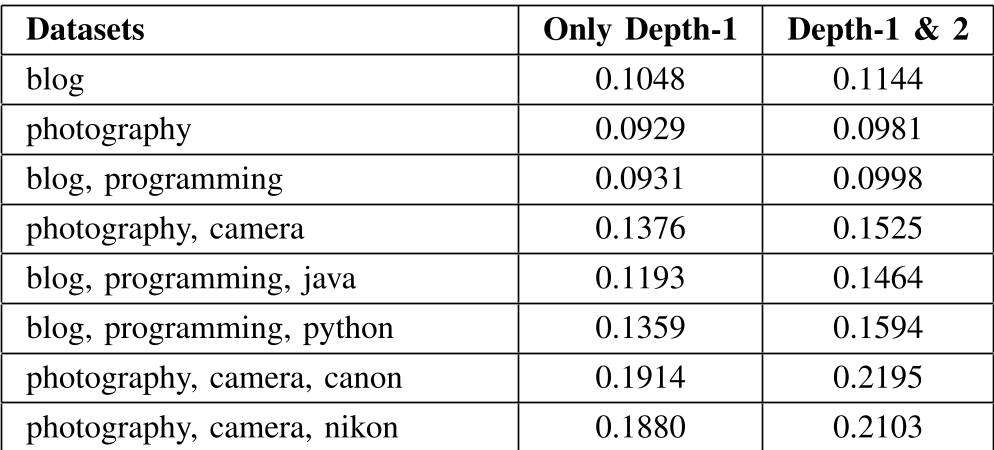
The researchers created eight datasets with increasing levels of tag specificity. For example, moving from "Photography" (Generic) to "Photography + Camera + Canon" (Specific).
Key Results
As the domain becomes more granular, the social network aligns more closely with the collaborative filtering logic.
| Tags Used | User Count | Similarity (Depth-1) |
|---|---|---|
| blog (Generic) | 27,142 | 10.48% |
| blog, programming, python (Specific) | 14,140 | 13.59% |
| photography (Generic) | 31,085 | 9.29% |
| photography, camera, canon (Specific) | 8,478 | 19.14% |
The "Friend-of-a-Friend" Effect
The study also found that including Depth-2 connections (friends of friends) consistently increased the similarity scores. This suggests that transitive trust in specialized communities is a strong indicator of shared interests, providing a useful signal for alleviating the cold-start problem.
Critical Analysis & Conclusion
Takeaway
For developers building recommendation engines: Filter your social signal. Using a raw Facebook friend list might introduce more noise than value. However, using a niche community graph (like LinkedIn skills or GitHub follows) provides a high-fidelity signal that naturally mimics the logic of collaborative filtering.
Limitations
The paper utilizes a simplified kNN approach that treats all missing values as negative—a known bias in OCCF research. While this serves the purpose of comparing graph structures, modern methods like Weighted Matrix Factorization (WMF) or BPR might yield different "Neighbor Graphs."
Future Outlook
The next frontier involves weighting connections. Not all depth-1 connections are equal, and as the authors suggest, finding the mathematical "sweet spot" where depth-2 and depth-3 connections provide signal without drowning out direct ties will be crucial for the next generation of social-aware recommenders.