
Social Network Spam Detection: Beyond Content via Graph Topology and Interaction Sequences
Social Networks Spam Detection Using Graph-Based Features Analysis and Sequence of Interactions Between Users
This paper presents a dual-model approach for spam detection in social networks using the Tagged.com dataset. It proposes a structural Graph-Based Analysis model and a Dynamic Sequence of Interactions model (Bi-LSTM/Bi-GRU) to identify malicious users based on multi-relational interactions, achieving a peak accuracy of 94.2% with Random Forest.
TL;DR
As social networks evolve into complex ecosystems, spammers have become adept at evading simple text filters. This paper shifts the battlefield from what is said to how users connect and interact. By representing social data as multi-relational graphs and temporal sequences, the researchers achieved a 94.2% accuracy in identifying spammers, proving that structural "behavioral fingerprints" are far harder for bots to fake than message content.
Background & Motivation: The Failure of Content Filtering
Most of us are familiar with "Content-based filtering"—if a message contains "Win a Prize" or "Click here," it gets flagged. However, modern spammers are sophisticated; they use obfuscation and natural language variation to slip through.
The authors argue that while content can be hidden, behavior is much harder to mask. A spammer’s structural position in a network (who they follow and who follows them back) and their sequence of interactions (sending 100 "likes" in 10 seconds) deviate significantly from human patterns. The core insight here is to treat the social network as a Multi-Relational Graph, where types of interactions (Likes, Friends, Messages) are separate layers of evidence.
Methodology: The Two-Pronged Attack
The paper proposes two distinct representation models to analyze the Tagged.com dataset (consisting of 5 million users and nearly 1 billion relations).
1. The Structural Approach (Graph-Based Features)
Instead of looking at the users in isolation, this model extracts features that describe the "neighborhood" of a user. These include:
- Demographics: Age, gender, and joining time.
- Centrality Measures: PageRank (node importance) and k-Core (network resilience).
- General Connectivity: The shortest path between users and the number of common vertices.
2. The Temporal Approach (Sequential Interaction)
Interaction is a two-way street. The authors model user relationships as a chronological sequence of actions and reactions . To process this, they employ Bidirectional Deep Learning (LSTM/GRU).
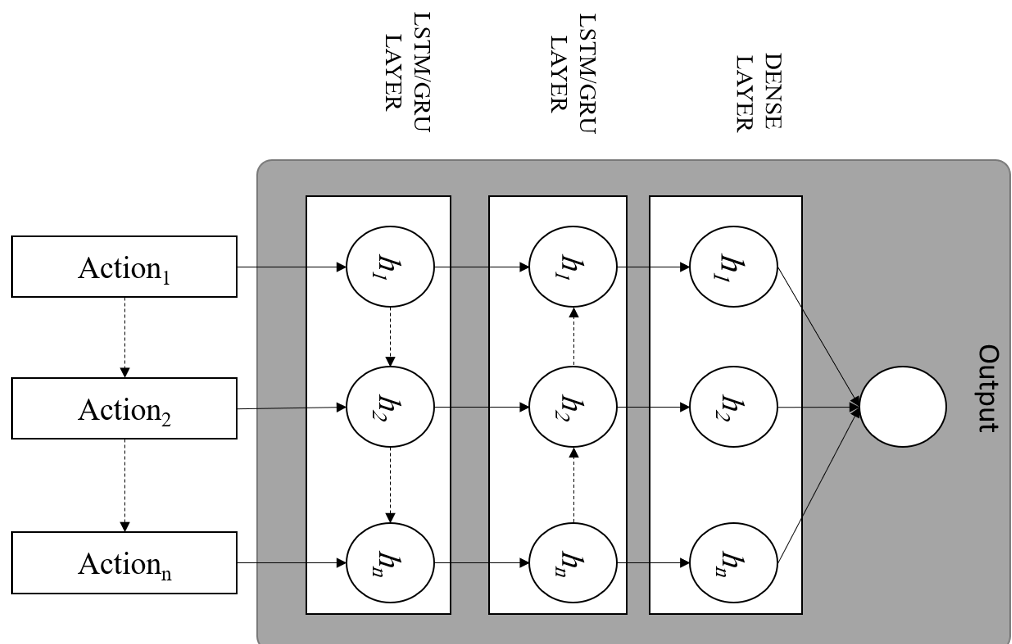 Fig 1. The Bidirectional RNN architecture used to capture contextual information from both ends of an interaction sequence.
The bidirectionality allows the model to "look into the future" of a sequence to understand the context of an earlier action—crucial for identifying bot-like automated patterns.
Experiments and Results
The researchers tested traditional Machine Learning (SVM, Decision Trees, Random Forest) against Deep Learning (LSTM, GRU).
Quantitative Performance
The structural features proved to be the "MVPs" of the study:
- Random Forest took the lead with an Accuracy of 94.2%.
- Bi-LSTM followed with a respectable 91.0%.
Interestingly, SVM struggled with a lower recall (51.3%), indicating it missed many spammers, whereas the tree-based models (Random Forest/Decision Tree) were much better at capturing the non-linear thresholds of malicious behavior.
 Table 1. Comparison of different classifiers using graph-based features.
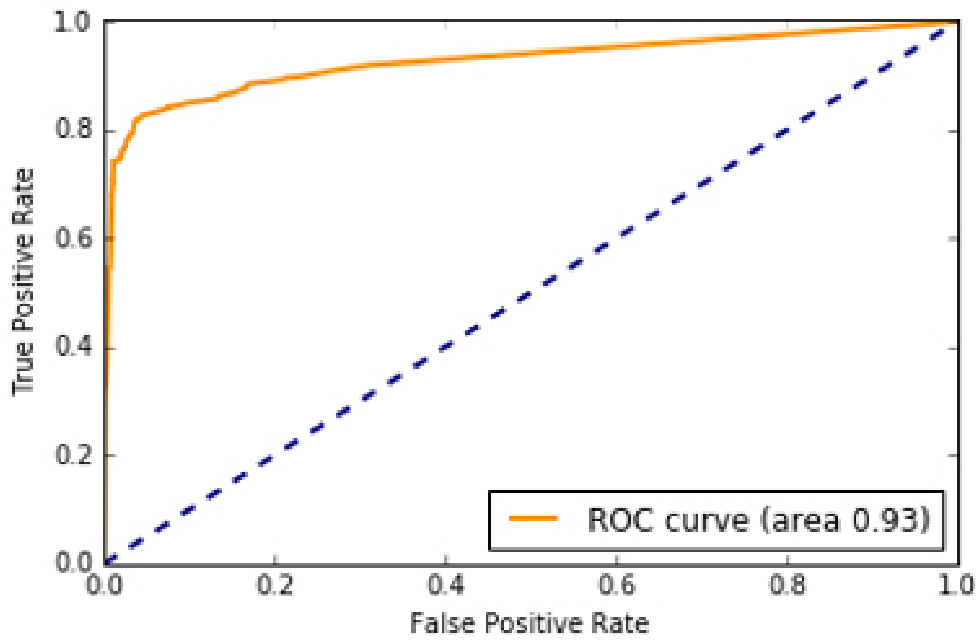 Fig 2. ROC curve for the Random Forest model, demonstrating high AUC and robust classification stability.
Critical Insights & Takeaways
Why is Graph-based analysis superior? Sequence models (RNNs) are powerful but computationally expensive and sensitive to "windowing." In this study, the authors limited sequences to the first 100 interactions. Graph features like PageRank and k-Core, however, effectively "summarize" the user's entire history and global position in the network, providing a more stable signal for the classifier.
The "Majority Vote" Insight: The paper introduces a critical logic step: we don't just classify a user; we classify their relations. If the majority of a user's relationships are flagged as "abnormal" by the model, the user is labeled a spammer. This collective classification reduces false positives caused by a single weird interaction.
Conclusion
This work underscores a shifting paradigm in cybersecurity: context is king. While content analysis remains useful, the structural and sequential "meta-data" of human interaction provides a more resilient defense against the next generation of social bots. Future work could likely improve these results even further by using Graph Convolutional Networks (GCNs) to learn these features automatically rather than manual extraction.