
Social Networks: Why Rumors Travel Faster Than Logic (and Logarithms)
Social Networks Spread Rumors in Sublogarithmic Time
This paper investigates randomized rumor spreading in social networks modeled as Preferential Attachment (PA) graphs. It demonstrates that while a standard "push-pull" strategy informs all nodes in Θ(log n) rounds, a slightly modified protocol with 1-round memory—avoiding the same neighbor contacted in the previous round—achieves sublogarithmic time of Θ(log n / log log n).
TL;DR
Information in social networks spreads at "warp speed," often faster than standard mathematical models predict. This paper proves that on Preferential Attachment (PA) graphs—the standard model for social networks—a simple "push-pull" rumor protocol with a 1-round memory can inform the entire network in sublogarithmic time (). This exactly matches the graph's diameter, effectively hitting the theoretical speed limit for information propagation.
Background: The Power of Social Connectivity
We have all seen news break on Twitter (now X) faster than any news agency can report it. From an algorithmic perspective, this is a "rumor spreading" problem. Traditional models like the "push" strategy (where an informed node tells a random neighbor) are surprisingly slow on social network graphs. In fact, on PA graphs, "push" alone can take polynomial time. To fix this, researchers use the Push-Pull Strategy: in every round, nodes either share what they know or ask their neighbors for new info.
The Problem: The Log-Square Gap
Previous studies suggested that push-pull on PA graphs takes rounds. However, the diameter of these graphs—the maximum shortest path between any two nodes—is only . This "gap" suggested that our understanding of rumor dynamics was inefficient. Why should it take so many more rounds than the actual distance between nodes?
Methodology: The Secret is in the Memory
The authors introduce a tiny tweak: Memory. In the "Push-pull strategy with memory (M=1)," a node avoids contacting the neighbor it just talked to in the previous round.
The Intuition of "Fast" Nodes
The core insight is that low-degree nodes are the unsung heroes of fast propagation. In a PA graph, most nodes have constant degrees. If such a node can avoid "double-contacting" the same person, it acts as a perfect relay.
The proof structure is as follows:
- Reach a Useful Node: The rumor spreads from an arbitrary start to a high-degree "useful" node in rounds.
- The Backbone Path: There exists a path from high-degree nodes to the "core" of the network (node 1) where every second node is "fast"—effectively relaying the rumor in constant time.
- Symmetry: Using a symmetry argument, the authors show that if a rumor reaches the center quickly, it can spread back out to the periphery just as fast.
 Note: The Preferential Attachment model dictates that new nodes attach to existing ones based on degree, creating the "rich-get-richer" power-law structure observed above.
Experiments & Empirical Evidence
The authors didn't just stop at math; they simulated networks with up to 67 million nodes ().
The results were striking:
- Classic Push-Pull (M=0): Followed a linear trend on a log scale, confirming .
- Memory Push-Pull (M=1): Showed a clear downward curve, confirming the sublogarithmic bound.
- Diminishing Returns: Interestingly, adding more memory () provided almost no additional benefit. is the "sweet spot."
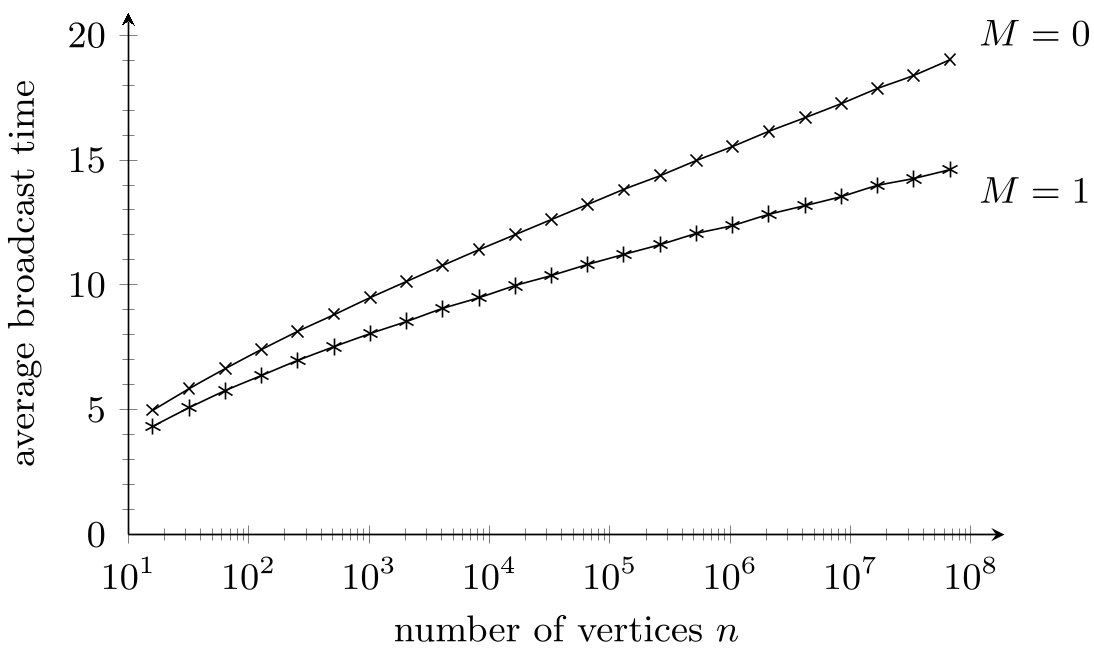 Figure 1: The empirical comparison shows M=1 (sublogarithmic) significantly outperforming the standard M=0 (logarithmic) strategy as the network size grows.
Deep Insight: Why This Matters
The fundamental takeaway is that redundancy is the enemy of speed. By simply ensuring we don't talk to the same person twice in a row, we allow the "small-world" nature of social networks to be fully exploited by the algorithm.
Limitations
While the PA model is a great approximation, real social networks have "communities" and "triangles" (friends of friends). The paper notes that avoiding double-contacts is less effective in graphs with many triangles (like Erdős-Rényi graphs), but in the hierarchical, power-law world of preferential attachment, it is a game-changer.
Conclusion
This work provides the first proof of sublogarithmic broadcast time in a natural setting. It tells us that the "viral" nature of social media isn't just about the influencers at the center; it's about the efficient way even the smallest nodes in the network pass information when they avoid talking in circles.