
Smart Monitoring: Optimizing Social Network Crawlers with Poisson Processes and Ontologies
Topic Crawler for Social Networks Monitoring
This paper presents a high-performance focused crawler designed for social network monitoring, leveraging the MapReduce model and Apache Hadoop for distributed processing. It introduces a specialized knowledge-base classifier for identifying drug-related content and employs a non-homogeneous Poisson process to optimize blog update detection, achieving a significant boost in data freshness.
TL;DR
To monitor social networks effectively, you can't just crawl "whenever." This paper introduces a distributed, focused crawler that uses MapReduce to handle big data, an ontology-based classifier to detect drug-related content without supervised training, and a non-homogeneous Poisson process to predict exactly when a blogger is likely to post. The result? A 25% improvement in catching new content.
Background: The Social Network Monitoring Challenge
Monitoring social networks like Livejournal or X (formerly Twitter) isn't just about volume; it's about latency. In critical scenarios—like monitoring drug propagation or emergency responses—catching a post 5 minutes after it's published is vastly superior to catching it 5 hours later.
However, two major roadblocks exist:
- Quota Limits: Social networks restrict the number of requests you can make.
- Irregular Activity: Some users post daily, others weekly; some post only at night, others during lunch breaks. A "one-size-fits-all" uniform crawling frequency wastes your quota on inactive periods and misses spikes in activity.
Methodology: Intelligence via Ontology and Probability
1. The Focused Classifier (Domain Expertise)
Instead of relying on a black-box neural network that requires thousands of labeled examples, the authors built an ontology-based knowledge database.
- Architecture: It captures official drug names (e.g., Heroin) and slang (e.g., "snow").
- Weighted Logic: Phrases are given higher weights than individual words. If a post's total weight exceeds a threshold, it’s flagged. This allows the system to be deployed immediately in new, niche domains where no training data exists.
2. Modeling the "When" (Non-Homogeneous Poisson Process)
The core innovation lies in how the crawler schedules its visits. The authors model blog updates as a Poisson process.
- Homogeneous: Used to estimate how many times a day a blog should be visited based on its average frequency.
- Non-Homogeneous: Used to determine at what time those visits should happen. By analyzing the "post pattern" (a 24-hour intensity vector), the crawler concentrates its efforts during the specific hours a user is historically active.
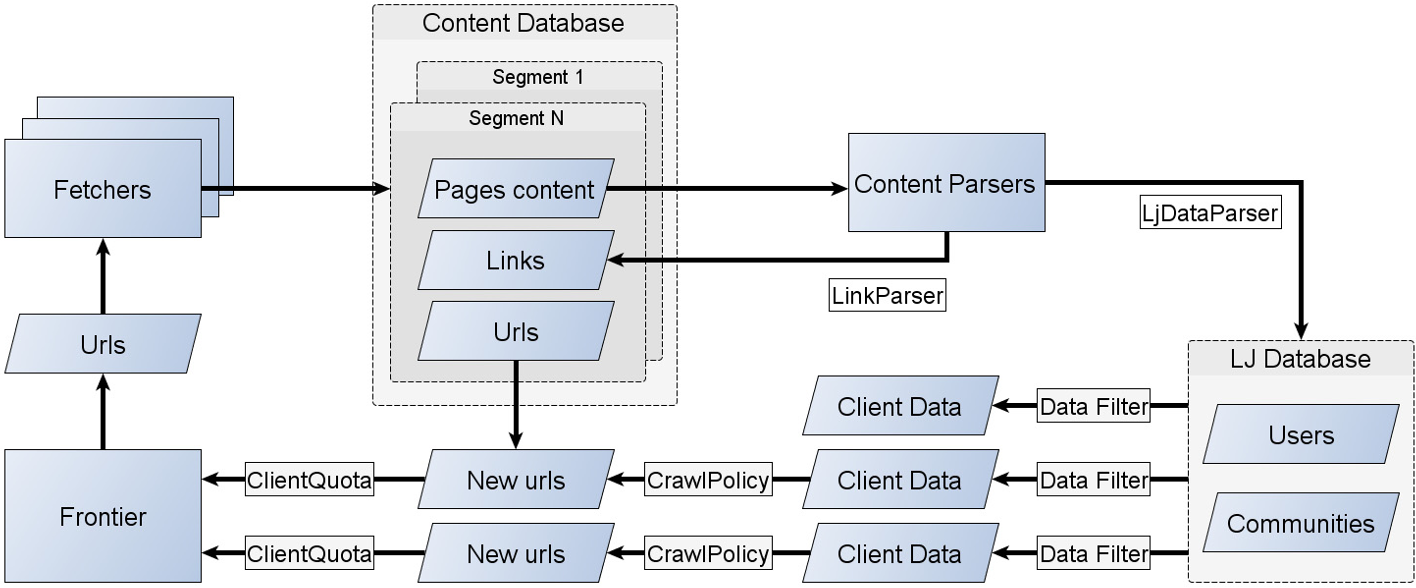 The distributed architecture utilizes Hadoop and MapReduce to separate the frontier (priority queue) from the fetchers (the boots on the ground).
Experimental Insights
The researchers tested their policies on the Russian segment of Livejournal, analyzing millions of posts.
Key Findings:
- The Time-of-Day Win: Using a "post-pattern" (scheduling based on hour-of-day intensity) alone reduced retrieval delay by 30% compared to uniform intervals.
- The Synergistic Effect: When the system combined update frequency estimation with time-of-day modeling (the "Rate-Day" policy), it achieved a total performance gain of 25% in detecting new posts compared to standard crawling strategies.
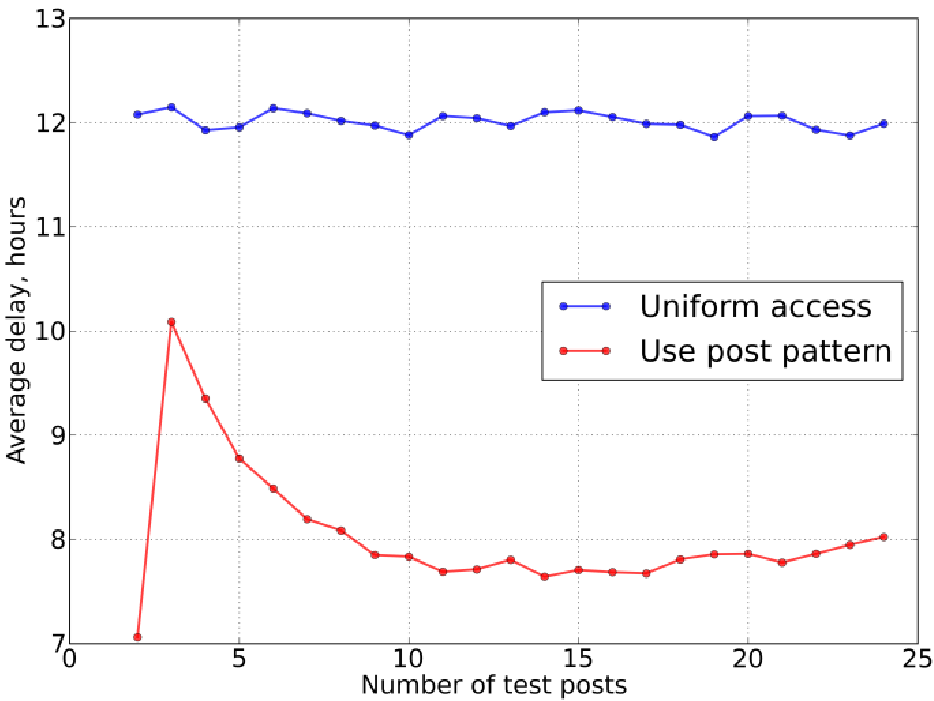 Fig. 6 shows that the 'Rate-Day' policy consistently maintains the lowest average delay as retrieval quotas increase.
Critical Analysis & Conclusion
Takeaway
The paper proves that probabilistic modeling of human behavior is the most effective way to optimize restricted resources (crawling quotas). By treating the social network as a dynamic system governed by Poisson intensity, the crawler moves from a blind "brute-force" approach to an "intelligent-sniping" strategy.
Limitations
- Independence Assumption: The model assumes blogs update independently. In reality, "viral" events cause cascades where one post triggers many others (reposts/quotes). Future work could integrate Hawkes Processes to account for these self-exciting clusters.
- Bot Noise: While the authors filtered bots (posts within <5 minutes), sophisticated bots that mimic human patterns might still skew the Poisson intensity estimates.
Future Outlook
This methodology isn't limited to drug monitoring. Any domain requiring real-time situational awareness—from financial market sentiment to tracking pandemic outbreaks—can use this "Rate-Day" Poisson strategy to maximize the freshness of their data pipeline.