
Social Networks and the "Gun-Jumping" Phenomenon: Why We Hire Too Early
Social networks and unraveling in labor markets
This paper presents a theoretical model of entry-level labor markets where social networks mediate "early hiring" (unraveling) before full information on worker quality is revealed. The author characterizes how network topology—specifically span, density, and degree distribution—triggers or prevents market unraveling, demonstrating that an efficient matching procedure (e.g., centralized clearinghouses) can mitigate this phenomenon.
TL;DR
In elite labor markets—think federal judicial clerks or medical interns—firms often "jump the gun," hiring candidates years before they graduate. Itay P. Fainmesser’s research reveals that this "unraveling" isn't just about competition; it's driven by the social networks that allow for the flow of "soft" information. The paper proves that the structure of these networks—how connected your mentors are—dictates whether a market remains stable or collapses into a local, early-hiring frenzy.
The "Local" Nature of Early Hiring
Economists have long observed that early hiring is curiously local. If you're hired two years before graduation, it’s likely because your professor knows the judge. Fainmesser identifies a critical dual-information structure:
- Stage -1 (Early): Only "Soft Information" (impressions, noisy signals) exists. It can only be traded via trusted connections (networks).
- Stage 0 (Graduation): "Hard Information" (final grades, degrees) becomes public and verifiable to everyone.
The "unraveling" happens because firms with connections use them to "scoop" high-quality workers early, fearing that if they wait until the market is public, they'll be left with a diluted pool of candidates.
Methodology: The Bipartite Network Model
Fainmesser models the market as a two-sided (bipartite) graph .

The core of the paper uses a mean-field approximation for large networks. A key insight is the derivation of the equilibrium hiring level , defined by the fixed point of a mapping function: This function calculates the probability that a worker receives at least one acceptable early offer based on the degree distribution () of the network.
Counter-Intuitive Insights on Network Density
One of the most striking findings is the Non-monotonic effect of density.
- Sparse Networks: Adding links increases unraveling because more firms gain the ability to hire early.
- Dense Networks: Surprisingly, making the network even denser can reduce unraveling.
Why? In a very dense network, the lack of coordination means multiple firms might make offers to the same "star" student. This "mis-coordination" acts as a friction that makes early hiring less reliable for firms, pushing them back toward the graduated, public market.
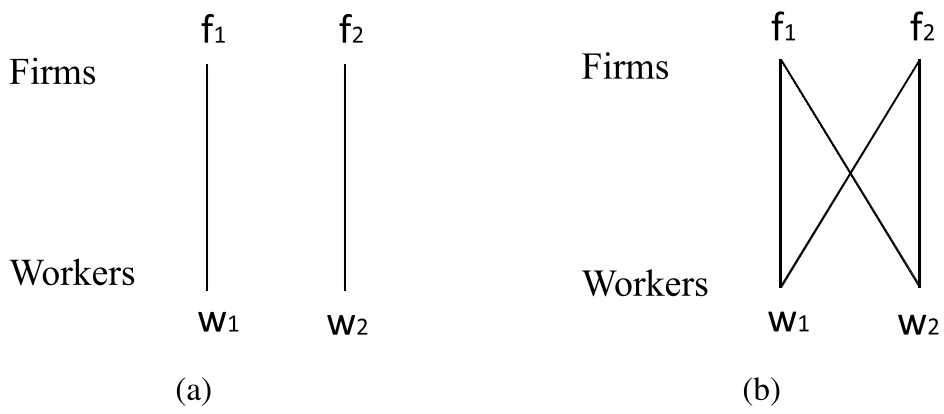 Figure 2: Demonstrating how skewed degrees (centralized "star" workers) can actually lower aggregate early hiring efficiency through offer duplication.
The Role of Market Design
Can we stop the "rat race"? The paper offers a parameter representing the efficiency of the matching procedure.
- Decentralized markets often have lower , increasing the "insurance" value of an early offer for workers.
- Centralized clearinghouses (like the NRMP for doctors) push toward 1.
The result is clear: If the "official" market at graduation is highly efficient and fair (strictly stable), the incentive for both students and firms to engage in the risky, early "soft information" market evaporates.
Critical Analysis & Takeaways
Fainmesser’s work shifts the conversation from "hiring dates" to "informational infrastructure."
Limitations: The model assumes "exploding offers" are a given. In reality, legal shifts or "market culture" (as seen in some elite MBA programs) can penalize firms for this behavior, which this model doesn't fully internalize as a dynamic variable.
Future Outlook: For HR tech and professional platforms, the takeaway is profound. To prevent market fragmentation and "nepotistic" early hiring, the solution isn't just more data—it's building high-efficiency, centralized matching tools that reduce the "fear of missing out" (FOMO) that drives unraveling.