
Social-Aware D2D: Beyond SINR to Human-Centric Wireless Networks
Exploring social networks for optimized user association in wireless small cell networks with device-to-device communications
This paper proposes a social-aware user association framework for wireless small cell networks with Device-to-Device (D2D) capabilities. By modeling the problem as a "matching game with externalities," the authors leverage social metrics (centrality and similarity) to select "important UEs" that act as relay nodes, significantly boosting network throughput.
TL;DR
Current cellular networks are blind to the "who" and "why" of data traffic. This paper introduces a Socially-Aware User Association scheme that uses social network metrics—like how "central" a person is in a social graph—to optimize how devices connect to Small Cell Base Stations (SCBS) or each other via D2D. By treating the problem as a Matching Game with Externalities, it achieves up to a 63% boost in user data rates.
The Problem: The Physical Layer Blind Spot
Historically, your phone connects to the "strongest" signal (Max-RSSI). While this makes sense in a vacuum, it ignores two modern realities:
- D2D Potential: If two people in the same area are accessing the same social content, one could act as a hub for the other.
- Interference Dynamics: In dense small cells, one user's association choice changes the interference environment for everyone else—a phenomenon known in game theory as externalities.
Traditional algorithms fail here because they are "socially unaware," treating every user as an isolated data point rather than a node in a connected social web.
Methodology: Quantifying "Importance"
The authors' core insight is that social popularity indoors mirrors data demand. They use three primary metrics to identify "Important UEs" (nodes that will act as D2D servers):
- Edge Betweenness Centrality: Identifying users who sit on the shortest paths of information flow.
- Similarity Matrix: Measuring common neighbors between users to predict data dissemination efficiency.
- Social Distance: A composite metric () that blends these social insights.
Architecture and Game Theory
The system is modeled as a matching game between User Equipments (UEs) and Serving Nodes (SNs). Unlike standard stable matching (like the Gale-Shapley algorithm), this game includes externalities: your utility depends on who others are matched with because of physical interference.
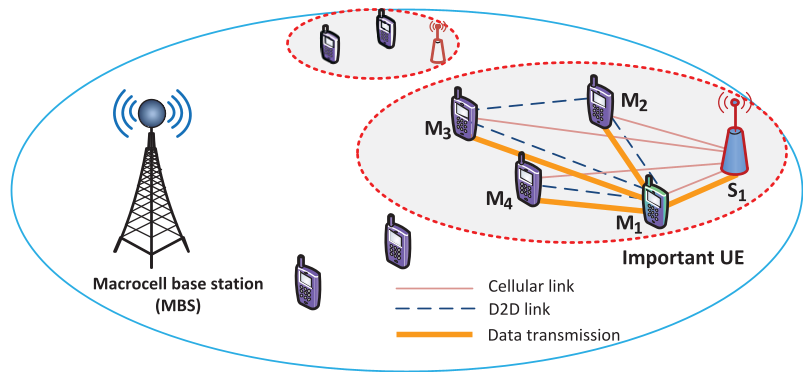 Figure 1: The deployment scenario where UEs choose between SCBS and socially important D2D peers.
To solve this complexity, the authors propose a Distributed Swap-Matching Algorithm based on Markov Chain Monte Carlo (MCMC) methods. Users "swap" their connections only if it improves the overall "Social Welfare"—the sum of all utilities in the network.
Experimental Results: The Social Dividend
The performance gains are most visible as the network density increases.
- Throughput Gains: As shown in the results, the social-aware approach consistently outperforms the max-RSSI baseline. When the number of small cells , the data rate gain reaches a staggering 63%.
- The "Crowd" Effect: As the number of UEs increases (Fig 4), the gap between the proposed method and the baseline widens, proving that social awareness is a powerful tool for managing congestion in dense urban areas.
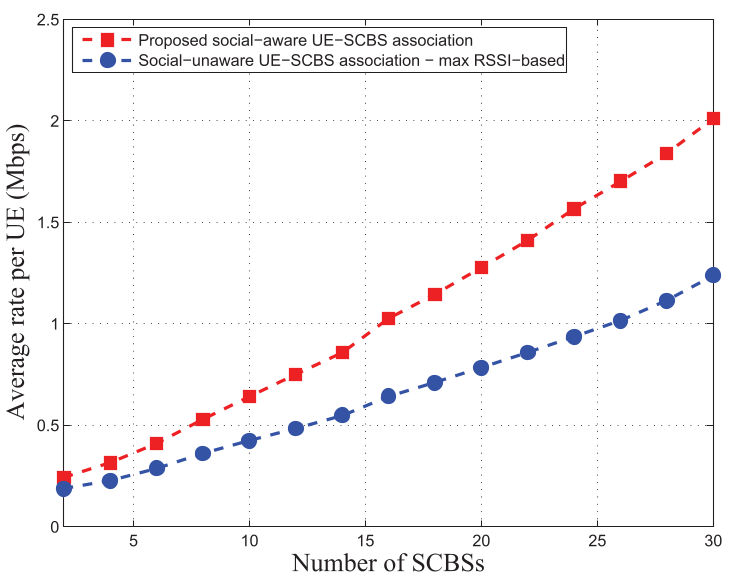 Figure 2: Average rate per UE vs Number of SCBS. The gap represents the "Social Gain".
Complexity and Convergence
A critical question for any distributed algorithm is: does it stop? The authors demonstrate that while the number of iterations peaks around 1400 for 150 users, the algorithm effectively converges to a stable state where no more beneficial "swaps" are possible.
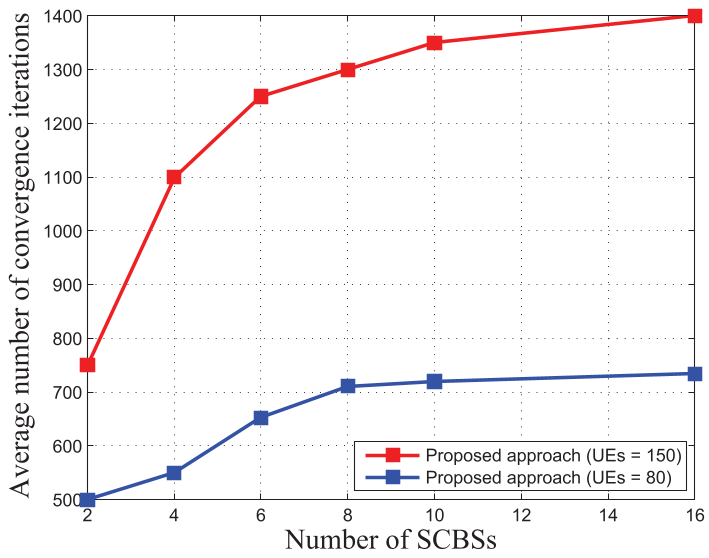 Figure 3: Iterations required for convergence across different network scales.
Critical Analysis & Conclusion
Takeaway: This work proves that physical layer optimization has reached a point of diminishing returns, and the next frontier is Context-Awareness. By understanding the social fabric, we can design networks that offload traffic more naturally than any "dumb" signal-strength algorithm could.
Limitations: The model assumes that "socially important" users are willing to share their bandwidth/battery (incentive mechanisms are mentioned but not fully explored). Furthermore, the 2026 perspective might require looking at privacy—sharing social graphs with base stations is a significant privacy "cost" that needs to be addressed via Federated Learning or similar techniques in future iterations.
Future Outlook: The integration of power control and multi-hop D2D links under this social framework could push these gains even further, making ultra-dense 6G networks feasible.