
The Facebook Dilemma: Why Social Utility Trump Privacy Fears
Social networks: the role of users' privacy concerns
2012-12-03
Summary
Problem
Method
Results
Takeaways
Abstract
This research investigates the psychological tension between privacy concerns and perceived benefits on Facebook. Using a Structural Equation Model (SEM) with formative indicators, it validates why users continue to disclose information despite significant privacy risks, identifying that "Perceived Usefulness" is the primary driver of adoption.
## TL;DR
Despite the constant headlines about data breaches and surveillance, social media usage continues to grow. This paper explores the **Privacy Paradox**—the gap between what users say about privacy and what they actually do. Through a rigorous structural analysis, the authors prove that the "Perceived Usefulness" of social connection effectively "crowds out" privacy fears in the user's mind.
## The Motivation: Why Do We Share So Much?
The core of the problem lies in a dichotomy of human needs: the need for **privacy** versus the need for **public self-presentation**. Historically, researchers struggled to explain why users ignore privacy policies they claim to value. The authors of this study set out to provide a mathematical framework (using Structural Equation Modeling) to weigh these competing forces.
## Methodology: Measuring the Intangible
The study moves beyond simple surveys by using **formative indicators**. Unlike reflective indicators (where all questions represent the same underlying concept), formative indicators treat each question as a unique "cause" of the construct.
### The Research Model
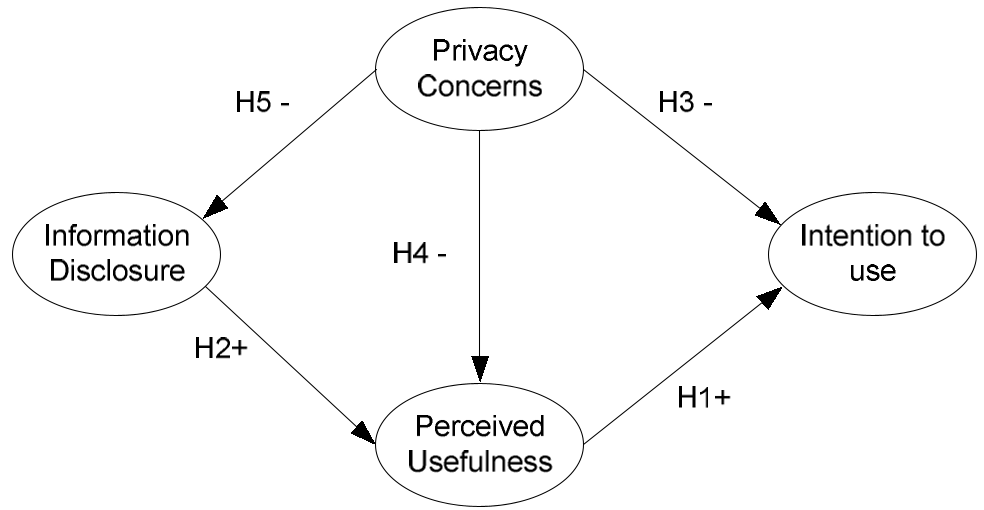
The researchers analyzed four primary variables:
1. **Intention to Use (IU)**: The final goal—will the user stay on the platform?
2. **Perceived Usefulness (PU)**: What value does the user get?
3. **Information Disclosure (ID)**: How much data is the user dumping?
4. **Privacy Concerns (PC)**: What are the perceived risks?
## Key Insights: The Weight of Social Capital
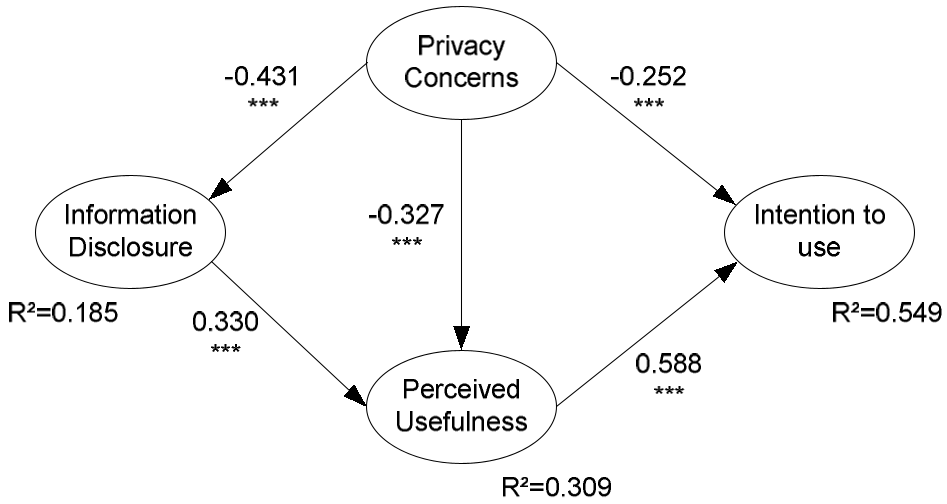
The data from 1,628 participants revealed a clear hierarchy of motivations:
* **Social Connection is King**: The strongest driver for using Facebook was the ability to support personal relationships over distances (PU1). Interestingly, "saving money" or "contacting many people at once" were not significant drivers.
* **The Optimistic Bias**: Users suffer from an "it won't happen to me" syndrome. When asked about specific risks—like government monitoring or data abuse—the results were statistically non-significant. Users feel that as long as they *know* how to use privacy settings (even if they don't use them effectively), they are safe.
* **The Power of Disclosure**: Users found the platform *more useful* when their friends had detailed profiles (ID2). This creates a recursive loop: to get value from others' data, you feel pressured to provide your own.
## Critical Analysis & SOTA Position
In the context of 2012, this was a landmark study that utilized **SmartPLS** to model behavioral intentions. Compared to earlier qualitative works, this paper provided the weights needed to prove that **utility (β=0.709) carries significantly more psychological weight than risk (β=-0.530).**
### Limitations
* **Homogeneous Sample**: The study focused on a younger, well-educated demographic (typical for Facebook in 2012), which might not reflect older or less tech-savvy populations.
* **Self-Reporting**: The study relies on user perception, which can be swayed by "Social Desirability Bias."
## Conclusion: Lessons for the Future
The industry takeaway is sobering for privacy advocates: users are willing to trade their digital souls for social convenience. As we move into an era of Generative AI and even deeper data integration, the "Perceived Usefulness" of these tools will likely continue to outweigh the inherent privacy risks unless the utility is fundamentally compromised.
### Takeaway for Researchers
If you want to understand technology adoption, don't just look at what people fear; look at what they can't live without. The social "hedonic" value of a platform is its strongest defense against privacy-related churn.