
Distorting the Digital Mirror: Privacy via Social Query Forwarding
Using social networks to distort users’ profiles generated by web search engines
The paper introduces a privacy-preserving scheme that uses social networks to distort user profiles generated by Web Search Engines (WSE). By forwarding queries through a decentralized social network, the system ensures the WSE receives a noisy profile, achieving a level of privacy comparable to k-anonymity without centralized proxies or high-latency anonymous channels.
TL;DR
Web Search Engines (WSE) know too much about us. While personalized search is convenient, it builds a dangerously accurate profile of our lives. This paper proposes a decentralized solution: Social Network Distorting. Instead of sending your queries directly to Google, you pass them through a network of "friends." The result? The WSE sees a "distorted" profile that mixes your interests with those of your social circle, making it impossible to pin down your true identity while maintaining search relevance.
The Privacy Paradox in Web Search
Modern search engines provide high-quality results by disambiguating terms (e.g., knowing if "Mercury" means the planet or the element) based on your history. However, this history is a privacy time bomb. Past attempts to solve this have failed on two fronts:
- Efficiency: Systems like Tor or PIR are agonizingly slow.
- Robustness: Simple "fake query" generators (like TrackMeNot) are easy for WSEs to filter out using timing analysis or "work hour" patterns.
The authors' insight is simple: Hide in the crowd you already trust. By using a social network, we can ensure that the "noise" added to our profile isn't random junk, but legitimate queries from similar people.
Methodology: How Social Distorting Works
The protocol operates on a decentralized social network (DSN) where users act as relays.
1. The Decision Engine (Function W)
A user doesn't just forward everything. The system uses a function W to estimate how "exposed" the user is. If you've sent too many of your own queries lately, the system forces you to forward the next one to a neighbor.
2. Guarding Against the "Free Riders"
In any P2P system, "selfish users" are a threat—they use others to hide their queries but refuse to help in return. The paper introduces a Selfishness Evaluation Function ().
- If you accept a query, your neighbors trust you more.
- If you reject, they stop helping you. Eventually, selfish users are isolated and forced to submit queries directly, losing their privacy.

3. The Liability Mechanism
To prevent users from sending illegal content through their friends' IP addresses, every transaction is digitally signed. This creates a "chain of evidence." If the police come knocking on your door for a query you relayed, you can provide a cryptographic certificate proving the query originated from someone else.
Experiments: Does it Actually Scale?
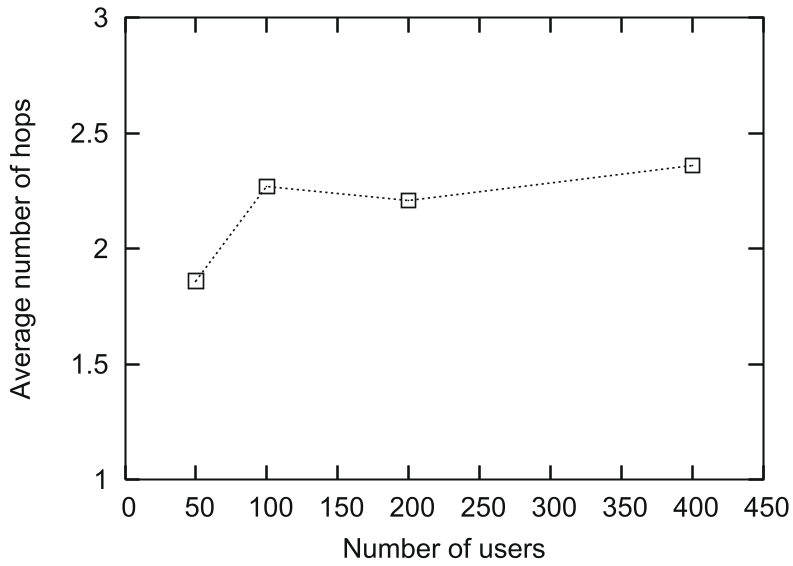
The authors simulated networks of up to 400 users using power-law distributions to mimic real-world social connectivity.
Key Performance Findings:
- Latency: The average query takes 3.9 seconds. While slower than a direct search (0.4s), it is twice as fast as the next best academic solution (UUP) and nearly 3x faster than Tor-based plugins.
- Privacy Success: Users with 5 or more neighbors remained almost entirely unprofiable by the WSE.
- Scalability: The number of "hops" required to hide a query (avg. 2.4) stays constant even as the network grows, meaning the system won't slow down as it gets more popular.
Critical Insights & Future Outlook
The beauty of this approach is its Inductive Bias: it assumes friends share interests. This means the WSE's "distorted" profile still provides somewhat relevant results because your friends are likely interested in similar topics.
Limitations:
- Bootstrap Problem: You need real-life friends to invite you to the network.
- Storage: Users must store evidence of relayed queries for up to 2 years to satisfy legal requirements, though the authors demonstrate this only requires ~335 KB.
Conclusion: This research proves that decentralized, social-based privacy isn't just a theoretical dream—it's a high-performance alternative to the "all-seeing eye" of centralized search engines.
Senior Editor's Note: While this paper was written in the late 2000s, its principles of decentralized trust and profile distortion remain highly relevant in the age of LLMs and personalized AI agents.