
XSS Worms in Social Networks: Modeling the Viral Spread of Malicious Scripts
Social Networks' XSS Worms
This paper investigates the propagation of Cross-Site Scripting (XSS) worms within social networks (e.g., MySpace). It proposes an enhanced epidemic model that accounts for user behavior—specifically the probability of visiting friends' profiles—and validates this model through discrete-event simulations on a power-law graph.
TL;DR
XSS worms are unique threats that combine legacy virus self-replication with modern web vulnerabilities. This paper analyzes how the specific behavior of social network users—specifically our tendency to visit friends' profiles—drastically alters the mathematical trajectory of an infection, shifting it from a simple exponential curve to a more complex, "dampened" propagation model.
Background: The Rise of the Web-Based Pathogen
The landscape of cybersecurity changed significantly with the arrival of the Samy Worm on MySpace. Unlike conventional worms that flood network routers (e.g., Code Red), XSS worms use the web server as a central distribution hub. Infection occurs in the browser, making the attack platform-independent and highly efficient.
The paper identifies that while XSS is a well-known vulnerability, its combination with AJAX (allowing background HTTP requests) creates a silent, high-speed propagation vector where a single profile visit can turn a victim into a carrier.
The Friction of Friendship: Problem & Motivation
Standard epidemiological models assume that any "infectious" host can contact any "susceptible" host with equal probability. However, social networks are Power-Law Graphs where individuals primarily interact with a small circle of friends.
The authors' key insight is that the Friend visiting probability (q) acts as a stabilizer. If users only visit their friends, an infection stays trapped within a small group (a clique) for a longer period. To reach the rest of the network, the worm must "jump" through users who occasionally visit non-friends or have extremely high degree counts (influencers).
Methodology: Refining the Epidemic Model
The authors start with the classic Kermack-McKendrick model:
Recognizing its limitations, they introduce a modified version where the infection speed is no longer a constant:
Architecture of the Simulation
To validate this, they built a virtual network of 15,000 members using the Barabási–Albert model to ensure a realistic power-law degree distribution (where a few users have many friends, and many have few).
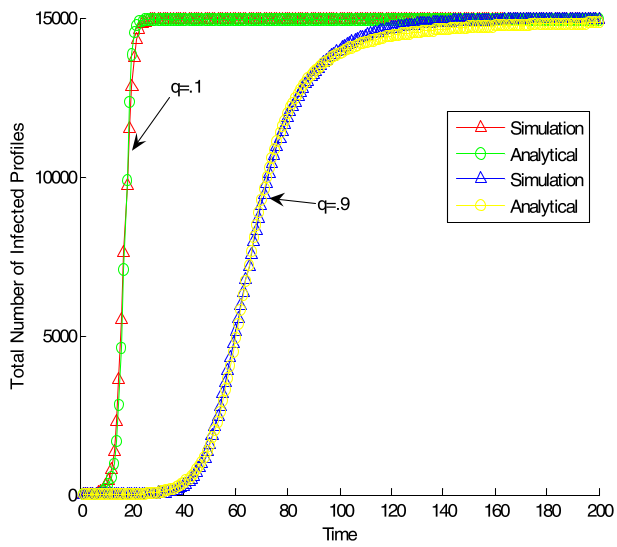 Figure: The power-law distribution used in the simulation, mimicking MySpace's real-world connectivity.
Experiments & Results: The "Damping" Effect
The core finding of the simulation is that as q (the probability of visiting a friend) increases, the infection curve shifts to the right and loses its steepness.
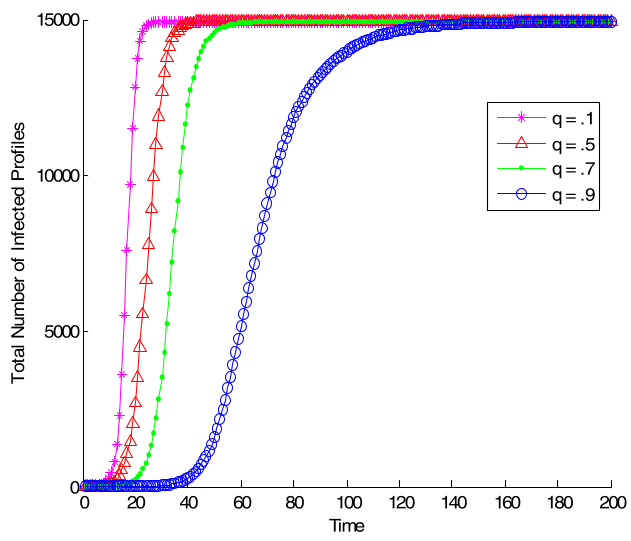 Figure: Results showing how higher "q" values (friend-loyalty) slow down the total infection count over time.
Key Insights from the Data:
- Delayed Exponential Growth: There is a "slow start" phase (often several hundred minutes) where the worm is localized. This is the golden hour for security teams to detect and patch the vulnerability.
- Analytical Convergence: The authors successfully derived a mathematical function for and that matches the simulation, allowing future researchers to predict worm speed if they know a network's average user behavior.
Conclusion and Future Outlook
This research highlights that human behavior is a variable in network security. The "cliquishness" of social networks, while often seen as a social limitation, actually provides a structural defense against the instantaneous global spread of XSS worms.
Limitations: The model currently ignores "social cliques" (groups that interact even more densely than friends) and the potential for "re-infection" or users leaving the network. Future work will likely explore how multi-platform social sharing (e.g., cross-posting from X to Facebook) creates "bridges" that bypass the damping effect discovered here.
Takeaway for Developers: Filtering untrusted input remains the primary defense, but understanding the topology of your user base can help you design better rate-limiting and anomaly detection systems to catch a worm before it hits the exponential "kink" in the curve.