
Social Opinion Mining: Bridging the Gap Between User Reviews and Complex Decisions
Social opinion mining for supporting buyers’ complex decision making: exploratory user study and algorithm comparison
This paper introduces a holistic framework for social opinion mining to support complex decision-making for inexperienced products. The core contribution is a linear-chain Conditional Random Field (CRF) based algorithm designed to extract fine-grained product entities and opinion polarities, achieving state-of-the-art F-measures (up to 85.7%) compared to traditional HMM-based approaches.
TL;DR
Choosing an expensive digital camera is harder than picking a $10 book. This paper explores how "social content" (reviews and popularity) actually drives our choices. By introducing a Linear-Chain Conditional Random Field (CRF) model, the authors provide a way to turn messy human reviews into structured data, boosting the accuracy of opinion extraction by over 7% compared to previous HMM-based methods.
The "Inexperienced Product" Dilemma
Most recommendation engines (like Amazon's "People also bought...") work great for movies or music. But for "inexperienced products"—expensive, infrequent purchases like cars or high-end cameras—the system has no data on you. You've never bought one before.
The authors discovered that in these high-stakes scenarios, users don't just "filter and buy." They follow a specific three-stage cycle:
- Screening: Narrowing down the noise using popularity.
- Evaluating: Deep-diving into reviews for a few specific models.
- Confirming: Comparing a "wish list" to make a final, confident choice.
The critical insight? Negative reviews matter more than positive ones. Users aren't looking for perfection; they are looking for "deal-breakers" they can live with.
Methodology: From Linguistic Chaos to CRF Logic
The mathematical heart of this paper is the move from Lexical-HMMs (Hidden Markov Models) to CRFs.
Why CRF?
Traditional HMMs assume that words and tags are independent of each other given the hidden state. Real language doesn't work that way. For example, in the phrase "High ISO images are noisy," the word "noisy" is a negative opinion only because it's linked to "ISO" (a feature).
The authors used a Linear-Chain CRF, which is a discriminative model. Instead of trying to model the joint probability of everything, it focuses on the conditional probability —the likelihood of a tag sequence given the words.
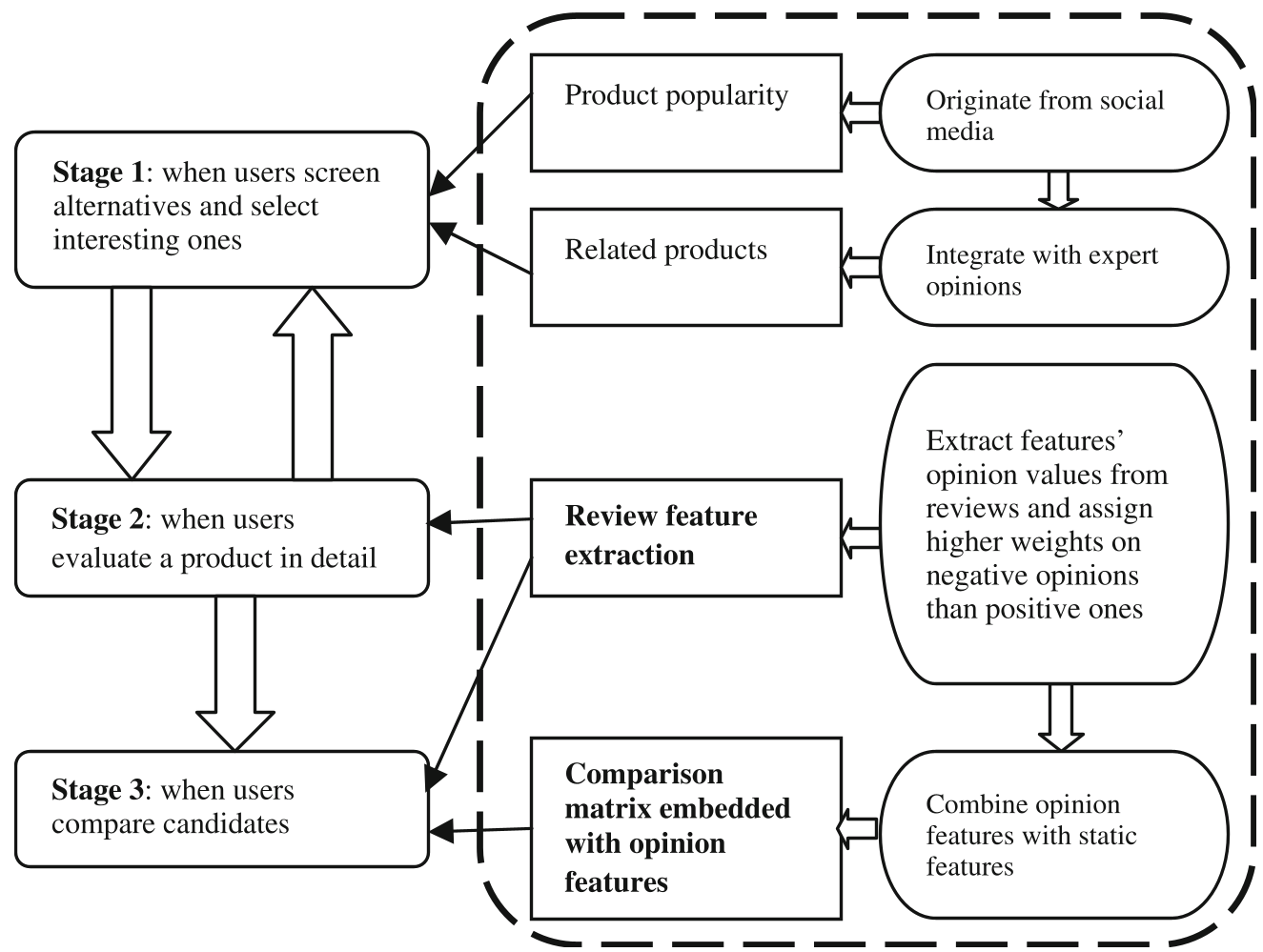 Figure: The refined decision support architecture based on user behavior.
The model uses "Feature Functions" to capture:
- First-order dependencies: Current word + current tag.
- Transition dependencies: How tags switch from "Feature" to "Opinion."
- Overlapping features: Combining POS tags (like adjectives) with specific keywords to find infrequent features.
Experiments & Results: Crushing the Baselines
The researchers tested their CRF model against L-HMMs and standard Rule-based systems using real-world data from Yahoo Shopping and Flickr.
| Metric | L-HMMs (Prior SOTA) | CRF (This Paper) | Improvement |
|---|---|---|---|
| Precision | 83.9% | 90.0% | +6.1% |
| Recall | 72.0% | 79.8% | +7.8% |
| F-Score | 77.1% | 84.3% | +7.2% |
The CRF model significantly outperformed L-HMMs in identifying Functions and Opinions. This is because CRFs can handle "overlapping features"—where a word's meaning depends on its neighbors—much better than the rigid independence assumptions of HMMs.
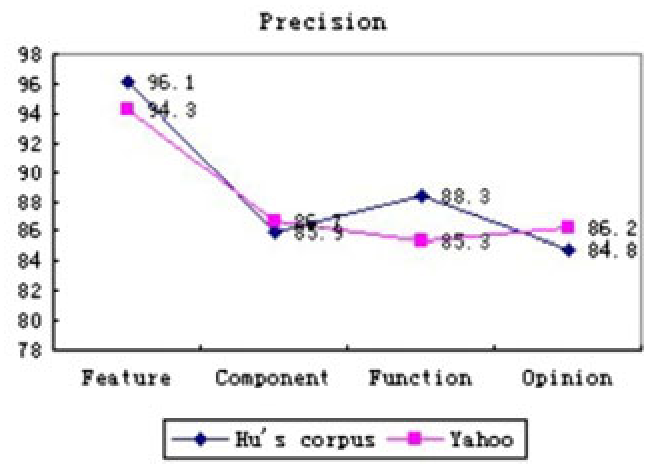 Figure: Consistency of performance across different datasets (Hu & Liu vs. Yahoo).
Deep Insight: Visualizing the Sentiment
The paper doesn't just stop at the math. It proposes two interface "bridges":
- Tag Clouds (Qualitative): Visualizing opinion frequency via font size, helping users "feel" the community consensus.
- Bar Charts (Quantitative): Mapping subjective opinions to a -5 to +5 scale for easy side-by-side comparison.
Critical Analysis & Conclusion
This work was a pioneer in showing that Aspect-Based Sentiment Analysis (ABSA) isn't just an NLP exercise—it's a critical component of e-commerce psychology.
Takeaways for Researchers:
- Linear-chain CRFs remain a robust baseline for sequence labeling even in the age of Transformers, especially when training data is limited.
- Understanding the Stage of a user's journey (Screening vs. Confirming) should change how you rank information.
Limitations: The study was limited to digital cameras and cell phones. Modern applications would need to adapt these feature functions to handle the slang and multi-modal content (like review videos) prevalent in 2024.
The bridge between what people say and what we buy is built on structured opinion mining.