
Social Opportunistic Sensing: Redefining the Human Pulse of Smart Cities
Social opportunistic sensing and social centric networking
This paper introduces Social Opportunistic Sensing (SOS) and Social-Centric Networking (SCN) as foundational pillars for Smart City architectures. It integrates mobile crowdsensing, opportunistic sensing, and context-aware routing to create a human-centered interaction platform within the Internet of Things (IoT).
Executive Summary
TL;DR: This seminal paper by Sigg and Fu argues that while the technical building blocks of Smart Cities (sensors, protocols, mobile devices) are mature, the "social glue" connecting them is missing. They propose two transformative technologies: Social Opportunistic Sensing (SOS) and Social-Centric Networking (SCN). These systems shift the focus from mere data collection to a human-centered ecosystem where context steers the flow of information.
Background Positioning: Published in 2014, this work acts as a visionary bridge between traditional Mobile Ad Hoc Networks (MANETs) and the modern vision of the "Internet of People" (IoP). It addresses the fundamental trade-off between user burden (Participatory Sensing) and privacy (Opportunistic Sensing).
Problem & Motivation: The "Lifeless" Smart City
Most Smart City research treats the urban environment as a collection of nodes—energy grids, transport systems, and manufacturing lines—often ignoring the citizens themselves. Prior works in sensing fell into two traps:
- Participatory Sensing: Requires too much active user attention, leading to "notification fatigue."
- Opportunistic Sensing: Operates in the background but creates a "privacy nightmare" as third-party applications access device sensors without explicit social context or control.
The authors' insight is that context is the missing link. If the network understands why and under what conditions a user is providing information, it can protect privacy and ensure data quality simultaneously.
Methodology: SOS and Decentralized Context Routing
1. Social Opportunistic Sensing (SOS)
The SOS platform operates as a non-hierarchical interaction hub. It leverages Mobile Crowdsourcing but solves the "low-quality reply" problem by using ambient sensors. For example, if a user answers a question while running (detected by accelerometers) or in a noisy environment (detected by microphones), the system can weight their response accuracy accordingly.
2. Social-Centric Networking (SCN)
To avoid a central server being a "single point of failure" and a privacy honeypot, the authors propose SCN. Unlike Content-Centric Networking (CCN) which routes by name, SCN routes by Context Similarity.
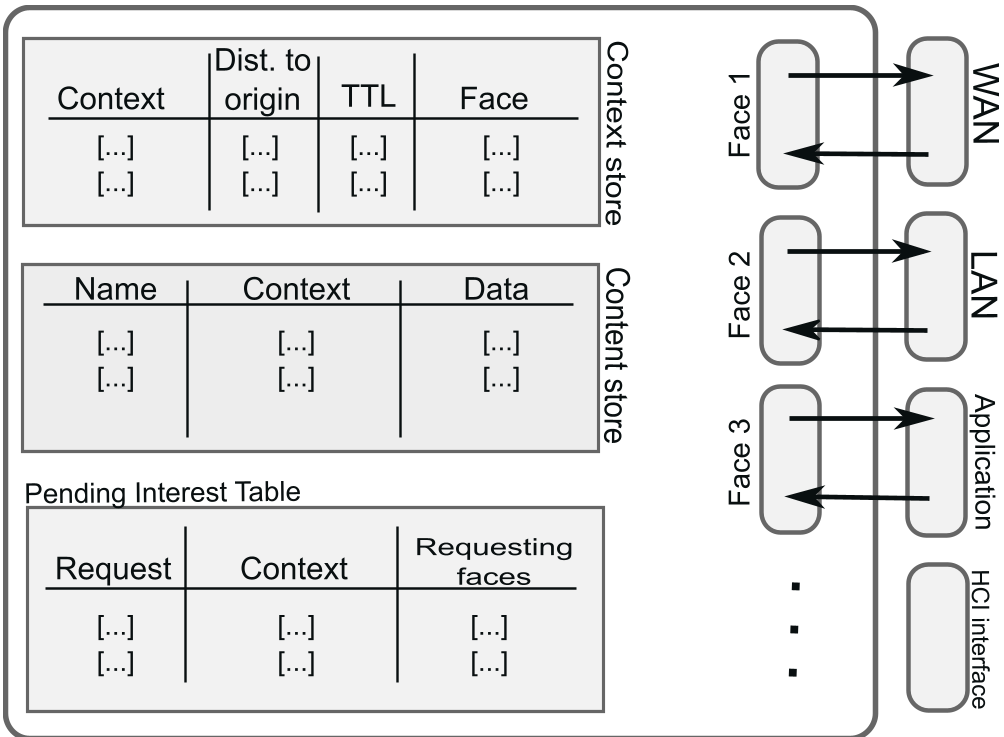
- Context Store: Replaces the traditional Forwarding Information Base. It stores "contextual maps" of neighboring nodes.
- Interest Routing: Queries are forwarded to nodes that exhibit high contextual similarity (e.g., location, activity, or environment) to the query's requirements.
- Probabilistic Forwarding: To ensure the discovery of new paths, the system uses "random routing" where the probability of choosing a path is proportional to context match.
Implementation: The Human-in-the-Loop Concept
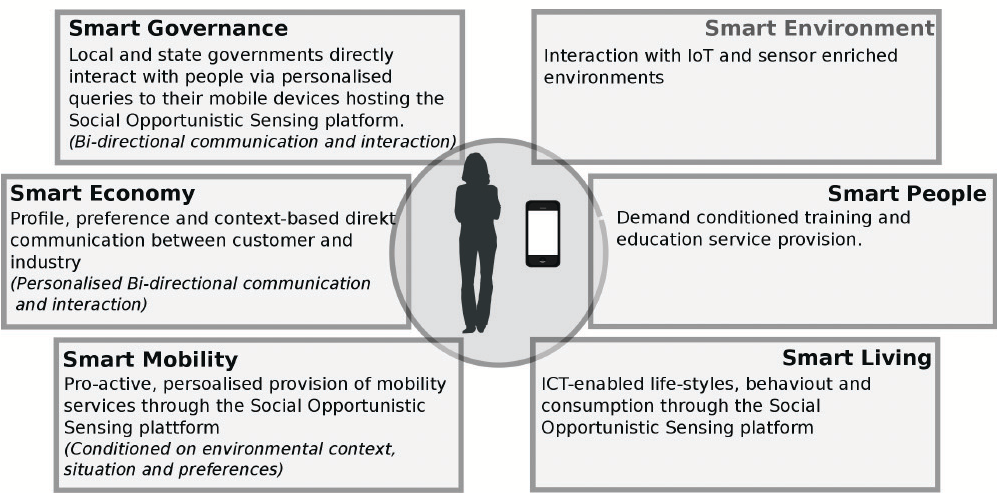
The paper emphasizes that individuals are the "nerve center" of the city. As shown in the SOS interaction diagram, users, government, industry, and the environment are all interconnected via a mobile platform that serves as a bidirectional information hub.
Critical Analysis & Conclusion
Takeaway
The core contribution is the decoupling of "identity" from "utility." By routing based on context rather than user ID, the SCN architecture allows for high-functioning social services without necessitating mass surveillance.
Limitations
While theoretically robust, SCN faces the "Cold Start" problem: a context-based network requires high node density (IoT penetration) to function effectively. Furthermore, the computational overhead of maintaining a dynamic Context Store on low-power IoT devices was a significant challenge at the time of publication.
Future Outlook
This work predates the surge in Edge Computing and Federated Learning, yet it anticipates their goals. Future iterations of this work likely involve using local AI models at the "SCN Nodes" to generate even more sophisticated context representations, paving the way for truly autonomous urban social networks.