
Socially Orchestrated Cloud: Bridging Expertise and Social Ties in P2P Networks
A Social P2P Approach for Personal Knowledge Management in the Cloud
The paper introduces a Social P2P approach for Personal Knowledge Management (PKM) that enables decentralized knowledge sharing in the Cloud. It proposes a specialized routing mechanism called "Smart Questions" (SQ) that leverages social tie strength and personal expertise summaries to locate experts within an overlay network integrated with Facebook.
TL;DR
In an era of centralized AI and Cloud silos, this paper proposes a return to decentralized intelligence. By treating social media contacts as "peers" in a P2P network, the authors develop a system that automatically routes niche questions to the most qualified "expert" in your extended social network, using Tie Strength and Clustered Tag Clouds to ensure both relevance and privacy.
Background: The New Digital Divide
As knowledge becomes increasingly locked within proprietary clouds, a new digital divide emerges—not of access, but of the ability to extract value. The authors argue for a Socially Orchestrated Cloud, where Personal Knowledge Management (PKM) isn't just about storing your own files, but about articulating your "know-how" into a global, yet private, peer-to-peer ecosystem.
The Problem: Why Traditional Search Fails
- Privacy: Users are reluctant to share data with central providers.
- Context-Blindness: Standard search engines don't know who you trust.
- The "Close-Circle" Limitation: We often ask friends for help, but our friends might not be experts. We need a way to reach "friends of friends" safely.
Methodology: The Architecture of a Social Sphere
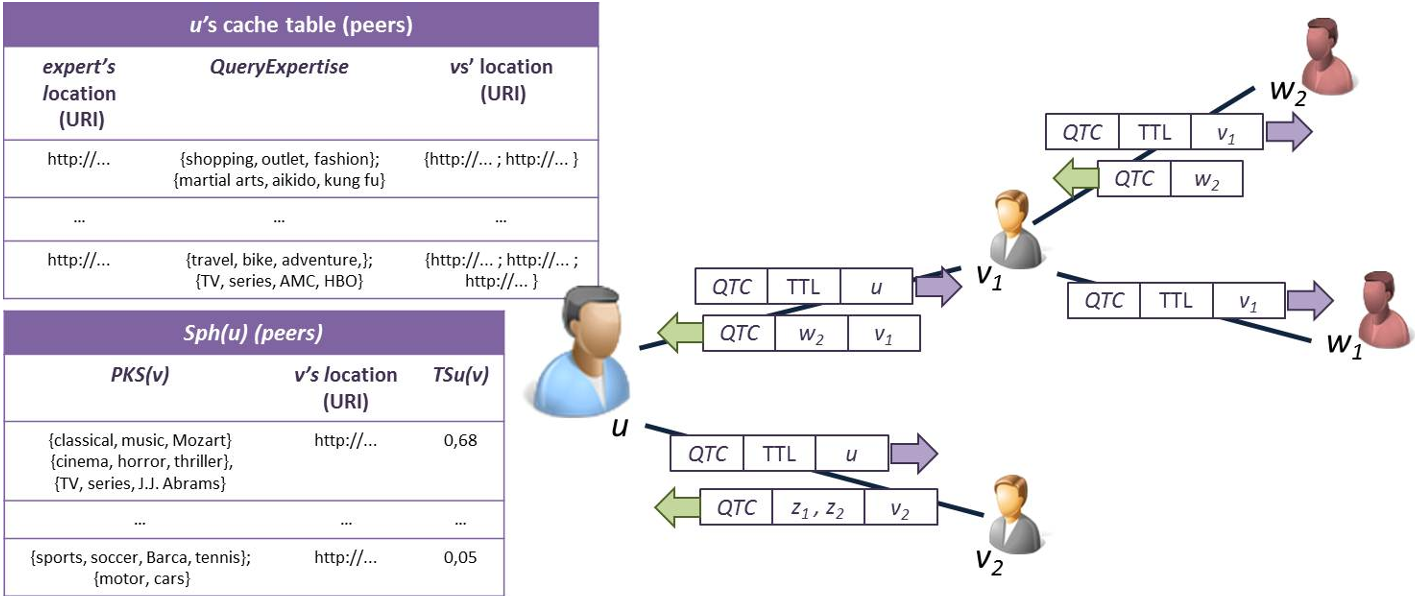
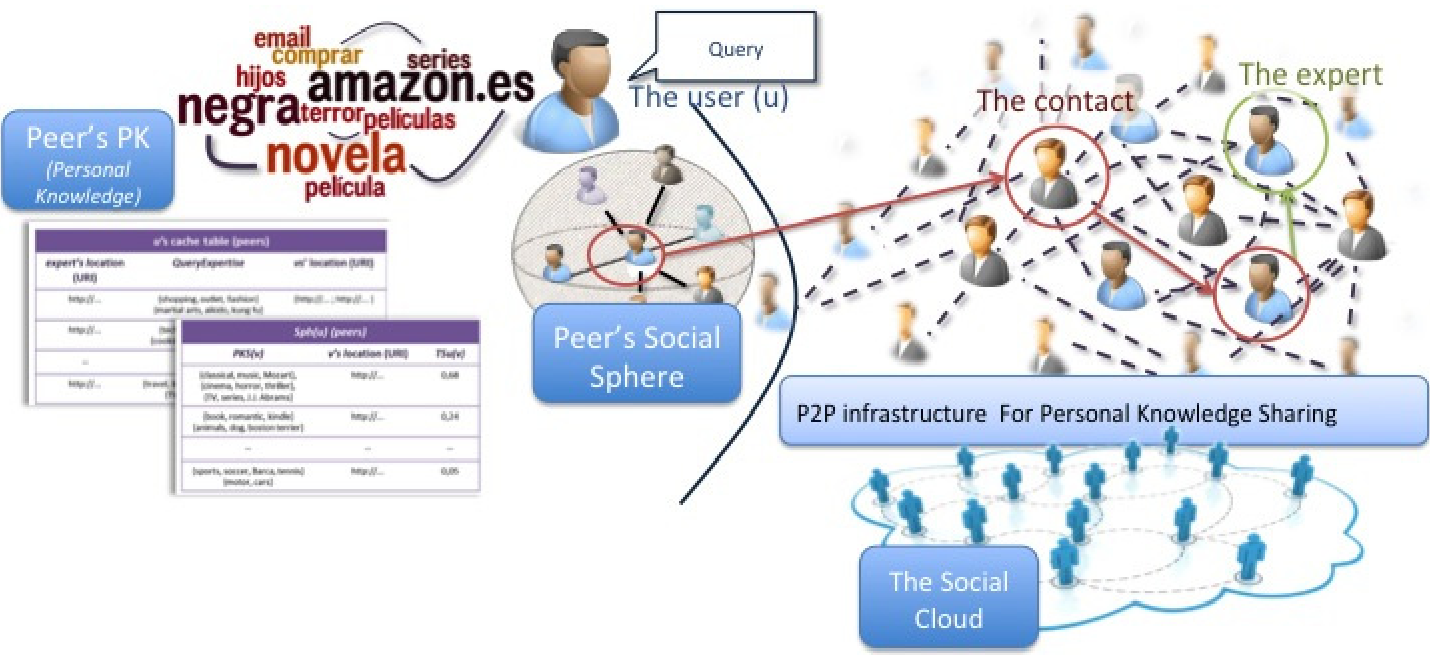
The core of the proposal is the Social Sphere, a 3-tuple representing the user's egocentric view of the network:
- Colleagues (): Peer nodes in the network.
- Tie Strength (): An index (0 to 1) calculating closeness based on direct vs. indirect and public vs. private interactions.
- Personal Knowledge Summary (): A condensed representation of what a user knows, created by clustering their social "tags" using the k-means algorithm.
1. The Expert Discovery Logic
When a user asks a question, it is converted into a Query Tag Cloud (QTC). The system doesn't just broadcast this to everyone. Instead, it uses a Folksonomy-based Similarity () to rank peers.
2. Intelligent Routing
If an expert isn't immediate, the query "hops" through the network using three distinct strategies:
- Knowledge Proximity: Forwarding to those whose is "close" to the query.
- Social Activity: Forwarding to the strongest ties (hub nodes).
- The Power of Weak Ties: Randomly selecting weak connections to jump into new social clusters and avoid "echo chambers."
Experiments & Results: The Facebook SQ App
The authors validated this via "Smart Questions" (SQ), a Facebook app.
- Utility: Users found SQ answers 2x more useful than the baseline Facebook Questions service.
- Precision vs. Recall: SQ yielded fewer responses (1/3 less), but they were higher quality.
- The Trust Gap: A fascinating finding was that students were reluctant to act on advice from experts who were total strangers, even if they were technically qualified.
Critical Insight & Future Outlook
This work highlights a critical truth in PKM: Knowledge is social. However, the study identifies two major hurdles for future decentralized systems:
- Latency: Crowdsourced expert response is slower than AI/Algorithmic search.
- Reputation: Without a "trust score," the reach of P2P networks is limited by the "friend-of-a-friend" boundary.
As we move toward a Web3 or Agentic future, the logic of Social P2P routing—where agents represent our expertise and social circles—remains a powerful blueprint for escaping the gravity of centralized Big Tech.
Takeaway
True collective intelligence requires more than just data; it requires a routing layer that respects the strength of ties and the context of expertise.