
Social-P2P: Bridging the Gap Between Online Trust and P2P Efficiency
Social-P2P: An Online Social Network Based P2P File Sharing System
This paper introduces Social-P2P, a novel file-sharing system that integrates Online Social Networks (OSNs) with P2P architectures. By combining interest-based clustering with social trust ties, it achieves simultaneous high search efficiency and file trustworthiness, outperforming traditional DHT and reputation systems.
TL;DR
Social-P2P is a hybrid file-sharing architecture that solves the dual problem of finding files fast and ensuring those files aren't malicious. By mapping a user's social network (friends and friends-of-friends) onto the P2P overlay, the system uses social accountability to discourage "poisoning" attacks while utilizing multi-interest clustering to maximize search hit rates. It reduces system overhead by nearly 50% compared to systems that run search and trust modules separately.
Background: The Broken Trust in Open P2P
In the era of BitTorrent and Gnutella, users faced two major hurdles: the "needle in a haystack" search problem and the "poisoning" problem where malicious actors upload viruses disguised as popular content. Historically, research solved these separately:
- Efficiency was tackled via Distributed Hash Tables (DHT) or Interest-clustering.
- Trust was tackled via Reputation systems like EigenTrust.
The authors observe that simply stacking these two solutions doubles the maintenance cost and ignores a vital resource: Real-world social pressure.
Methodology: Engineering Social Accountability
The genius of Social-P2P lies in its three-pillar construction guided by Facebook and BitTorrent trace data.
1. The Interest/Trust-based Structure
Instead of simple single-interest clusters, the system uses the Vector Space Model (VSM) to represent a node's complex interests. These vectors are mapped via Hilbert Curves into a 1D space, allowing nodes with similar high-dimensional interest profiles to find each other easily.
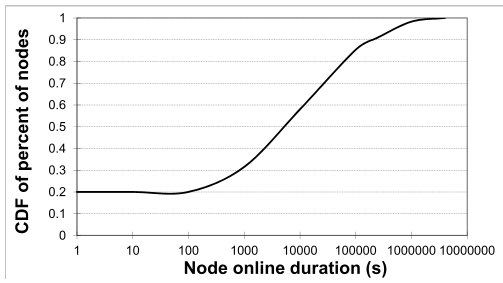 Fig 7: The structural layout showing stable ambassadors in a DHT and local nodes connected via social ties.
2. Trust-Weighted Search (How it works)
Searches are not just random; they are Socially Weighted. A node calculates a trust weight for neighbor based on social distance (Friends vs. Friends-of-Friends).
When a query is launched, it is more likely to be sent to a direct friend than a stranger. Because people generally value their real-world reputation, they are statistically less likely to serve a "Trojan" to a friend.
3. Content-Based Routing Tables (CRT)
To move beyond blind random walks, the "Advanced-CRT" mechanism allows nodes to learn which neighbor successfully delivered a specific file type in the past, creating a "breadcrumb trail" that drastically reduces hop counts for subsequent queries.
Performance: Proving the Social Advantage
The study utilizes a massive dataset (32,000+ Facebook users and 3.5M BitTorrent nodes).
Search Efficacy
The system proves that multi-interest clustering is superior. As shown below, Social-P2P maintains a lower query delay across different network sizes compared to PROSA or PIS architectures, particularly because it doesn't need to rebuild clusters from scratch—it uses the pre-existing social graph.
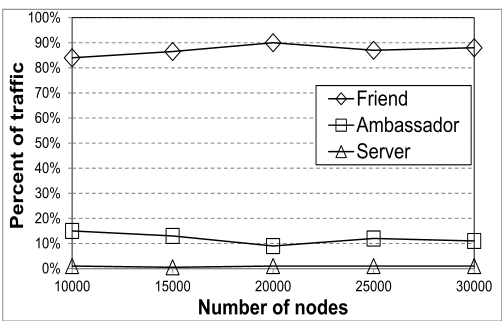 Fig 16: Query delay comparison showing Social-P2P's resilience to network scaling.
The Death of Malicious Collusion
One of the most impressive results is the system's handling of colluding nodes (groups that lie to boost each other's reputation). In Social-P2P, because trust is anchored in social distance, a cluster of malicious colluders can be quickly isolated. Once they serve a bad file, the trust weight drops exponentially along the routing path, physically cutting the malicious "neighborhood" off from the rest of the network.
Critical Insight & Conclusion
Social-P2P proves that decentralized efficiency does not require complex cryptography if you have social topology. By exploiting the "Zipf distribution" of file interest (most people want the same few things) and the "Small World" nature of social networks (anyone is 6 hops away), the authors created a system that is both lean and robust.
Limitations: The system assumes that users are willing to share their social graph with the P2P client. While anonymous routing is discussed, the privacy-utility tradeoff remains a challenge for future iterations.
Future Work: The shift toward Information-Centric Networking (ICN) will likely be the next frontier, where content is retrieved by name rather than location, potentially integrating even more seamlessly with the Interest-based clusters proposed here.